Karnataka approves AI Centre of Excellence in Bengaluru's Electronics City
Bengaluru (PTI): The Karnataka government has approved the establishment of a CoE for AI in Biotechnology at IBAB in Electronics City (Phase 1), here.
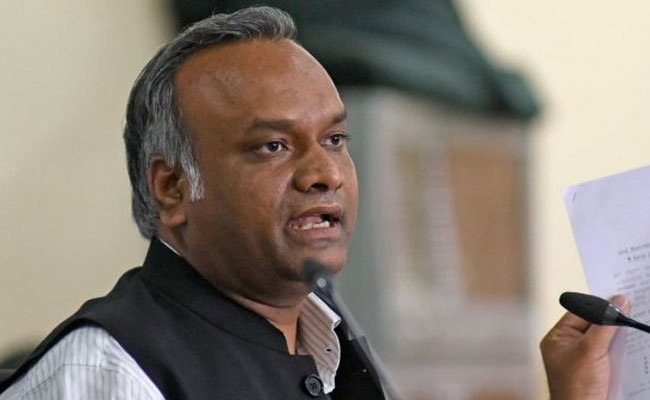
The decision, taken by the state Cabinet on Thursday night, marks a significant step towards strengthening Karnataka’s leadership in emerging technologies, IT and biotechnology, Karnataka Minister Priyank Kharge said on Friday.
The centre will be established over four years with a total outlay of Rs 20 crore, in partnership with the Institute of Bioinformatics and Applied Biotechnology and the Centre for Cellular and Molecular Platforms (C-CAMP), according to a statement from the minister’s office.
"Karnataka has consistently been at the forefront of technological innovation. As we enter the decade of deep tech, our focus is on building future-ready capabilities at the intersection of artificial intelligence and biotechnology," Minister for IT and Biotechnology said.
"This Centre of Excellence will strengthen our research ecosystem, accelerate innovation and enable Karnataka to lead in high-impact next-generation technologies," he added.
Priyank added that the state government, through the Departments of Electronics, IT, Biotechnology, and Science & Technology, is actively investing in emerging technologies and taking steps to strengthen Karnataka’s AI and deep-tech ecosystem.
The minister said the Cabinet has also approved the transfer of a 51 per cent stake in the Karnataka Technology & Innovation Museum Foundation (KTIMF) to the Unboxing BLR Foundation.
KTIMF was established by the Government of Karnataka as a not-for-profit organisation to promote innovation, technological awareness, startup culture and public engagement in science and technology, aligned with the state’s vision of building a robust innovation ecosystem, he said.
The Technology & Innovation Museum will be developed at the NGEF campus in Baiyappanahalli, Bengaluru, under a Public-Private Partnership (PPP) model, with a total project cost of Rs 100 crore. Of this, Rs 49 crore will be contributed by the state government and Rs 51 crore by the private partner, he said.
Let the Truth be known. If you read VB and like VB, please be a VB Supporter and Help us deliver the Truth to one and all.
Union Minister Sanjay Kumar's son booked under POCSO, files counter-complaint of extortion
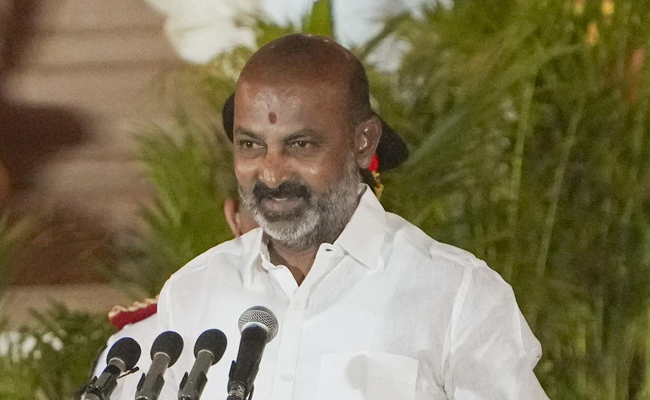
Hyderabad (PTI): A case under POCSO Act was registered against Union Minister Bandi Sanjay Kumar's son here following allegations of sexual harassment of a minor girl, a charge denied by the accused who alleged extortion and criminal intimidation by the teen and her parents.
According to the 17-year-old girl's mother, Sanjay Kumar's son Bhageerath, who was in a relationship with her daughter, sexually harassed her.
The alleged relationship began about seven-eight months ago, police said.
They are yet to examine the girl, who is a student.
Meanwhile, Bhageerath complained to the police in Karimnagar that the girl who got acquainted to him, invited him to her family functions and group gatherings.
An FIR was registered based on the complaint.
Bhageerath said in the complaint that, believing the girl's family to be trustworthy, he accompanied them and visited some holy places, as part of a friends group.
Subsequently, the girl and her parents intimidated him to marry her, but he rejected the proposal, following which the girl's parents demanded money and also threatened him with false complaints if he failed to pay the amount.
Out of fear, he paid Rs 50,000 to the girl's father, but they demanded Rs five crore. If he failed to comply, the girl's mother would commit suicide, Bhageerath alleged in his complaint.