Karnataka BJP MLA Munirathna sent to police custody in harassment, bribery case
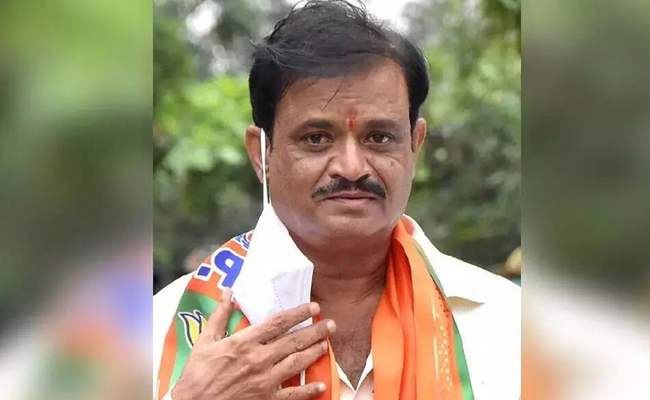
Tumakuru (Karnataka) (PTI): Karnataka Home Minister G Parameshwara on Sunday said BJP MLA N Munirathna, arrested in connection with two cases registered against him for allegedly issuing death threats to a BBMP contractor, has been sent to two-day police custody.
The Minister ruled out any vendetta politics behind the former Minister's arrest and said the action was taken in accordance with law.
Munirathna, who represents Rajarajeshwari Nagar Assembly segment in Bengaluru, was picked up from Nangli village in Kolar’s Mulbagal on Saturday evening on charges of harassing a Bruhat Bengaluru Mahanagara Palike (BBMP) contractor for bribe, using casteist slurs against a former corporator, cheating, criminal intimidation and outraging a woman’s modesty.
Contractor Cheluvaraju, who is one of the complainants, has also released a purported audio recording of a phone conversation between him and Munirathna.
"A complaint has been lodged alleging that he (Munirathna) spoke in a very derogatory manner about a former corporator who was a block Congress president and also about a contractor. On the basis of the complaint he has been arrested. Now the investigation has begun," Parameshwara said.
Addressing reporters here, he said this morning he was produced before a judge, who remanded Munirathna to two days police custody.
"They will investigate, let's see what happens." "... his voice samples will be taken, it will be sent to the Forensic Science Laboratory (FSL), and it will be verified whether it is his voice or not," he added.
Munirathna in a video statement on Saturday had termed the allegations against him as "far from truth", and claimed that a conspiracy was being hatched against him.
Citing violation of party discipline, the state BJP has issued a show cause notice to Munirathna and asked him to clarify the allegations before a disciplinary committee within five days.
Responding to allegations of vendetta politics, the Home Minister said, "action has been taken in accordance with law based on a complaint, where is vendetta politics in it? Those who were with him and faced abuse have complained. Did Congress or anyone else give the complaint?"
"If action is not taken then it will be alleged that action has not been taken despite complaint. Police have taken action in accordance with law," he added.
Let the Truth be known. If you read VB and like VB, please be a VB Supporter and Help us deliver the Truth to one and all.
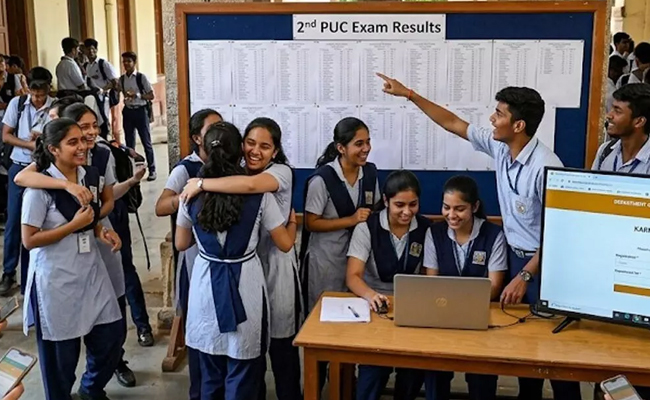
Second PUC results: Life convict clears exam with distinction, DGP lauds effort
_vb_63.jpeg)
Bengaluru: A life convict lodged in Ballari Central Prison has successfully cleared the second PUC examination.
Ashok Kumar S, who appeared for the examination under prison escort, secured 481 marks out of 600, registering 80.1 percent.
Director General of Police (Prisons and Correctional Services), Alok Kumar (IPS), shared the development on his official ‘X’ handle, commending the inmate’s achievement.
In his post, he stated that it was heartening to see a life convict score over 80 percent in the examination, adding that the inmate had appeared from Ballari Central Prison under escort.
It’s heartening to see that one of our life convict prisoners Ashok has obtained 80.1% marks in PUC exam. He appeared under Prison escort from Ballari Central Prison for his exams.
— alok kumar (@alokkumar6994) April 9, 2026
Glad to see that Walls of the prison has not subdued his hopes for a better future. pic.twitter.com/Nzlcy076SR
He further noted that the achievement reflected that the “walls of the prison have not subdued his hopes for a better future.”
Alok Kumar in his post also shared the result sheet of Ashok.
The Karnataka School Examination and Assessment Board (KSEAB) declared the second PUC results for 2026 on April 9.
A total of 6,32,200 students appeared for the examination across all streams, of whom 5,46,698 passed, recording an overall pass percentage of 86.48 per cent.