Karnataka Cabinet to meet again to discuss SC internal reservation during recruitment
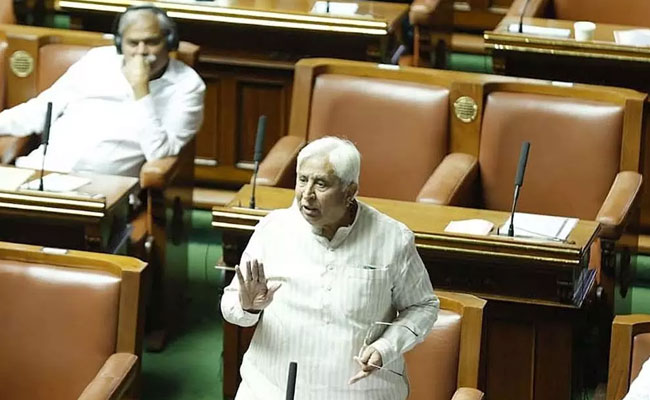
Bengaluru (PTI): The Karnataka Cabinet has decided to meet again to discuss the issue of providing internal reservation among Scheduled Castes for direct recruitment in the government sector, as deliberations on the matter remained incomplete.
While no specific date for the next meeting has been announced, Law and Parliamentary Affairs Minister H K Patil told reporters it would be held "at the earliest" and reiterated the government's commitment to the issue.
The issue came up for discussion at the Cabinet meeting on Thursday, amid reports of rifts between SC(Right) and SC (Left) factions within the ruling Congress over providing internal reservation in the recruitment to 56,432 vacant posts.
"The government is committed to providing internal reservation. We will meet again for further discussion. The chief minister will decide when to meet at the earliest. It will be a Cabinet meeting and will be held as early as possible," Patil said.
He said, "We had a detailed discussion on this matter for some time, but it was incomplete because many ministers are yet to speak on this. The order already issued (for filling up vacancies) will not be disturbed, and about other things, we will discuss in the next meeting."
The state government decided to conduct recruitment for 56,432 vacant jobs based on the reservation order in force before December 28, 2022, (15 per cent for SCs and 3 per cent for STs), due to the stay on the enhanced quota and internal reservation, while continuing to pursue its case in court.
The previous BJP government had increased the reservation quota for SCs from 15 per cent to 17 per cent and for Scheduled Tribes from 3 per cent to 7 per cent, raising the state's total reservation to 56 per cent, exceeding the Supreme Court-mandated 50 per cent ceiling.
While this matter is still in court, the Congress government decided to provide internal reservation by slicing up the 17 per cent reservation matrix given to 101 scheduled castes, under three groups, with a formula of six, six, and five per cent respectively.
According to sources, the SC(Left)/Madiga community, which has fought for internal reservation for decades, opposes recruitment for 56,432 jobs without providing internal reservation.
The SC (Right)/Holeya community, however, favoured recruitment without providing internal reservation.
At the meeting, the Cabinet gave administrative approval for Karnataka State Road Transport Corporation to purchase 144 'BS-VI' urban transport diesel buses at an estimated cost of Rs 62 crores.
It also granted administrative approval for the purchase of hardware and software for implementing ICJS (Inter-operable Criminal Justice System) and IT services in the state under the Police Modernisation Project at an estimated cost of Rs 227.58 crores.
The Cabinet also asked the health minister to speak with officers, doctors and other staffers appointed on a permanent, contract, temporary, or outsourced basis in the health department, who have threatened to go on strike over their various demands.
Approval was also given for amendments to certain sections of the Karnataka Municipalities Act, 1964, and the Karnataka Municipal Corporations Act, 1976, regarding advertisement charges under local bodies.
Let the Truth be known. If you read VB and like VB, please be a VB Supporter and Help us deliver the Truth to one and all.
Iran offers to reopen Strait of Hormuz if US lifts its blockade and the war ends: officials
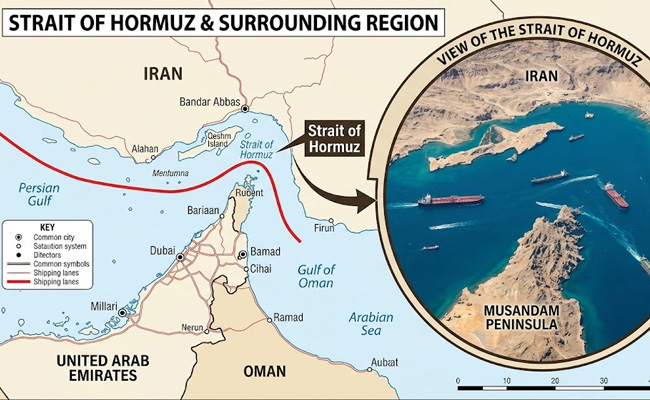
Cairo (AP): Iran has offered to end its chokehold on the Strait of Hormuz in exchange for the US lifting its blockade on the country and an end to the war, while proposing that discussions on the larger question of its nuclear programme would come in a later phase, two regional officials said Monday.
US President Donald Trump seems unlikely to accept the offer, which was passed to the Americans by Pakistan and would leave unresolved the disagreements that led the US and Israel to go to war on February 28.
With a fragile ceasefire in place, the US and Iran are locked in a standoff over the strait, through which a fifth of the world's traded oil and gas passes in peacetime. The US blockade is designed to prevent Iran from selling its oil, depriving it of crucial revenue while also potentially creating a situation where Tehran has to shut off production because it has nowhere to store the oil.
The strait's closure, meanwhile, has put pressure on Trump, as oil and gasoline prices have skyrocketed ahead of crucial midterm elections, and it has pressured his Gulf allies, which use the waterway to export their oil and gas.
The closure has also had far-reaching effects throughout the world economy, raising the price of fertilizer, food and other basic goods.
The proposal would push off negotiations on Iran's nuclear programme to a later date. Trump said one of the major reasons he went to war was to deny Iran the ability to develop nuclear weapons.
The two officials, who had knowledge of the proposal, spoke on condition of anonymity to discuss the closed-door negotiations between Iranian and Pakistani officials this weekend. The Axios news outlet first reported Iran's proposal.
It came as Iran's foreign minister visited Russia, which has long been a key backer of Tehran. It's unclear what, if any, assistance Moscow might offer now.
Strait of Hormuz remains blocked
===================
Iran's ability to choke off traffic in the Strait of Hormuz, the narrow mouth of the Persian Gulf, has proved one of its biggest strategic advantages in a war that has often boiled down to which side can take more pain.
Oil prices have risen steadily since the war began and tankers full of crude became stranded in the Persian Gulf, unable to safely transit through the strait and reach global distribution points.
On Monday, the spot price of Brent crude, the international standard, was trading at around $108 per barrel, nearly 50 per cent higher than when the war began.
Iranian foreign minister holds talks as negotiations with US stall
===============================
Trump last week indefinitely extended the ceasefire the US and Iran agreed to on April 7 that has largely halted fighting. But a permanent settlement remains elusive in the war that has killed thousands of people.
Iran's state-run IRNA news agency said Foreign Minister Abbas Araghchi landed in St. Petersburg on Monday morning ahead of a meeting with Russian President Vladimir Putin.
“It is a good opportunity for us to consult with our Russian friends about the developments that have occurred in relation to the war during this period and what is happening now,” Araghchi said in a video interview posted by IRNA.
It comes as Pakistan has been seeking to revive stalled talks between Iran and the US, and negotiations had been expected in Islamabad over the weekend. Instead, Trump called off a trip by his envoys and suggested the talks could take place by phone instead.
Over the weekend, Araghchi made two stops in Pakistan and a visit to Oman, which shares the strait with Iran. He also spoke by phone with counterparts in Qatar and Saudi Arabia on Sunday.
Iran wants to persuade Oman to support a mechanism to collect tolls from vessels passing through the strait, according to a regional official who spoke on condition of anonymity because he was not authorised to discuss the matter.
Oman's response wasn't immediately clear.
The official, who is involved in mediation efforts, also said Iran insisted on ending the US blockade before new talks and that Pakistan-led mediators are trying to bridge significant gaps between the countries.
Trump says Iran has offered a much better proposal
===========================
Trump told journalists Saturday that after he called off a trip by his envoys to Pakistan, Iran sent a “much better” proposal.
He did not elaborate but stressed that one of his conditions is that Iran “will not have a nuclear weapon”.
Iran insists its programme is peaceful, but the US wants to remove Tehran's stockpile of highly enriched uranium, which could be used to build a bomb, should Tehran choose to pursue one.
Since the war began, at least 3,375 people have been killed in Iran and at least 2,509 people in Lebanon, where fighting between Israel and the Iran-backed Hezbollah militant group resumed two days after the Iran war started. Another 23 people have been killed in Israel and more than a dozen in Gulf Arab states. Fifteen Israeli soldiers in Lebanon, 13 US service members in the region and six UN peacekeepers in southern Lebanon have been killed.
The ceasefire between Israel and Hezbollah has been extended by three weeks. Hezbollah has not participated in the Washington-brokered diplomacy.