Karnataka CM effects cabinet reshuffle twice on a single day to mollify those upset
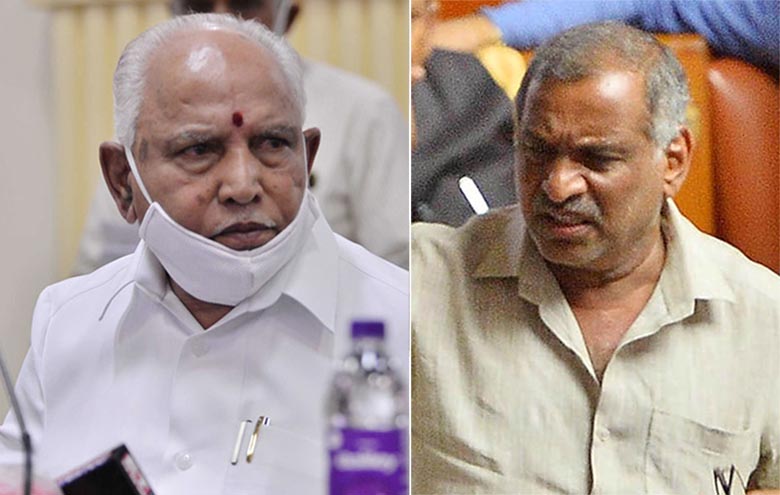
Bengaluru, Jan 25: Aimed at mollifying his Cabinet colleagues, Karnataka Chief Minister B S Yediyurappa on Monday effected a rejig, twice on a single day, by reallocating portfolios to some upset ministers.
Earlier in the day, Yediyurappa had carried out a minor reshuffle, the third in less than a week, by reallocating portfolios to three ministers- J C Madhuswamy, Anand Singh and K Sudhakar.
With Minister Madhuswamy, who was in the afternoon assigned Tourism, Ecology and Environment departments, expressing his displeasure and amid reports that he may resign, the Chief Minister exchanged his portfolio with Minor Irrigation Minister C P Yogeeshwara by late evening, effecting another round of rejig.
The second round of reallocation today was carried out to pacify Madhuswamy, who was said to have been contemplating resigning as minister, after Republic Day celebrations on Tuesday, official sources said.
Madhuswamy, who has been sulking ever since the reallocation of portfolios took place for the first time on January 21, today openly expressed that he was "upset" as his departments have been changed repeatedly in the last one week and he would arrive at some decision after flag hoisting tomorrow, as his self-esteem was deeply hurt.
Sources close to the minister said with the Chief Minister on Monday night reassigning him with the Minor Irrigation department that he was demanding, Madhuswamy is unlikely to take any drastic step.
Earlier he was given Medical Education, Kannada and Culture departments, when the portfolios were first reallocated on January 21, while being divested of Law, Parliamentary Affairs, Legislation and Minor Irrigation portfolios.
On the very next day, January 22, when minor changes were made and portfolios were reallocated once again, he was given Haj and Wakf Department along with Medical Education, while he was relieved of Kannada and Culture.
Among other portfolios reallocated today is Minister Anand Singh has been given the charge of Infrastructure Development Department and Haj and Wakf.
He was on January 21 assigned Tourism, Environment and Ecology departments, while being divested of the Forest Department.
Though there were reports that Singh too was planning to resign after the Tourism department was divested from him, he denied it and said he will abide by the Chief Minister's decision.
He further said he has even offered Yediyurappa to give his ministerial berth to some other aspirant and that he was ready to serve as a normal legislator, as the Chief Minister has fulfilled his other demands (Vijayanagara district formation).
Today's reallocation was a happy note for Health Minister K Sudhakar as has been reassigned with the Medical Education Department as an additional charge, which was divested from him last week.
Sudhakar had been sulking ever since he was divested of the Medical Education portfolio, and had even warned that separating the two departments could impair the states Covid- 19 vaccination effort.
Yediyurappa earlier too on January 22 had effected changes to the portfolios reallocated on the previous day, under pressure from Ministers MTB Nagaraj, K Gopalaiah and K C Narayana Gowda, who had openly expressed displeasure over departments assigned to them and did not attend the cabinet meeting.
The rounds of portfolio reallocation has come after Yediyurappa expanded his 17-month old cabinet on January 13, by inducting seven ministers, after a long wait, which had resulted in resentment among several ministerial aspirants.
Against the sanctioned strength of 34, the Yediyurappa cabinet now has 33 members.
Let the Truth be known. If you read VB and like VB, please be a VB Supporter and Help us deliver the Truth to one and all.
DMK poll manifesto is game-changing plan for TN, says Stalin
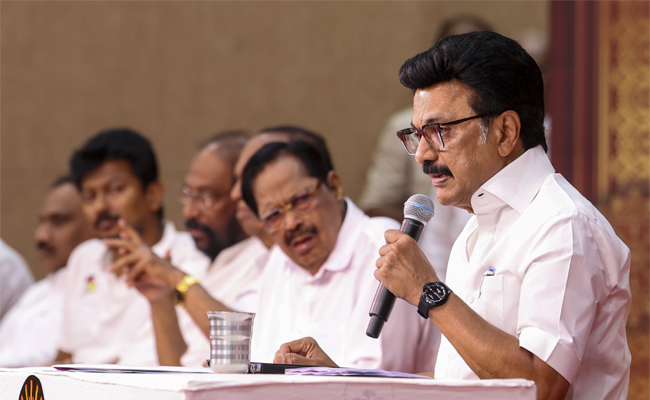
Chennai (PTI): DMK chief M K Stalin on Monday said his party manifesto for the April 23 Assembly election was a "game-changing" plan for Tamil Nadu as it underscored the steps towards progress.
The monetary support announced in the poll manifesto, he said, was a "smart economic multiplier" that would uplift the local economy, support small businesses, upskill people, and upgrade long-term outcomes.
"Development and welfare move together proving you can build infrastructure, grow the economy, and uplift people simultaneously. From one-size-fits-all to choice-based governance," the Tamil Nadu chief minister said, and added "people decide what works for them."
The manifesto focused on creating assets, improving productivity, generating economic activity, and delivering measurable long-term returns, he said in a post on 'X'.
"This is a next-phase document. It builds on what has already been delivered and scales it with smarter design, deeper impact, and wider reach," Stalin said.
The six steps towards progress outlined in the manifesto included development for women, family, youth, farmers, housing and infrastructure and governance, he said.
He highlighted the DMK poll promises of increasing the monthly grant under 'Kalaignar Magalir Urimai Thogai' (women entitlement) to Rs 2,000, from the present Rs 1,000, and adding new eligible women every year, expanding the Chief Minister's Breakfast Scheme till 8th Standard, providing coupon worth Rs 8,000 under the 'Illatharasi' (homemaker) scheme to buy new / replace household electronic appliances for their family, enhancing the medical treatment coverage to Rs 10 lakh, and increasing pension sum to Rs 2,000 per month for senior citizens, widows and spinsters above the age of 50.
Skill training for 5 lakh youth who have completed higher education, fetching foreign investment of Rs 18 lakh crore and creating 50 lakh jobs over 5 years, hiking the higher education monthly grant for college students to Rs 1,500 from the present Rs 1,000, providing 35 lakh free laptops to all college students, providing free modern electric pump sets without any meters to over 20 lakh farmers receiving free electricity, and providing 10 lakh new concrete houses under 'Kalaignarin Kanavu Illam' and various other housing schemes towards a hut-free Tamil Nadu by 2030, were among the other assurances.
On governance, he said the people's aspirations registered under the 'Unga Kanava Sollunga' (Tell us your dreams) initiative will be fulfilled as a priority.