Karnataka constitutes committee on responsible AI to develop comprehensive framework
Bengaluru (PTI): Karnataka govt on Thursday said it has constituted a committee on responsible AI to develop a comprehensive framework to guide the safe, ethical and transparent adoption of AI across government systems and public services.
The committee, chaired by Kris Gopalakrishnan, Co-founder of Infosys, and co-chaired by N Manjula, Secretary, Department of Electronics, IT, Biotechnology and Science & Technology, Government of Karnataka, brings together leading experts from industry, academia, policy and law, it said.
According to an official statement, in the first meeting of the committee, members discussed the rapidly evolving AI landscape and the need to establish strong governance frameworks to ensure the responsible use of AI technologies, particularly in systems that impact citizens.
"The committee will develop a responsible AI policy and implementation roadmap for Karnataka, aimed at enabling innovation while ensuring that AI systems deployed across government are safe, fair, transparent and accountable," it stated.
Speaking on the initiative, IT Minister Priyank Kharge said that as Karnataka enters its Deep Tech decade, the state is focused not only on accelerating AI innovation but also on ensuring that these technologies are deployed responsibly and in the public interest.
"The Responsible AI Committee brings together leading experts from industry, academia and policy to help shape a governance framework that promotes innovation while safeguarding transparency, accountability and citizen trust. This initiative will help Karnataka continue to lead in building an AI ecosystem that is both cutting-edge and responsible," he said.
Officials said that the committee will submit an interim report within 60 days and a final set of recommendations within 90 days, outlining a policy framework, risk classification system and implementation roadmap for responsible AI adoption across government.
The members discussed key areas that the committee will focus on while developing the framework. Those areas include, establishing responsible AI principles and policy guidelines for the state, developing a risk classification framework for AI systems used in governance, and categorising applications based on potential impact and risk levels.
Officials said the committee would also focus on identifying AI practices that should be prohibited or restricted, including social scoring of citizens, unlawful or disproportionate surveillance, discriminatory profiling or exclusion, and high-stakes automated decision-making without meaningful human oversight.
It also discussed recommending safeguards, approvals and review mechanisms for high-risk AI applications in sectors such as welfare delivery, healthcare, education, policing, recruitment, financial decision-making and public safety, they said.
The statement said the committee also discussed defining data governance and privacy safeguards for AI systems, establishing transparency and accountability mechanisms and cybersecurity safeguards.
They would also examine the implications of generative AI and social media technologies, developing responsible AI procurement guidelines and vendor due diligence frameworks for AI systems.
Lauding the state government for setting up this committee, Infosys Co-Founder said, "If we can leverage this opportunity effectively, Karnataka can become the first state in the country to develop a comprehensive framework for responsible AI, one that drives better citizen services, creates the jobs of the 21st century, and strengthens our innovation ecosystem. By harnessing AI thoughtfully and responsibly, we can accelerate the growth of the economy significantly."
Let the Truth be known. If you read VB and like VB, please be a VB Supporter and Help us deliver the Truth to one and all.
Late flourish masks CSK’s batting woes on lively Chepauk track, hosts post 158/7
Chennai (PTI): Bowlers calling the shots in a format dominated by big hitters is a rarity, but that script played out at Chepauk on Sunday as Gujarat Titans exploited a lively, bounce-friendly surface to stifle Chennai Super Kings before the hosts managed a late flourish to reach 158 for 7.
On a pitch that offered sharp carry, stroke-making demanded discretion and adaptability. Instead, CSK’s batters often opted for high-risk shots without fully assessing conditions, and paid the price with a flurry of miscued dismissals.
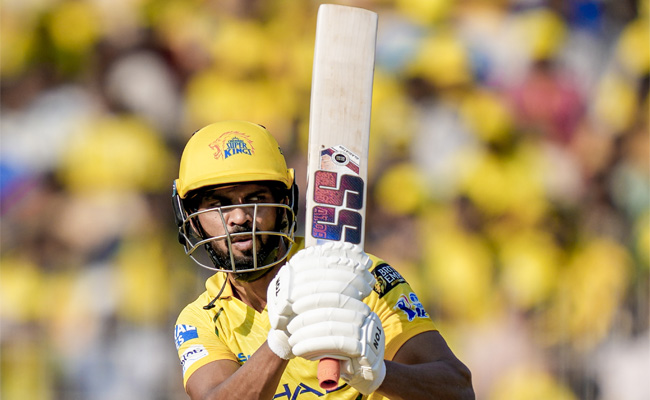
Invited to bat, CSK never quite found rhythm but skipper Ruturaj Gaikwad’s maiden half-century (74 not out) of the current IPL season lent a semblance of respectability to the total in a season where 200-plus scores have become commonplace.
Gaikwad's knock came off 60 balls with six fours and four sixes after a laboured start.
The tone was set early by GT pacer Mohammed Siraj, who extracted steep bounce and forced errors.
Sanju Samson (11) began watchfully, negotiating the first over before opening up against Kagiso Rabada to bring up his 5000 IPL runs milestone. However, Rabada’s bounce soon accounted for him as a hard slash outside off resulted in a faint edge that Jos Buttler pouched safely.
The dismissal triggered a collapse. Urvil Patel (4) fell in the same Rabada over attempting an ambitious pull, while Sarfaraz Khan (0) succumbed to Siraj’s extra lift, mistiming a short ball to offer a simple catch.
At 28 for 3 inside the Powerplay, CSK were already in trouble.
Gaikwad and Dewald Brevis (2) needed to rebuild, but the latter’s impatience against spinner Manav Suthar led to his downfall, holing out after failing to get to the pitch of the ball.
The mounting wickets forced Gaikwad into a shell — an approach that, while understandable, further stalled the momentum. His reluctance to improvise allowed dot balls to pile up, with CSK reaching 50 only in the 12th over.
The skipper eventually broke free, taking on Arshad Khan and Jason Holder with a couple of towering sixes, but the acceleration came too late.
Shivam Dube, dropped thrice on 6, 11 and 22, struggled for fluency before Arshad cleaned him up.
Kartik Sharma (15) and Jamie Overton (18) provided late impetus with a few lusty hits, but the damage had already been done.
On a pitch that rewarded discipline and smart shot selection, Titans' bowlers executed their plans to perfection, while CSK’s batters failed to read the conditions in time, a lapse that ultimately defined the innings.