Karnataka crosses six crore COVID-19 tests
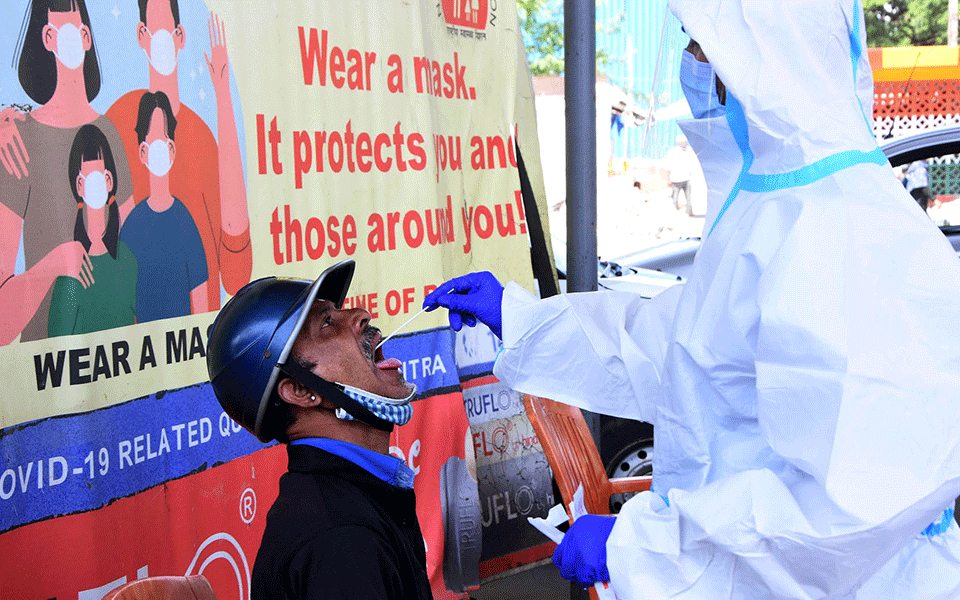
Bengaluru(PTI): Karnataka Health Minister Dr K Sudhakar on Saturday congratulated healthcare workers and district authorities as the state crossed six crore COVID-19 tests.
"Testing has been one of the cornerstones of Karnataka's success in fighting Covid. We have completed crore tests since the beginning of the pandemic, third highest in the country. Congratulations to all the health workers and district administration who made this possible," the minister tweeted.
Later speaking to reporters, the minister said when the pandemic started in early 2020, National Institute of Virology units were used to conduct tests and Karnataka used to send samples to NIV centres in Pune.
Karnataka gradually established labs across the state and now we have about 268 testing facilities including 99 government and 169 private labs, he added.
According to him, Karnataka has tested 6,01,14,815 samples so far including 1,14,12,162 Rapid Antigen Test and 4,87,02,653 RT-PCR tests.
While 1,41,96,065 samples were tested in 2020, 4,23,91,357 samples were tested in 2021 and so far 35,27,393 tests have been conducted in 2022, he explained.
Sudhakar said, "Testing plays a vital role in this battle against pandemic. Karnataka has always been aggressive in testing and tracking and it has been one of our cornerstones in this direction against COVID. Karnataka has now achieved another milestone by crossing 6 crore tests."
Further, the minister said that both Health and Family Welfare and Medical Education departments have always religiously followed 5T strategy of Test, Track, Trace, Triaging and Technology.
"We have set up 3,678 comprising of 3,102 government and 666 private swab collection centres, which is one each for every 20,000 population. We have labs in government hospitals, medical colleges and also private hospitals," Sudhakar explained.
He also said that initially only 10 to 12 government labs had COVID testing facility which has now increased to 57.
"With 108 NA extractors and 139 RT-PCR machines we have capacity to test 1,20,800 samples per day in govt facilities," the minister said.
After Omicron variant was found, the state mandated that at least 2 per cent of the tests should be conducted at airports, the minister said adding, the government then increased the target to about 80,000 to one lakh samples per day.
Speaking about infection among children he said since it was opined that third wave could predominantly affect children, the state government mandated to conduct at least two per cent of the tests on children.
"Out of total tests conducted between December 1 and January 20, 29 per cent of the tests were conducted on children. We are also conducting random RAT tests in schools, colleges, restaurants once in every 15 days," the minister told reporters.
He also said that the testing target has been increased to two lakh per day from January 18.
Further, targeted testing of symptomatic persons and primary contacts has been started, the minister said adding the RTPCR tests has been made mandatory for symptomatic persons even if RAT report is negative.
Let the Truth be known. If you read VB and like VB, please be a VB Supporter and Help us deliver the Truth to one and all.
WHO declares global health emergency over Ebola outbreak in Congo, Uganda
Abuja (Nigeria) (AP): WHO Director-General Tedros Adhanom Ghebreyesus declared the Ebola disease outbreak in Congo and Uganda a public health emergency of international concern on Sunday after more than 300 suspected cases and 88 deaths.
In a post on X, the World Health Organisation said the outbreak does not meet the criteria of a pandemic emergency like the COVID-19 pandemic, and advised against the closure of international borders.
Ebola is highly contagious and can be contracted via bodily fluids such as vomit, blood or semen. The disease it causes is rare, but severe and often fatal.
Health authorities have confirmed the current outbreak is caused by the Bundibugyo virus, a rare variant of the Ebola disease that has no approved therapeutics or vaccines. Although more than 20 Ebola outbreaks have taken place in Congo and Uganda, this is only the third time the Bundibugyo virus has been reported.
Congo accounts for all except two of the cases, both of which were reported in neighbouring Uganda, the WHO said.
Officials first reported the spread of the disease in Congo's eastern province of Ituri, close to Uganda and South Sudan, on Friday. On Saturday, the Africa Centres for Disease Control and Prevention reported 336 suspected cases and 87 deaths.
“There are significant uncertainties regarding the true number of infected persons and geographic spread associated with this event at the present time. In addition, there is limited understanding of the epidemiological links with known or suspected cases,” Tedros said.
Uganda on Saturday confirmed one case it said was imported from Congo, and said the patient died at a hospital in Uganda's capital, Kampala, and the WHO said that a second case has been reported in Kampala. The two cases had no apparent links to each other, and both patients had travelled from Congo, it added.
The Bundibugyo virus was first detected in Uganda's Bundibugyo district during a 2007-2008 outbreak that infected 149 people and killed 37 people. The second time was in 2012 in an outbreak in Isiro, Congo, where 57 cases and 29 deaths were reported.
WHO's emergency declaration is meant to spur donor agencies and countries into action. However, the global response to previous declarations has been mixed.
In 2024, when the WHO declared mpox outbreaks in Congo and elsewhere in Africa a global emergency, experts at the time said it did little to get supplies like diagnostic tests, medicines and vaccines to affected countries quickly.