Karnataka draft bill to curb fake news proposes 7 years jail

Bengaluru, June 10 (PTI): The Karnataka government's draft law aimed at prohibiting misinformation in the state proposes punishment with imprisonment which may extend up to seven years and fine up to Rs 10 lakhs or both, if any social media user is found guilty of posting fake news.
The draft of the Karnataka Misinformation and Fake news (Prohibition) Bill, 2025 is likely to be placed before the next cabinet meet.
Any individual outside or inside Karnataka who communicates misinformation to persons in the state, which is "prejudicial to public health, public safety, public tranquility or the conduct of free and fair elections" will face 2-5 years of imprisonment and will also be liable to fined. For abetting the spread of misinformation, two years of jail term has been proposed.
As per the draft Bill, the state government shall ensure a complete prohibition on fake news on social media platforms.
It provides for the government to constitute the "Fake News on Social Media Regulatory Authority" for carrying out the purpose of this proposed legislation.
The Authority shall consist of -- the Minister for Kannada and Culture Information and Broadcasting as ex-officio Chairperson, one member each from the Karnataka Legislative Assembly and the Karnataka Legislative Council, two representatives from social media platforms to be appointed by the State Government in such manner as may be prescribed as member and IAS officer who shall be the Secretary to the Authority.
The draft bill defines "misinformation" as knowingly or recklessly making a false or inaccurate statement of fact, whether wholly or in part, in the context in which it appears excluding opinions, religious or philosophical sermons, satire, comedy or parody or any other form of artistic expression if a reasonable man of ordinary prudence does not pursue such communications as statements of fact.
While, "fake news" has been defined as combinations of misquotation or the false and/or inaccurate report of one's statement. editing audio or video which results in the distortion of facts and/or the context, or purely fabricated content.
The authority along with ensuring complete ban on promotion and spread of fake news on the social media platforms, will also ensure prohibition on the posting of contents which are abusive and obscene including anti-feminism and insult to the dignity of the female on the social media platforms.
It would also prohibit publication of content amounting to disrespect of Sanatan symbols and beliefs, and content promoting superstition on the social media platform.
The draft bill also mentions setting up of special courts for faster trials of offences, and provides for appointment of at least one special public prosecutor for every special court and one in each bench of the High Court.
The Bill's statement of objects and reasons point out that the problem of fake news is becoming more complex because the number of people using the internet in India is continuously increasing.
At present, 27 per cent of India's population uses internet. India has the second largest number of internet users in the world after China.
Further noting that today social media is the biggest force in the world, but caution is also necessary in its use, and a small piece of fake news can create a ruckus in the whole country, it said, without knowing truth, no message should be forwarded so as to avoid the menace of fake news.
Let the Truth be known. If you read VB and like VB, please be a VB Supporter and Help us deliver the Truth to one and all.
Akash Singh says signature celebration fuels motivation, reinforces dominance
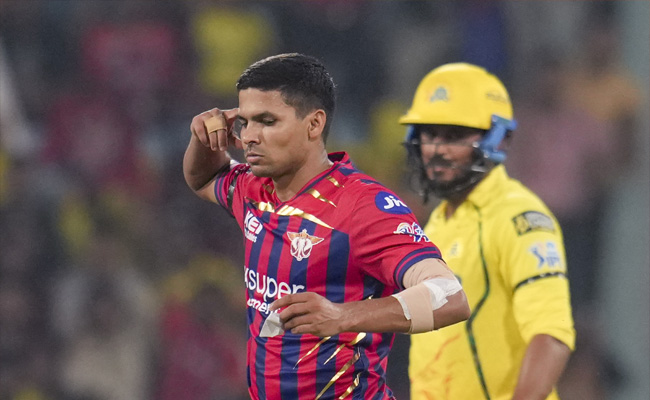
Lucknow (PTI): Pacer Akash Singh caught the eye with his unique celebration during Lucknow Super Giants' win over Chennai Super Kings, pulling out a piece of paper from his pocket after a wicket, a gesture he said was aimed at "motivating" himself and "asserting dominance" over batters.
The left-arm pacer pulled out a scrappy piece of paper after each of the three wickets he took in LSG seven-wicket win over CSK, with the message reading: "Akki on fire -- Akash knows how to take wickets in T20 cricket.
The 24-year-old, who began his IPL journey with Rajasthan Royals and was part of Chennai Super Kings’ title-winning campaign in 2023 before moving to Lucknow Super Giants, registered his best IPL figures with 3 for 26 on Friday.
"'Akki knows how to take wickets in T20 cricket', right?" Akash said when asked about the message on the piece of paper, adding that it serves as a source of motivation and helps him focus on dominating batters and delivering stronger performances for the team.
"Different things motivate different people. Some days I show the paper, some days I don't, but it reflects my mindset on that particular day. When you carry a piece of paper with something written on it, you manifest things and the most important part is when those manifestations actually materialise," he added.
Akash, who hails from Bharatpur in Rajasthan, said the strong backing from the Lucknow Super Giants support staff over the last two years had played a huge role in his growth as a cricketer.
"I've been with LSG for two years and the most important thing has been the backing from the coaches, even when I'm not in the playing XI. This year we have Bharat Arun sir, last year Zaheer sir was there...Tom Moody. The way they guide us, prepare us and keep us ready for opportunities is very important when there are 25 players in the squad," he said.
"When you are not playing, you naturally seek backing and every player wants to make the most of the opportunities he gets. The support from the captain also matters a lot and with Rishabh bhaiya backing you, the confidence grows and you are able to perform better," Akash said, referring to Rishabh Pant.
Akash said Pant had asked him to trust his strengths ahead of the clash against CSK.
"He told me that the new ball is my strength and that I can swing it both ways. So I just tried to make the best use of my skills. The wicket also had good bounce, so I focused on using the bouncer effectively,” added Akash.
On his success against CSK, Akash said his experience of playing in the IPL since 2020, including a stint with CSK, helped him understand the opposition batters better, while backing his own strengths with the ball also played a key role in his impressive spell.
"Obviously, when you play in the IPL and have shared the dressing room with some players, you understand their strengths and weaknesses. My focus was first to back my own strengths, then exploit their weaknesses and also make the best use of what the wicket was offering," Akash said.
Akash said he had sensed over the last two-three games that an opportunity could come his way after being repeatedly told to "be ready", though he admitted he was unfortunate not to get a chance earlier.
"Two days before the match, during practice, I was told to be ready," he said.
Clarifying that he had not been carrying the piece of paper in anticipation, Akash said he often notes down thoughts that could help improve his game..
"Whenever I’m alone or about to sleep, any thought that comes to my mind which can help my cricket, I write it down. The other night I got this thought and jotted it down on paper," he added.