Karnataka government employees demand return of Old Pension Scheme

Bengaluru: Government employees in Karnataka have urged the state government to scrap the New Pension Scheme (NPS) and bring back the Old Pension Scheme (OPS), The New Indian Express reported.
The demand was made by the Karnataka State Government Employees’ Association, whose leaders met senior IAS officer Uma Mahadevan on Monday and submitted a memorandum. The association asked the NPS Review Committee, headed by senior IAS officer Anjum Parvez, to recommend the reintroduction of OPS in the state.
Association president C.S. Shadakshari reportedly said the review committee has already visited Rajasthan, Himachal Pradesh, Andhra Pradesh and Telangana where NPS was revoked and OPS re-implemented. The committee is yet to submit its report, but has told the government it will do so soon.
ALSO READ: Udupi man loses Rs 55,000 in Facebook graphics card scam
Shadakshari allegedly said NPS has been in force in Karnataka since 2006. He pointed out that West Bengal never adopted the scheme, while Andhra Pradesh and Telangana replaced NPS with a contributory pension model.
States including Rajasthan, Chhattisgarh, Himachal Pradesh, Punjab and Jharkhand have already scrapped NPS through cabinet decisions or budget announcements.
“Under NPS, 10% of the employees’ basic salary and DA, and 14% contribution from the state is credited to the employees’ fund. It constitutes 24% of the total which is non-withdrawable. This is invested in the share market and the final amount depends on the ups and downs of the market,” TNIE quoted Shadakshar as saying.
As per the report, he said that by limiting its contribution to 14%, the government could save up to ₹1.87 lakh crore annually if all vacancies are filled, strengthening the case for bringing back the old pension system.
Let the Truth be known. If you read VB and like VB, please be a VB Supporter and Help us deliver the Truth to one and all.
Trump launches new effort to reopen Strait of Hormuz
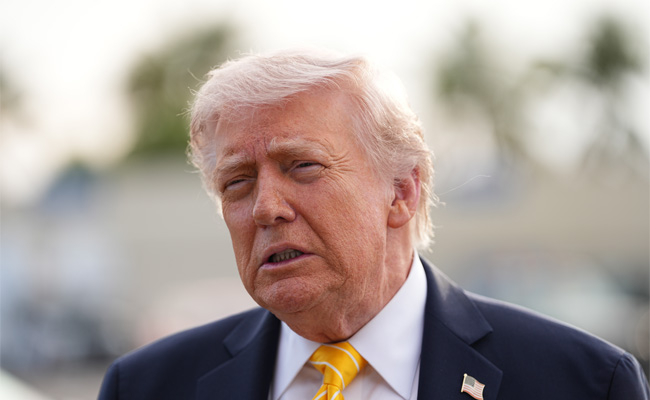
Dubai (AP): US forces on Monday launched an effort to guide commercial ships through the Strait of Hormuz, where hundreds have been stuck since the Iran war began.
Two American-flagged merchant ships have “successfully transited” through the critical waterway, the US military said. Separately, the US military denied Iran's claims that it struck an American Navy vessel southeast of the strait.
Iran handed over its latest proposal for negotiations with the US to mediators in Pakistan, Iran's state-run IRNA news agency reported Friday. Trump subsequently said he's “not satisfied” with it, but did not elaborate on the proposal's apparent shortcomings. The shaky ceasefire between the US and Iran has lasted for three weeks.
Here's the latest:
European leaders see Trump's troop drawdown from Germany as new proof they must go it alone
-----------------------------------------------------------------------------------
European leaders on Monday said President Trump's snap decision to pull thousands of US troops out of Germany came as a surprise but is a fresh sign that Europe must take care of its own security.
The Pentagon announced last week that it would pull some 5,000 troops out of Germany, but Trump told reporters Saturday that “we're going to cut way down. And we're cutting a lot further than 5,000.”
He offered no reason for the move, which blindsided NATO, but his decision came amid an escalating dispute with German Chancellor Friedrich Merz over the US-Israeli war on Iran, and Trump's anger over European allies' reluctance to get involved in the conflict in the Middle East.
Wall Street hesitates and oil prices climb with uncertainty about the Strait of Hormuz
---------------------------------------------------------------------------------
The US stock market is holding tentatively near its record heights Monday, while oil prices climb with uncertainty about when oil tankers can resume crossing the Strait of Hormuz and restore the world's flow of crude. Dueling claims about a possible Iranian strike on a U.S. Navy vessel in the strait heightened the tensions.
The S&P 500 slipped 0.1 per cent, coming off its latest all-time high. The Dow Jones Industrial Average was down 216 points, or 0.4 per cent, as of 9:35 am Eastern time, and the Nasdaq composite was up 0.1 per cent.
The action was stronger in the oil market, where the price for a barrel of Brent crude climbed 2 per cent to USD 110.37 and briefly topped USD 114 during the morning. Iran's closure of the Strait of Hormuz due to its war with the United States has kept oil tankers pent up in the Persian Gulf and away from customers worldwide. That in turn has sent the price of Brent soaring from roughly USD 70 per barrel before the war.
Iran stands firm on its grip of the strait
-------------------------------------------
The disruption of the waterway has squeezed countries in Europe and Asia that depend on Persian Gulf oil and gas, raising prices far beyond the region.
Trump has promised to bring down gas prices as he faces midterm elections this year.
The US has warned shipping companies they could face sanctions for paying Iran for transit of the strait. It has enacted a naval blockade on Iranian ports since April 13, telling 49 commercial ships to turn back, U.S. Central Command said Sunday. The blockade has deprived Tehran of oil revenue it needs to shore up its ailing economy.
US officials have expressed hope the blockade forces Iran back to the negotiation table.
US claims progress in reopening the Strait of Hormuz, saying two merchant ships have transited
------------------------------------------------------------------------------------
The US military said Monday that two American-flagged merchant ships had successfully transited the Strait of Hormuz and Navy guided-missile destroyers in the Persian Gulf were helping to restore shipping traffic. It separately denied Iran's claims to have struck an American Navy vessel.
The announcement came a day after US President Donald Trump announced a new initiative to help guide ships through the critical waterway for global energy. Iran has effectively closed the strait since the US and Israel started the war Feb 28, rattling the global economy.
The US-led Joint Maritime Information Center has advised ships to cross the strait in Oman's waters, saying it set up an “enhanced security area.” U.S. Central Command didn't say when the Navy ships arrived or when the merchant vessels departed.
It was unclear whether shipping companies, and their insurers, will feel comfortable taking the risk given that Iran has fired on ships in the waterway and vowed to keep doing so.