Karnataka government to propose Prevention of Cow Slaughter Act in coming assembly session
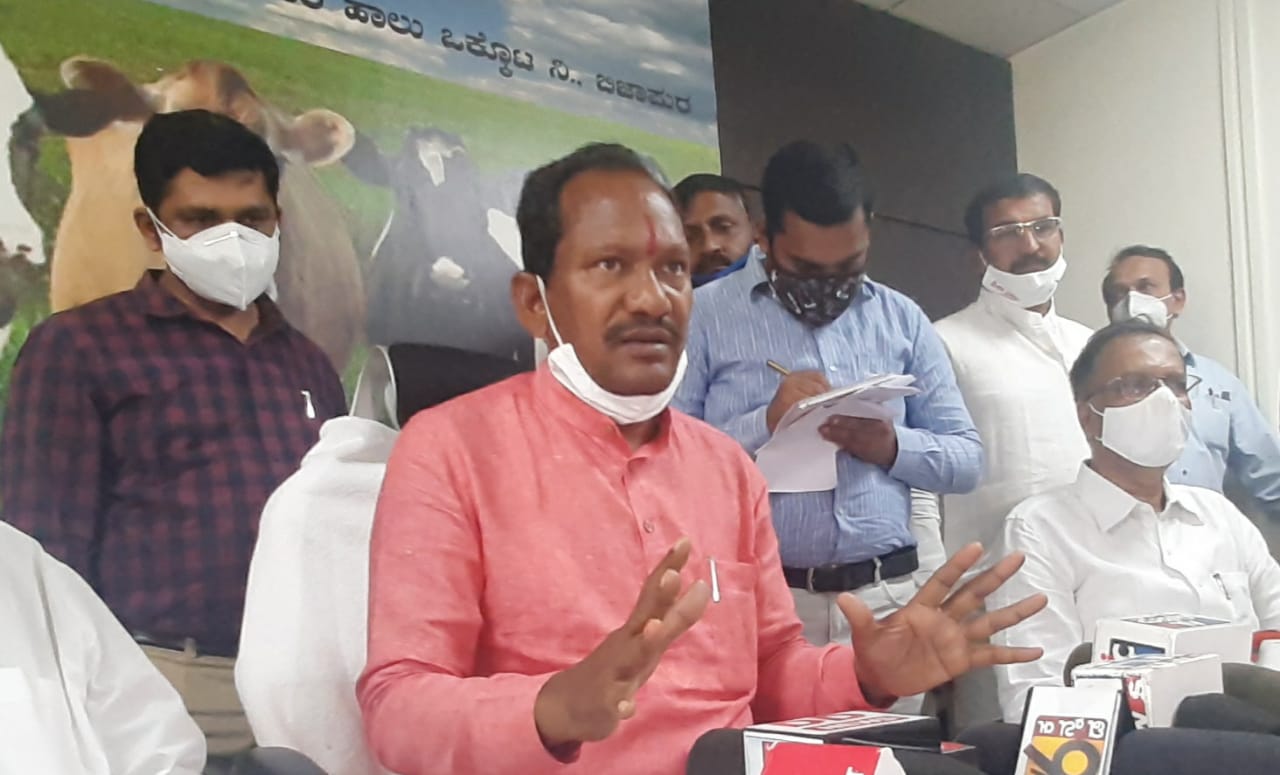
Bijapur: Reiterating that the BJP Government will certainly bring the Prevention of Cow Slaughter Act, Minister for Animal Husbandry, Hajj and Wakf, Prabhu Chavan has said that he plans to submit the details related to the Act in the coming assembly session.
Addressing presspersons on Tuesday, he however made it clear that the government is not in a hurry to bring the Act as a committee headed by the officials of the department has been constituted to study all aspects of the Act before its implementation.
“A team headed by the Commissioner of Animal Husbandry Department has been constituted which has been asked to study the Act which is already implemented in Gujarat and Uttar Pradesh. Besides this, the discussion would also be held with other stakeholders such as farmers to bring the Act. We will surely bring the Act but not in haste”, the Minister asserted.
Earlier, he informed that a high-tech slaughterhouse is being built at the cost of Rs. 44 crore on a 20-acre land in Sira taluk in Tumkur district, and claimed that soon the building would be inaugurated.
Acknowledging that the department is facing a shortage of staff, Chavan said that while the sanctioned posts are around 18,000, the department presently functioning only with around 9,000 staff which is only half of the total sanctioned posts.
To a question, he said that he has talked to Chief Minister, B. S. Yediyurappa on the matter, and assured that the vacant posts would soon be filled.
Admitting that the cattle owners are regularly complaining of doctors not visiting the villages for providing treatment to cattle, Chavan said that he has planned to set up a helpline centre where the farmers could call for any complaint.
“The centre will receive calls from the farmers. After collecting the address, the complaint will be forwarded to the respective veterinary doctor of the area. The doctor after attending the complaint should also record it for any verification of the visit”, he said.
He however said that the plan is still in the nascent stage.
About the demand for the construction of Hajj houses in different districts, the Minister said that so far, besides Bengaluru, a Hajj house has been granted for Mangaluru. Based on the need and availability of land, more houses could be granted.
On the demand for increasing the quota for Hajj pilgrims of the State, he said that he would speak to the Central Government for increasing the quota.
MLA, Somanagouda Patil Sasnur was present.
Let the Truth be known. If you read VB and like VB, please be a VB Supporter and Help us deliver the Truth to one and all.
Allen, Raghuvanshi, Green power KKR to 29-run win over GT

Kolkata (PTI): Finn Allen blasted a 35-ball 93, while Angkrish Raghuvanshi hit an unbeaten 44-ball 82 as Kolkata Knight Riders kept their playoff hopes alive with a 29-run win over Gujarat Titans in the IPL match here on Saturday.
Sent in to bat, Allen went on a six-hitting spree, smashing 10 maximums and four boundaries to add 95 off 41 balls with Raghuvanshi (82).
Raghuvanshi then shared another 108 off 53 balls with Cameron Green (52 not out) to power KKR to a challenging 247 for 2.
In reply, GT could manage 218-4, riding on skipper Shubman Gill's 49-ball 85 and a 35-ball 57 from Jos Buttler. Opener Sai Sudarsan was retired hurt but returned to make a 28-ball 53 not out.
Sunil Narine (2/29) claimed two wickets and Saurabh Dubey snapped one for KKR.
For GT, Mohammed Siraj (1/50), Sai Kishore (1/38) were the wicket-takers.
Brief Score:
KKR: 247 for 2 in 20 overs (Finn Allen 93, Angkrish Raghuvanshi 82 not out, Camero Green 52 not out; Mohammed Siraj 1/50).
GT: 218 for 4 in 20 overs (Shubman Gill 85, Sunil Narine 2/29).