Karnataka govt hints at increasing PHH ration card income limit
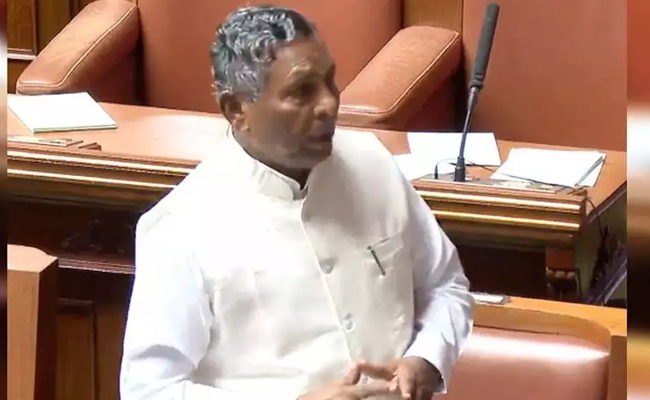
Bengaluru (PTI) The Karnataka government on Thursday indicated that it may hike the family income limit to obtain a Priority Households (PHH) ration card, considering rising costs.
Karnataka Health & Family Welfare Minister Dinesh Gundu Rao gave this indication in the Legislative Assembly, while replying to a question on behalf of Food and Civil Supplies Minister K H Muniyappa. He was responding to a question by senior BJP MLA C N Ashwath Narayan, during question hour.
"The current family annual income limit of Rs 1.20 lakh was fixed in 2017, it should certainly be accepted that the amount is less. From 2017, we are now in 2026. There is a need to revise this. It must be re-examined," said Rao, who previously served as Food and Civil Supplies Minister.
Noting that the Karnataka Administrative Reforms Commission, headed by senior Congress MLA R V Deshpande, has recommended increasing the income limit to Rs 3 lakh, he said, "The department will look into this."
Raising the issue, Narayan stressed the need for higher income limits as the cost of living in Bengaluru had risen.
Replying to Narayan's statement that 50 per cent of the urban population should get PHH or Antyodaya cards, citing the Food Security Act, the minister said the act meant for the country as a whole, while it varies for states.
Karnataka has 1.24 crore households with PHH ration cards, Rao said. "The Centre has identified 1.09 crore eligible families in Karnataka. But the state has exceeded this by 15.8 lakh families. In some rural areas, 95 per cent of the population is covered."
He also highlighted cases where ineligible people have obtained the card.
"There is demand for this card as it is considered the basis for obtaining other benefits like medical and other things. They don't want it for obtaining ration, but for other benefits," he said.
Let the Truth be known. If you read VB and like VB, please be a VB Supporter and Help us deliver the Truth to one and all.
Late flourish masks CSK’s batting woes on lively Chepauk track, hosts post 158/7
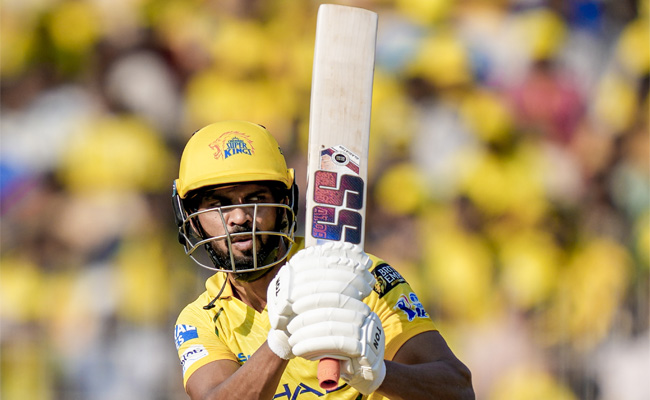
Chennai (PTI): Bowlers calling the shots in a format dominated by big hitters is a rarity, but that script played out at Chepauk on Sunday as Gujarat Titans exploited a lively, bounce-friendly surface to stifle Chennai Super Kings before the hosts managed a late flourish to reach 158 for 7.
On a pitch that offered sharp carry, stroke-making demanded discretion and adaptability. Instead, CSK’s batters often opted for high-risk shots without fully assessing conditions, and paid the price with a flurry of miscued dismissals.
Invited to bat, CSK never quite found rhythm but skipper Ruturaj Gaikwad’s maiden half-century (74 not out) of the current IPL season lent a semblance of respectability to the total in a season where 200-plus scores have become commonplace.
Gaikwad's knock came off 60 balls with six fours and four sixes after a laboured start.
The tone was set early by GT pacer Mohammed Siraj, who extracted steep bounce and forced errors.
Sanju Samson (11) began watchfully, negotiating the first over before opening up against Kagiso Rabada to bring up his 5000 IPL runs milestone. However, Rabada’s bounce soon accounted for him as a hard slash outside off resulted in a faint edge that Jos Buttler pouched safely.
The dismissal triggered a collapse. Urvil Patel (4) fell in the same Rabada over attempting an ambitious pull, while Sarfaraz Khan (0) succumbed to Siraj’s extra lift, mistiming a short ball to offer a simple catch.
At 28 for 3 inside the Powerplay, CSK were already in trouble.
Gaikwad and Dewald Brevis (2) needed to rebuild, but the latter’s impatience against spinner Manav Suthar led to his downfall, holing out after failing to get to the pitch of the ball.
The mounting wickets forced Gaikwad into a shell — an approach that, while understandable, further stalled the momentum. His reluctance to improvise allowed dot balls to pile up, with CSK reaching 50 only in the 12th over.
The skipper eventually broke free, taking on Arshad Khan and Jason Holder with a couple of towering sixes, but the acceleration came too late.
Shivam Dube, dropped thrice on 6, 11 and 22, struggled for fluency before Arshad cleaned him up.
Kartik Sharma (15) and Jamie Overton (18) provided late impetus with a few lusty hits, but the damage had already been done.
On a pitch that rewarded discipline and smart shot selection, Titans' bowlers executed their plans to perfection, while CSK’s batters failed to read the conditions in time, a lapse that ultimately defined the innings.