Karnataka govt. launches new cyber security policy
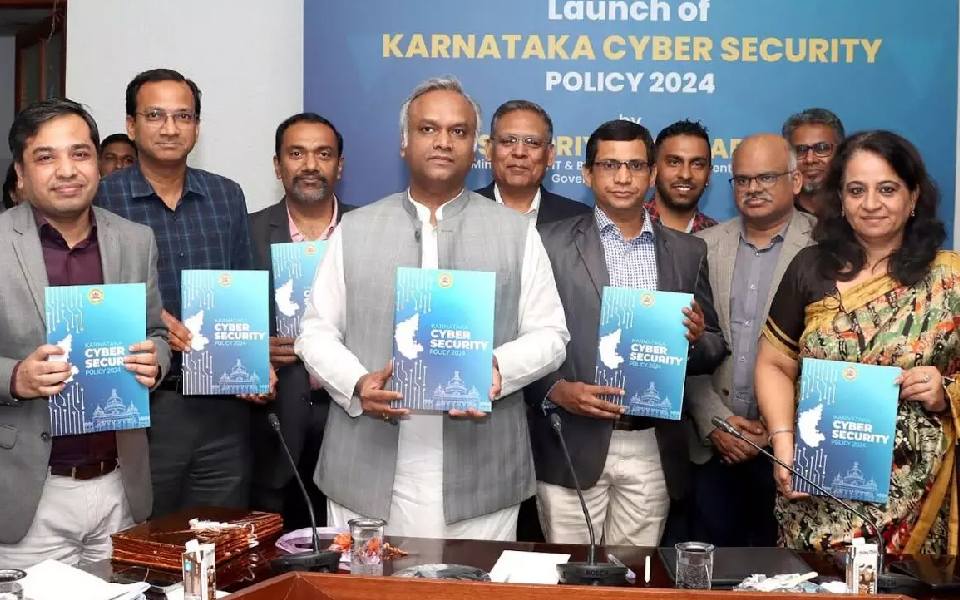
Bengaluru, Aug 1: The Karnataka Government on Thursday launched a comprehensive cyber security policy 2024 to combat rising levels of cybercrimes and promote awareness, skill building, public-private partnerships and technology integration to protect the State's digital infrastructure.
The policy focuses on several key areas such as awareness and education, skill building, promotion of industry and startups, partnerships and collaborations for capacity building, officials said.
The total financial outflow for implementation of the policy for five years is about Rs 103.87 crore, which would be met from the budgetary allocation of the Department of Information Technology and Biotechnology and Science & Technology. Out of this, Rs 23.74 crore would go towards providing incentives and concessions, they said.
According to an official statement, key highlights of the incentives under the policy are:
Under the internship programme, a stipend of Rs 10,000- Rs15,000 per month will be provided, for a maximum of three months, to Karnataka-based undergraduate and postgraduate interns. The target is to facilitate 600 undergraduate interns and 120 post-graduate interns during the policy period.
For R&D projects in the domain of cybersecurity, driven by Karnataka-based start-ups and in collaboration with Karnataka-based academic institutes, matching grants of up to a maximum of 50 per cent of the total project R&D cost, or up to Rs 50 lakh will be given.
The cost up to a maximum of Rs one lakh towards engagement of Karnataka-based, CERT-In empanelled service providers by start-ups registered with Karnataka Start-up Cell for cyber security audit will be reimbursed.
"The Government of Karnataka, recognising the rising importance of cyber security, has meticulously crafted this policy to establish a resilient and secure cyberspace for our citizens and enterprises," Minister for Rural Development and Panchayat Raj and Information Technology and Biotechnology, Priyank Kharge, said at the lunch event.
He emphasised that the policy, aligned with national and international efforts, highlights Karnataka's proactive stance in addressing cyber threats.
According to him, the policy has two parts. The first part focuses on building a strong cyber security ecosystem across all segments of the society, including public, academia, industry, start-ups and the government. The second part of the policy focuses on strengthening the cyber security posture of the State's IT assets.
Whilst the first part will be in public domain, the second will be internal to the state's IT teams and departments for their IT implementations.
This policy has been collaboratively drafted by the Department of Electronics, IT, BT and S&T, the department of Personnel and Administrative Reforms (e-Governance), and the Home Department, in consultation with relevant stakeholders from both the government and private sectors.
The policy was also reviewed by the Indian Institute of Science, which is the anchor institute for the state's K-tech Centre of Excellence for Cyber Security (CySecK).
He also launched a skilling programme by CISCO as the Karnataka Government signed a Memorandum of Understanding (MoU) with the network giant to train 40,000 individuals in cybersecurity skills and awareness.
"This partnership with CISCO is a testament to our commitment to fostering a secure digital environment. By training 40,000 individuals, with a special emphasis on empowering women, we are not only addressing the skills gap but also promoting inclusivity in the tech sector," Kharge said.
"Since, we are the fourth largest tech cluster in the world and the biggest tech cluster in the country, we have the highest number of cyber frauds also. That is the collateral damage of progress, So the highest number of online financial frauds in the country happen in Karnataka. Close to around 372 crore a year that is only reported (such frauds)...the first highest is of course Bengaluru and the second highest is Mandya," he said.
"The Government of Karnataka is extremely serious about it (addressing these issues) and I think probably we are also the first state to come up with a fact-check unit for misinformation, disinformation, fake news, deepfakes... so we tried this on for 90 days during the election period
And you will be quite surprised that a few of our partners who were enrolled detected close to around seven-and-a-half lakh threats. Out of which, serious threats were close to around 500....," he added.
According to him, the policy aims to build a dynamic, secure, and resilient cyberspace for all G2G, G2B, and G2C services of the Government of Karnataka.
"Beyond establishing a secure cyber ecosystem, the policy aims to create an assurance framework, strengthen the regulatory framework, quickly respond to security threats, protect critical information, reduce supply chain risks, and develop human resources," Kharge added.
The Minister said that the state government has also tied up with Meta to create awareness about cyber security.
"We have also tied up with Meta. We will be going to schools and colleges. We will be training one lakh teachers on how to be safe online and we will be teaching 10 lakh children on how to be safe online. We are also talking to WhatsApp and other social media organisations as well on how we can use their data, their analytics for a safer environment for our youngsters," Kharge said.
Let the Truth be known. If you read VB and like VB, please be a VB Supporter and Help us deliver the Truth to one and all.
Man arrested with Rs 2.54-crore heroin in Mumbai

Mumbai (PTI): Police have arrested a man and seized over 500 grams of heroin worth Rs 2.54 crore in the illicit market from him in Mumbai, officials said on Friday.
The police's Anti-Narcotics Cell (ANC) made the drug seizure in Santacruz in the western suburbs. The operation was conducted by the Kandivali unit of the ANC on Thursday as part of a special crackdown against drug trafficking in the area, they said.
Acting on specific inputs, an ANC team conducted a raid in Santacruz (East) and intercepted a man. During a search, the team recovered 508 grams of high-grade heroin from his possession, an official said.
The seized contraband, a highly addictive, opioid drug derived from morphine, is estimated to be worth Rs 2.54 crore in the international market, he informed.
Following the seizure, a case was registered against the man under relevant sections of the Narcotic Drugs and Psychotropic Substances (NDPS) Act, 1985, and he was formally placed under arrest in the early hours of Friday.
The police are currently investigating the source of the drug and trying to identify the intended recipients of the consignment, he said.