Karnataka govt. notifies dengue as 'epidemic disease'
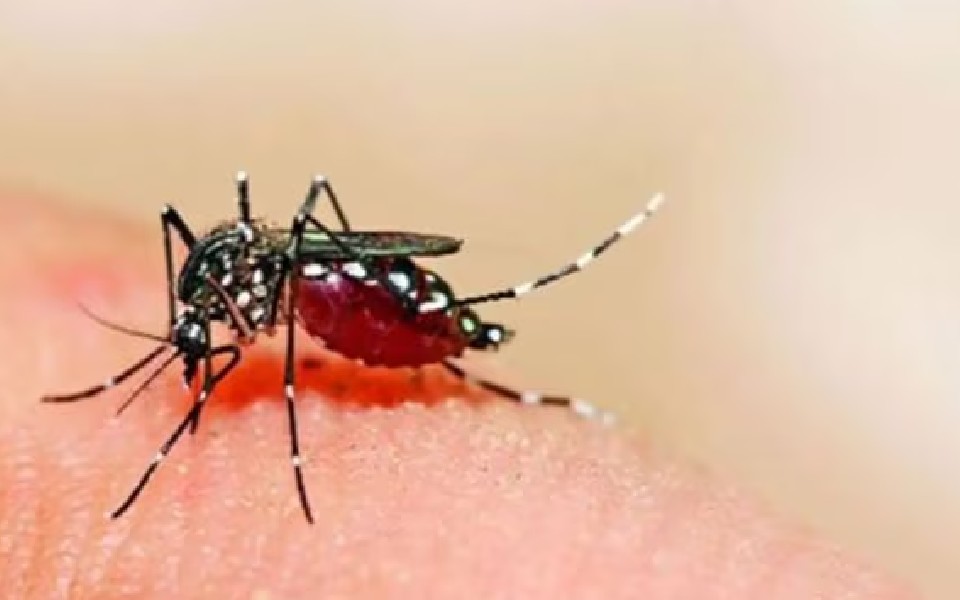
Bengaluru, Sep 3: The Karnataka government has notified dengue as an ‘epidemic disease’ and introduced regulations, which allow authorities to penalise those who disobey its orders or fail to take measures to stop breeding of mosquitoes.
“In exercise of the power conferred by section 3 of The Karnataka Epidemic Diseases Act, 2020 (Karnataka Act 26 of 2020), the Government of Karnataka hereby notifies Dengue fever, including severe forms of dengue fever as an Epidemic Disease in the State of Karnataka,” a government notification said.
The government has also introduced amendments to the Karnataka Epidemic Diseases Regulation, 2020, mandating people to be more responsible in containing the spread of the vector-borne disease.
The amendment proposes penalties in three categories – household, commercial and active construction areas.
For households in urban and rural areas, the penalty would be Rs 400 and Rs 200 respectively.
ALSO READ: Accord top priority to reprocess e-waste: K'taka Minister Khandre
In commercial areas, the penalty would be Rs 1,000 in urban regions and Rs 500 in the rural neighbourhoods.
Owners of active construction areas which provide space for mosquitoes to breed will be fined Rs 2,000 in urban localities and Rs 1,000 in rural ones.
The regulations make it mandatory for owners and occupiers of the household buildings to take necessary measures to prevent breeding of mosquitoes.
"They should ensure to cover or secure the water storage containers, sumps or overhead tanks with a lid or any material to prevent mosquito breeding. They should also dispose of solid waste material to prevent water accumulation & mosquito breeding," according to the notification.
Empty vessels, pot saucers, cans, containers, unused tyres, parts or any other solid waste materials should not be kept in such a manner that they are likely to collect and retain water which may cause breeding of mosquitoes, it was stated.
Every person, institution or agency should take care to prevent collection or accumulation of water, inside or outside the premises, so as to prevent nuisance to the neighbours or the community as a source for mosquito breeding, the regulations read.
The competent authority will be empowered to enter, inspect the premises, issue directions, levy penalties and implement all remedial measures and guidelines prescribed from time to time by the Health and Family welfare department of the state to curb the spread of the vector-borne diseases.
“If the person on whom a notice is served, fails or refuses to take measures to adopt the method of treatment specified in such notice within the time specified herein, the competent authority or its authorised officer may itself take such measures or adopt such treatment, specified in such notice within the time specified therein, and cause the cost to be recovered from the defaulter,” the regulations said.
Let the Truth be known. If you read VB and like VB, please be a VB Supporter and Help us deliver the Truth to one and all.
Mamata asks TMC nominees not to leave counting centres as EC data shows BJP leading
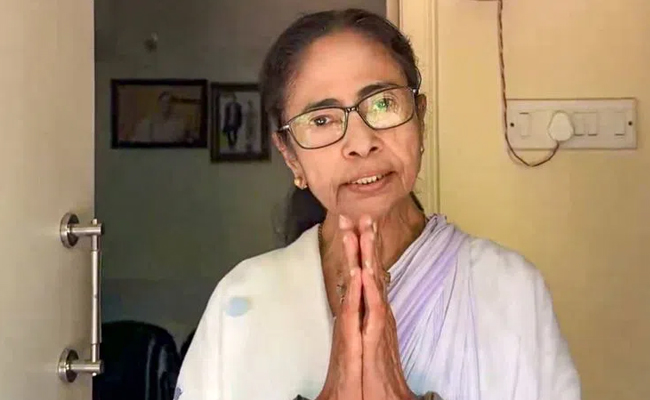
Kolkata (PTI): West Bengal Chief Minister Mamata Banerjee on Monday urged TMC candidates and agents to remain vigilant and not to leave counting centres, alleging that there was a "game plan" by the BJP and the Election Commission to show the saffron party taking a lead in the early trends of counting.
In a video message issued during the counting of votes, the TMC supremo appealed to party workers to stay put and not to lose morale.
"I appeal to everyone that neither TMC candidates nor counting agents should abandon counting centres," she said.
As trends on the Election Commission website indicated the BJP leading in 188 seats against the TMC's 94, Banerjee maintained that her party was still ahead in a significant number of constituencies.
"We are still ahead in 170 seats, but I request everyone not to lose hope," she said, adding that there were "around 70 to 100 seats where we are leading, but they are not sharing the data of those seats".
"A false narrative is being spread," she alleged.
The chief minister accused the Election Commission of "not declaring results or leads" in areas where the TMC was ahead.
"This is a game plan by the EC and the BJP as it (poll panel) is not declaring results or leads in areas where we are leading," she said.
Banerjee also alleged irregularities in the counting process at some locations.
"In several places, counting has been stopped after the first two to three rounds. In Kalyani, we have caught seven machines with severe anomalies," she claimed.
She further alleged that TMC workers were being "harassed with the help of central forces" and that party offices were being "vandalised and forcefully captured".
"With the help of central forces, they are harassing and torturing AITC workers. Our offices have been vandalised," she said, also alleging that voter list revision exercises were "purposefully done to target seats where we were strong".
Seeking to reassure party workers, Banerjee said more rounds of counting were yet to take place and urged them to stay firm.
"Fourteen to eighteen rounds of counting will happen. You will surely emerge victorious. Don't be afraid; fight like tigers," she said.
Her remarks came as counting trends suggested that the BJP was leading in 188 seats and had crossed the halfway mark of 148 in the 294-member assembly, pointing to a potential shift in the state's political landscape.
Counting for 293 constituencies was underway with postal ballots, followed by EVM votes.
Officials cautioned that trends could change as more rounds are counted, and final results would be known later in the day.
জরুরি বার্তা pic.twitter.com/Uc82oihwEL
— Mamata Banerjee (@MamataOfficial) May 4, 2026