Karnataka govt orders closure of accounts with SBI, PNB over non-refund of deposits

Bengaluru, Aug 12: The Karnataka government has ordered all its departments, boards, corporations, public sector units and universities to withdraw all their deposits and investments in the State Bank of India and the Punjab National Bank and stop transacting any business with these institutions.
The order came after the denial to redeem Rs 12 crore deposited by the Karnataka Industrial Area Development Board (KIADB) following a scam involving bank employees.
A state government circular on August 12 said the meeting with the bank officials did not yield any result and the matter is now sub judice.
Similarly, Rs 10 crore deposited by the Karnataka State Pollution Control Board (KSPCB) was not returned by the bank owing to a scam by the bank officials, the circular said.
The finance secretary P C Jaffer (budget and resource) said in the circular that the Auditor General too had objected to it.
“In this background, it is informed through this circular that the state government’s departments, public sector units, corporations, boards, local bodies and universities and other institutions should withdraw all the deposits/investments made in all the branches of the State Bank of India and the Punjab National Bank and no deposits/investments should be made in future,” the circular read.
The government also directed the government institutions to close their accounts in these two banks and submit the certified closer report and send details of deposits and investment reports in the prescribed format to the finance department by September 20, 2024.
Let the Truth be known. If you read VB and like VB, please be a VB Supporter and Help us deliver the Truth to one and all.
Nagaland bypoll: Nearly 20 pc voter turnout recorded in Koridang seat in first two hours
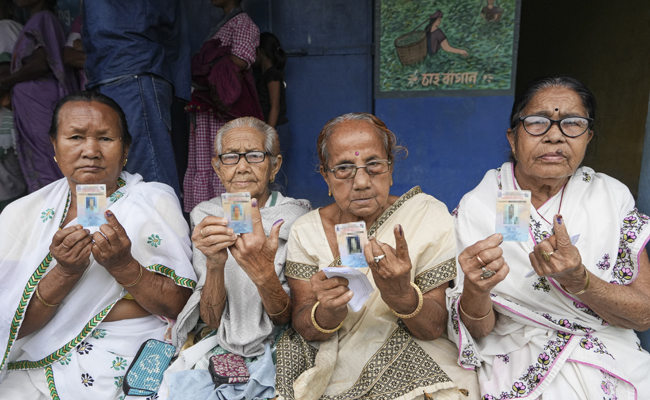
Kohima (PTI): Nearly 20 per cent of 22,382 electors exercised their franchise in Nagaland's Koridang Assembly bypoll in the first two hours of polling on Thursday, officials said.
The voting that commenced at 7 am across all 30 polling stations has so far been peaceful, they said.
The polling will continue till 4 pm.
Security has been significantly tightened across the constituency following violence on April 5 and 6, in which one person died, and several vehicles were damaged.
The byelection was necessitated by the demise of sitting BJP MLA Imkong L. Imchen in November last year.
A total of 22,382 electors, including 11,071 women, are eligible to decide the fate of six candidates in the fray.
The ruling People’s Democratic Alliance (PDA) has fielded BJP nominee Daochier I. Imchen, while the Congress candidate is T. Chalukumba Ao. The National People’s Party (NPP) has nominated I. Abenjang, while the Independent candidates are Imchatoba Imchen, Imtiwapang, and Toshikaba.
Of the 30 polling stations, 13 have been categorised as vulnerable and 17 as critical, prompting deployment of additional security personnel and intensified surveillance measures. Two polling stations have been designated as all-women booths.
Counting of votes is scheduled for May 4.