
Karnataka govt supports in SC trial of man in marital rape case
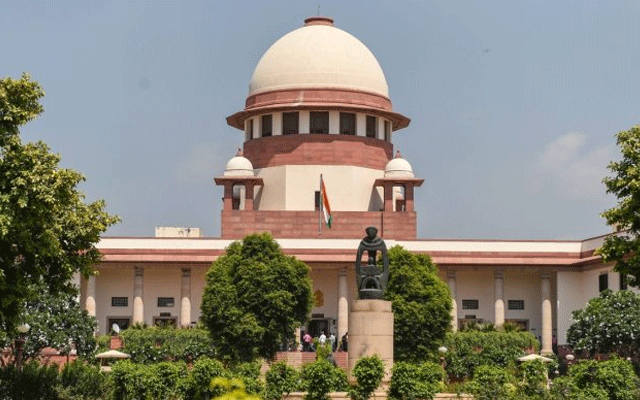
New Delhi (PTI): The Karnataka government has supported in the Supreme Court the trial of a man in a marital rape case saying the state high court has considered all related questions of law, amid a raging debate on whether to do away with a section in law that decriminalises rape by a husband.
In an affidavit filed before the top court, the Karnataka government has sought dismissal of the plea challenging a Karnataka High Court order and supported the prosecution of the husband accused of marital rape.
"It is respectfully submitted that the petition is not maintainable either in law or on facts and the same requires to be dismissed in limine (a motion before the trial starts).
"It is respectfully submitted that the High Court of Karnataka has considered all the questions of law involved in the present petition and it does not require any interference by this court," the affidavit said.
Referring to the case, the state government said whether the charge finally stands or not is a matter of trial and that the accused cannot be absolved at this stage despite the immunity against marital rape provided to husbands under IPC.
Exception 2 of Section 375 of IPC decriminalises rape by a husband on his wife.
The affidavit was filed in response to a notice issued by the apex court on an appeal by the man against the Karnataka high court judgment.
The high court had on March 23 said exempting a husband from allegation of rape and unnatural sex with his wife runs against Article 14 (equality before law) of the Constitution.
"If a man, a husband, a man he is, can be exempted from the allegation of commission of ingredients of Section 375 (rape) of the IPC, inequality percolates into such provision of law. Therefore, it would run counter to what is enshrined in Article 14 of the Constitution," the high court had said in the order.
The had dismissed the petition filed by the man seeking quashing of the proceedings of allegedly committing rape and unnatural sex with his wife and sexually harassing their daughter.
According to the high court, sexual assault by a husband on his wife will have grave consequences on the mental state of the woman as it has both psychological and physiological impact on her.
"Such acts of husbands scar the souls of the wives. It is, therefore, imperative for the lawmakers to now 'hear the voices of silence'," the high court had said.
The judge observed that in the Victorian era women were denied the exercise of basic rights and liberties and had little autonomy over their choice and, also, their statuses were nothing beyond those of materialistic choices. They were treated as chattels, the court had said.
The petitioner's wife, who had lodged the complaint of rape and unnatural sex against her husband and also of sexually harassing his own daughter, stated she had become a sex slave to her husband right from the day of the marriage.
The apex court had, in an important order in September, held the meaning of rape must include marital rape for the purpose of Medical Termination of Pregnancy Act.
Let the Truth be known. If you read VB and like VB, please be a VB Supporter and Help us deliver the Truth to one and all.
Assam govt moves SC against anticipatory bail to Congress leader Pawan Khera
_vb_90.jpeg)
New Delhi (PTI): The Assam government has moved the Supreme Court against the Telangana High Court order granting one-week transit anticipatory bail to Congress leader Pawan Khera in a case registered against him for levelling allegations against Chief Minister Himanta Biswa Sarma's wife.
The petition was filed on Sunday through advocate Shuvodeep Roy and is likely to be taken up for hearing this week.
On April 10, the high court granted one-week transit anticipatory bail to Khera.
The high court gave him a week's time to file an application before the court concerned and granted him relief with certain conditions.
"Without expressing any opinion on the merits of the case, this court is of the view that the petitioner has made out a case for grant of limited transit anticipatory bail, as his apprehension of arrest appears to be reasonable and supported by material on record," the high court had said in its order.
The conditions were that the petitioner shall be released on bail in the event of arrest on his executing a personal bond for Rs one lakh with two sureties for the like sum each, cooperate with the investigation and make himself available for interrogation as and when required by the Investigating Officer and that he shall not leave the country without prior permission of the competent Court.
The conditions further include that the petitioner shall, within the stipulated period, approach the competent jurisdictional court in Assam and seek appropriate relief and he, being a public figure, shall exercise restraint in making any further public statements in relation to the subject matter of the present case, which may prejudice the investigation, the order said.
The Congress leader on April 5 had alleged that the Assam CM's wife, Riniki Bhuyan Sarma, has multiple passports and foreign property, which were not declared in the chief minister's election affidavit for the April 9 Assembly polls in that state.
The case against Khera was registered at the Guwahati Crime Branch Police Station under several sections of the BNS, including 175 (false statement in connection with an election), 35 (Right of private defence of the body and of property) and 318 (cheating).
Khera, who approached the high court on April 7, showed his residential address in Hyderabad. He had requested the high court to release him on bail in the event of his arrest.
_vb_23.jpeg)
_vb_23.jpeg)
_vb_54.jpeg)