Bengaluru: The Karnataka High Court has dismissed three Public Interest Litigations (PILs) challenging the state government's decision to invite Booker Prize-winning author Banu Mushtaq as the chief guest for the inauguration of this year’s world-famous Mysuru Dasara celebrations.
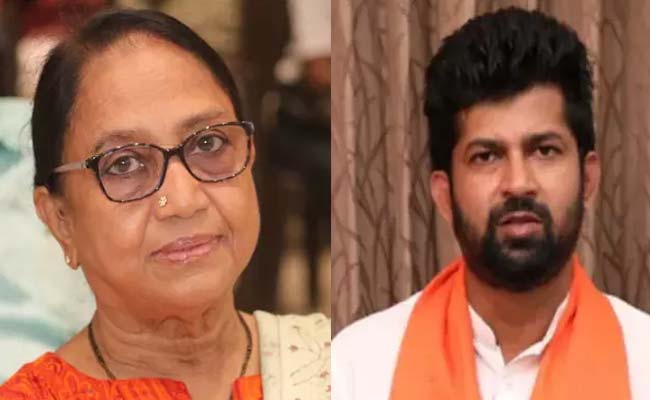
The PILs were filed separately by former MP Pratap Simha, Bengaluru-based entrepreneur T. Girish Kumar, and R. Soumya, the National Vice President of Abhinav Bharat Party. They had urged the court to direct the government to withdraw the invitation extended to Banu Mushtaq.
A division bench led by Chief Justice Vibhhu Bakhru heard the matter on Monday. After a round of arguments and counterarguments, the bench observed that the petitioners had not demonstrated any violation of their legal rights. Consequently, the court dismissed all three PILs and stated that a detailed order would be issued in due course.
This ruling clears the way for Banu Mushtaq to inaugurate the prestigious Dasara festivities as planned.
Let the Truth be known. If you read VB and like VB, please be a VB Supporter and Help us deliver the Truth to one and all.
Mumbai (PTI): India is engaging with international partners more intensively and from a "position of strength", External Affairs Minister S Jaishankar said on Tuesday, citing a string of recent trade agreements as evidence of the country's growing economic clout.
In an address at the Global Economic Cooperation conference, Jaishankar highlighted the successful negotiation of several high-profile deals, including a significant trade pact with the United States.
The Global Economic Cooperation is an event organised by the Future Economic Cooperation Council in partnership with the Ministry of External Affairs and the Government of Maharashtra.
Describing the current international landscape as perhaps the most turbulent in living memory, the minister warned that the world is witnessing the "weaponisation" of production and finance, alongside tightening export controls and volatile market shifts.
"The established global order is clearly changing. Replacements are hard to create, and we appear to be headed to a long twilight zone. This will be messy, risky, unpredictable, perhaps even dangerous," he said.
Long-standing assumptions and expectations have now become questionable, the minister pointed out.
Key dimensions are transforming simultaneously, be it strategic, political, economic or technological. Solutions lie in derisking and diversifying across multiple domains. This approach is increasingly visible in the policy of nations, the EAM said.
Jaishankar stressed that the "reform express" will continue to roll on.
"From a position of strength, India is engaging international partners more intensively. This is demonstrated in the recently concluded trade deals," he said.
Economic security is best served through stronger self-reliance and more trusted partners, the minister added.
Following a phone conversation between Prime Minister Narendra Modi and US President Donald Trump, both sides recently announced a reduction of US tariffs on Indian goods to 18 per cent from 50 per cent.
However, Leader of Opposition in the Lok Sabha, Rahul Gandhi, has alleged that the government "sold Bharat Mata" through the trade deal with the US, saying it was a "wholesale surrender", with India's energy security handed over to America and farmers' interests compromised.
Last month, India and the European Union (EU) concluded negotiations for the proposed free trade agreement (FTA), which will help boost two-way commerce and strengthen economic ties between the two sides. Over the last year, India has also finalised trade deals with the UK, New Zealand and Oman.
Jaishankar said that the world has entered a volatile and uncertain era, possibly the most turbulent in living memory.
He emphasised that India will also be more salient in the global calculus of production, on services, technology, skills and knowledge.
Economics will give way to politics and security when it comes to making choices and technology in the age of AI (Artificial Intelligence), he noted.
The minister further said that the US is determined to reindustrialise at any cost, and this is central to its tech future.
China's manufacturing and export focus continues unabated and may even expand, he added.
Technology competition is intensifying and polarising. Energy trade flows are being significantly redefined. New mindsets are encouraging greater risk-taking, including through military means. Migration and even mobility are getting contentious, he pointed out.
"Each nation and each society will respond as per their interests and calculations," Jaishankar said.