Karnataka HC upholds opening of additional fair price shop in village, dismisses monopoly claims
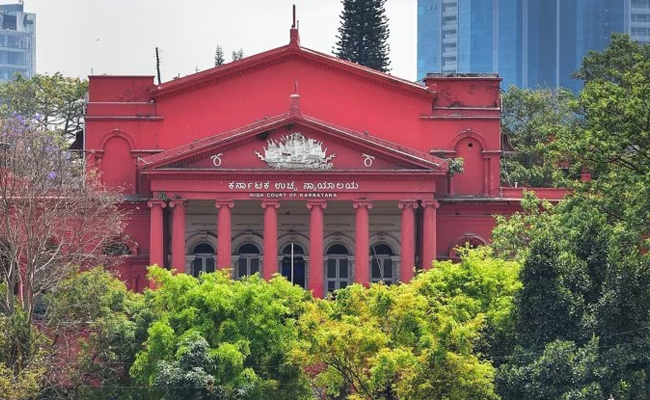
Bengaluru: The Karnataka High Court today observed that the purpose of fair price shops is to ensure easy and accessible distribution of essential commodities to all citizens, especially those from impoverished backgrounds. The court made this observation while dismissing a petition by Mahatma Gandhiji Grama Hitha Mandali, a fair price shop operator, challenging the government's decision to open another fair price shop in the same village.
A single judge bench of Justice Suraj Govindaraj clarified that the Karnataka Essential Commodities Public Distribution System (Control) Order, 2016, does not promote monopolies by authorizing only one fair price shop in a locality. Instead, the Order aims to facilitate speedy and affordable distribution of goods to all citizens.
The petitioner argued that the new shop would reduce the number of ration cardholders attached to his shop, thus impacting his business. However, the government contended that the decision was made following a representation from villagers and assured that a minimum of 500 cardholders would remain attached to the petitioner's shop as mandated by Rule 11 (2) of the Control Order, 2016.
The court, in its findings, noted that the petitioner's shop had more than 1,200 cardholders, which is double the minimum requirement in rural areas. The court further stated that there is no vested right for the petitioner to retain all cardholders, and the authorities are within their rights to establish additional fair price shops as long as the minimum requirement is met.
The petition was dismissed accordingly.
Let the Truth be known. If you read VB and like VB, please be a VB Supporter and Help us deliver the Truth to one and all.
Karnataka bypolls: Over 60 per cent voter turnout in Bagalkot, Davanagere South till 5 pm
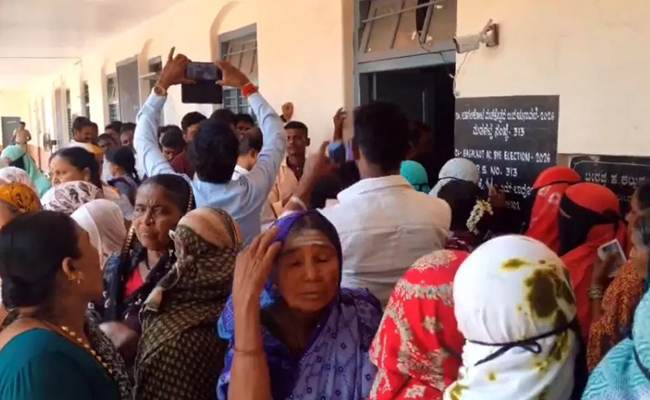
Bengaluru (PTI): Over 60 per cent voter turnout was recorded till 5 pm in both Assembly constituencies in Karnataka, where bypolls were held on Thursday.
While the turnout in Bagalkot was 65.68 per cent, it was 63.04 per cent in Davanagere South.
While the ruling Congress faces the challenge of retaining both seats, the BJP aims to wrest them and deliver a setback to its rival, which is currently witnessing an "internal power struggle" over leadership.
The bypolls were necessitated due to the demise of senior Congress MLAs H Y Meti (Bagalkot) and Shamanur Shivashankarappa (Davanagere South).
A total of over 2.59 lakh eligible voters are expected to cast their votes at around 319 polling stations in Bagalkot, where nine candidates are in the fray.
In Davanagere South, over 2.31 lakh eligible voters are expected to vote across 284 polling stations, with 25 candidates contesting.
The BJP has fielded former MLA and 2023 defeated candidate Veerabhadrayya Charantimath from Bagalkot, and a fresh face, Srinivas T Dasakariyappa, from Davanagere South.
The Congress has given tickets to family members of the late legislators in both constituencies. Bagalkot candidate Umesh Meti is the son of H Y Meti, while Samarth Mallikarjun from Davanagere South is the grandson of Shamanur Shivashankarappa.