Karnataka High Court reserves order on state’s plea against stay on ban of public gatherings without
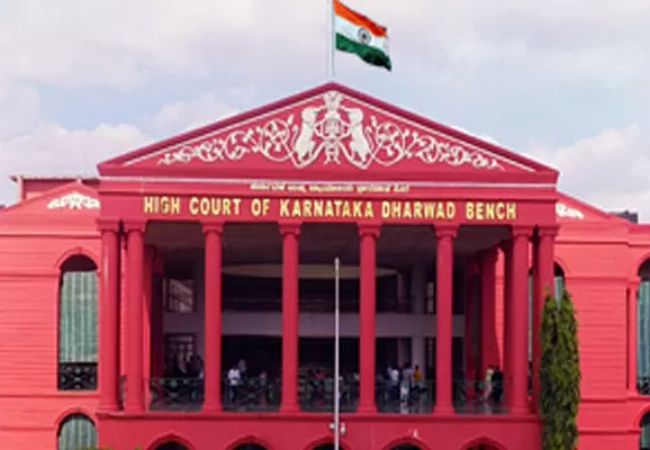
Bengaluru/Dharwad: The Karnataka High Court has reserved its order on the state government’s appeal challenging the interim stay granted against its directive that prohibits gatherings of more than 10 people in public places without prior permission from competent authorities.
The order in question, issued by the state government on October 18, 2025, sought to restrict any assembly, including those organised by private groups such as the RSS, in public areas like roads, parks, and playgrounds without prior approval. The Dharwad bench of the High Court, through a single-judge bench on October 28, had issued an interim stay on the order.
Hearing the government’s appeal on Tuesday, a division bench comprising Justice S.G. Pandit and Justice K.B. Geetha concluded arguments and reserved its decision.
Advocate General K. Shashikiran Shetty, representing the state government, argued that the notification was a lawful and reasonable measure intended to protect public property and citizens’ rights. He stated that gatherings of more than 10 people in public places such as roads and playgrounds without permission could disrupt public movement and order, and hence were declared unlawful under the Bharatiya Nyaya Sanhita.
Shetty contended that the single-judge bench’s interim order curtailed the government’s authority over its property. “Private organisations cannot use government property at their will. The order does not restrict people from using parks for walks; it only requires prior permission for organized events such as lectures or gatherings. There is nothing unreasonable about this,” he said.
He further noted that if any organisation sought permission, it would be granted within three days as per the new guidelines. “The order was issued solely to protect government property,” Shetty asserted.
The division bench questioned whether the government could have approached the single-judge bench itself for vacating the interim stay. Responding, the Advocate General said that since the stay order was already granted, the appropriate remedy was to approach a higher bench.
Senior Advocate Ashok Haranahalli, appearing for the original petitioners from Punashchetana Seva Trust, argued that the government’s view of public spaces as its exclusive property was legally flawed. “The state cannot claim ownership over playgrounds and parks in a manner that denies public access. Citizens have the right to use these spaces,” he said.
He further questioned, “If a group wishes to play cricket in a playground, must they seek daily permission from the government? Article 19(1)(b) of the Constitution guarantees the right to assemble peacefully without arms. This order amounts to an unreasonable restriction on that fundamental right.”
Haranahalli maintained that various provisions under criminal law already exist to curb unlawful assemblies and that municipal authorities, not the state government, are empowered to regulate the use of local public spaces. “If the state wants to impose such restrictions, it must enact legislation rather than issue an executive order that curtails citizens’ rights,” he argued.
On October 28, Justice M. Nagaprasanna of the single-judge bench had granted an interim stay on the state’s order, observing that the government directive prima facie infringed upon the fundamental rights guaranteed under Articles 19(1)(a) and 19(1)(b) of the Constitution, the rights to free speech and peaceful assembly.
The bench had held that fundamental rights cannot be curtailed by an executive order but only by a valid law enacted under constitutional provisions. “If such an order is allowed to stand, it would effectively deprive citizens of their basic freedoms,” the court had observed.
Invoking Article 13(2) of the Constitution, which prohibits the state from making any law that abridges fundamental rights, the bench had stayed the implementation of the October 18 government order and subsequent directives until further hearing.
Let the Truth be known. If you read VB and like VB, please be a VB Supporter and Help us deliver the Truth to one and all.
14 India-bound ships in Strait of Hormuz stopped by Iran; 1 hit by bullets, 1 crosses: Sources
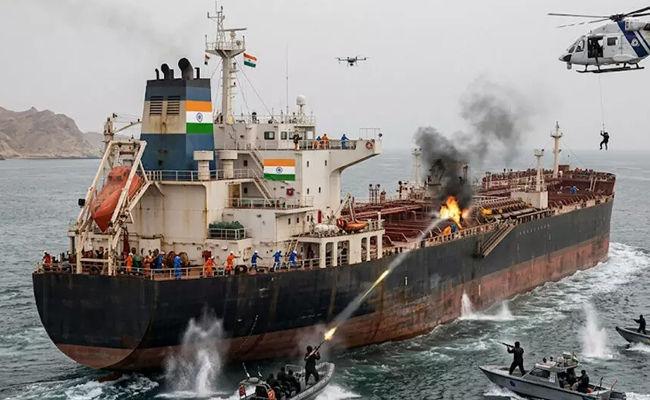
New Delhi (PTI): A convoy of 14 India-bound ships carrying crude oil and gas were stopped by the Iranian Revolutionary Guard Corps (IRGC) by firing at two of them while they were transiting the Strait of Hormuz, leading to 13 of the vessels returning to different locations in the Persian Gulf, official sources privy to the development said.
An Indian-flag carrying ship, which was hit by bullets fired by the IRGC while crossing the Strait of Hormuz, was carrying crude oil and a window pane was broken, forcing it to stop the journey and return. The extent of damage to the second vessel was not immediately known but it also had returned.
However, another ship, which was Indian flagged and loaded with crude oil for the Hindustan Petroleum Corporation Limited, sailed through the Strait and is now heading towards India, the sources said.
Two Iranian gunboats approached the targeted tanker and fired at it without warning. Gunboats approached the vessel 37 kilometres northeast of Oman, causing other vessels to return without completing the crossing, the sources said.
The incident was reported in waters between the Qeshm and Larak islands, they said.
Out of the 14 India-bound vessels, seven are carrying the Indian flag, four have the Liberia flag, two are of the Marshall Islands and one of Vietnam.
Six of them are loaded with crude oil, three have LPG and four are loaded with fertilisers. Among the ships, five are bulk carriers. All 14 vessels were sailing in a row.
Thirteen of them were stopped by the Iranian Navy and were instructed to wait. Out of the 13 stranded vessels, seven vessels are drifting south of Larak Island, waiting for clearance from the Iranian Navy, the sources said.
The Indian government is understood to have been coordinating with the Iranian authorities for the safe voyage of the stranded India-bound ships, they said.
The standoff over the Strait of Hormuz reportedly escalated again on Saturday as Iran reversed its reopening of the crucial waterway and fired on ships attempting to pass. This came as the United States pressed ahead with its blockade of Iranian ports.
Confusion over the Strait, through which roughly one-fifth of the world's oil passes, threatened to deepen the energy crisis.
The ceasefire between Iran and the US is due to run out by mid-next week.
Iran's joint military command said Saturday that "control of the Strait of Hormuz has returned to its previous state ... under strict management and control of the armed forces."
It warned that it would continue to block transit through the strait as long as the US blockade of Iranian ports remained in effect.