Karnataka High Court stays FIR against Kuloor road protestors
Why was an FIR necessary for a peaceful protest?: High Court questions police
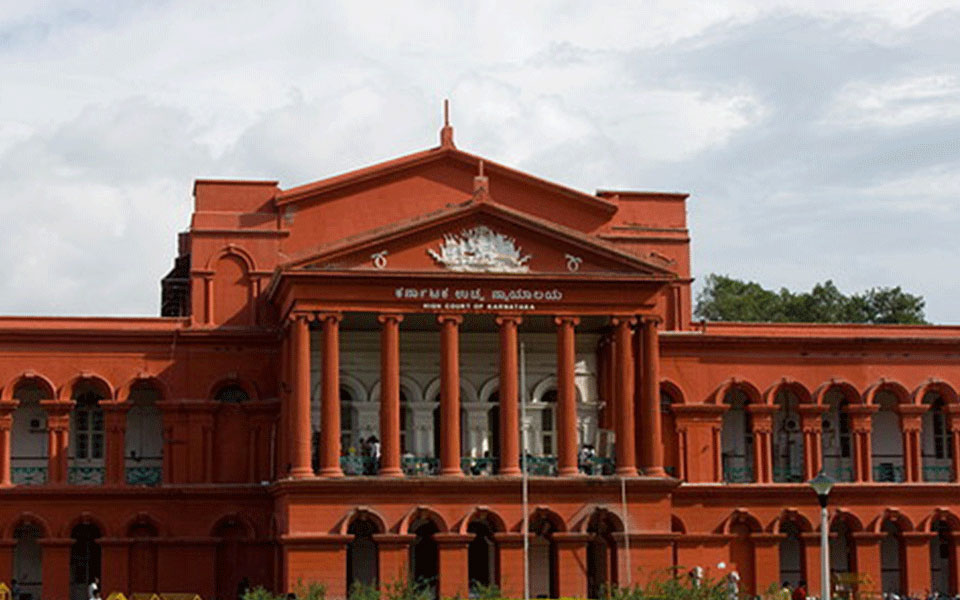
Kuloor: The Karnataka High Court has granted a stay on the FIR registered by Kavoor police against members of the Toll Virodhi Horata Samithi, including Muneer Katipalla, for protesting to demand road repairs in Kuloor.
The protest was held on 26 November 2024 by the Toll Virodhi Horata Samithi, demanding the repair of the Kuloor road. In response, the Kavoor police registered an FIR against Muneer Katipalla, B.K. Imtiaz, Sunil Kumar Bajal, Manjula Nayak, Srinath Kulal, Raghavendra, Yadav Shetty, and Dayanand Shetty and filed a charge sheet in court. Subsequently, a non-bailable warrant was issued against the protestors.
Senior Advocate S. Balan, representing the protestors, filed a petition in the Karnataka High Court seeking the quashing of the FIR. Justice Hemant Chandan Gowdar, hearing the case, has granted a stay on the FIR.
High Court questions police
The court questioned the police on what grounds they had invoked s. 189 and s. 190 of the Bharatiya Nyaya Sanhita (BNS) without applying s. 3(5). The judge also asked, "What was the necessity of an FIR for a peaceful protest?"
Senior Advocate S. Balan argued, "Filing an FIR against those who demanded road repairs is a violation of citizens' fundamental duties. Article 51A of the Indian Constitution outlines fundamental duties, which include protecting public property and avoiding violence."
He further stated, "No loudspeakers were used during the protest, nor was public movement obstructed. The police were deployed for security, but they neither intervened nor arrested anyone during the protest. The FIR was filed only after the protestors had returned home."
Protestors accused of being "absconding"
Balan also pointed out that those named in the FIR are well-known activists in Mangaluru and that even after the FIR, they continued holding protests for public interest. Yet, the police deliberately filed an 'Absconding Charge Sheet' against them.
He further argued, "The charge sheet was filed without issuing a notice under s. 35 of BNS, which is a clear violation of fundamental rights and an abuse of law."
Allegations against Mangaluru police
Balan alleged that illegal gambling, unauthorised sand mining, and unlicensed massage parlours were operating in Mangaluru under police supervision. He argued that instead of addressing these issues, police officials were targeting activists by registering FIRs against them in retaliation for their protests.
After hearing the arguments, Justice Hemant Chandan Gowdar stayed the FIR and the proceedings in the Mangaluru court. The High Court also issued an urgent notice to the Kavoor police, providing relief to the protestors.
Advocate Rakshita Singh assisted in the case.
Let the Truth be known. If you read VB and like VB, please be a VB Supporter and Help us deliver the Truth to one and all.
Govt using women's quota pretext to push delimitation: TMC
_vb_65.jpeg)
New Delhi (PTI): The Trinamool Congress (TMC) on Monday accused the government of using the pretext of early implementation of women's reservation law to "bulldoze" its "real agenda of delimitation".
The TMC said it has always supported women's reservation, but the government cannot "rush" through a bill that will "change the political map" of India based on the 2011 Census.
Parliament is set to meet from April 16 to 18 to consider bills to ensure the implementation of the 33 per cent quota in legislative bodies for women in the 2029 elections. It includes increasing the strength of the Lok Sabha from 543 to 816 seats, with 273 seats reserved for women, and amendments to the Delimitation Act to enable redrawing of constituencies.
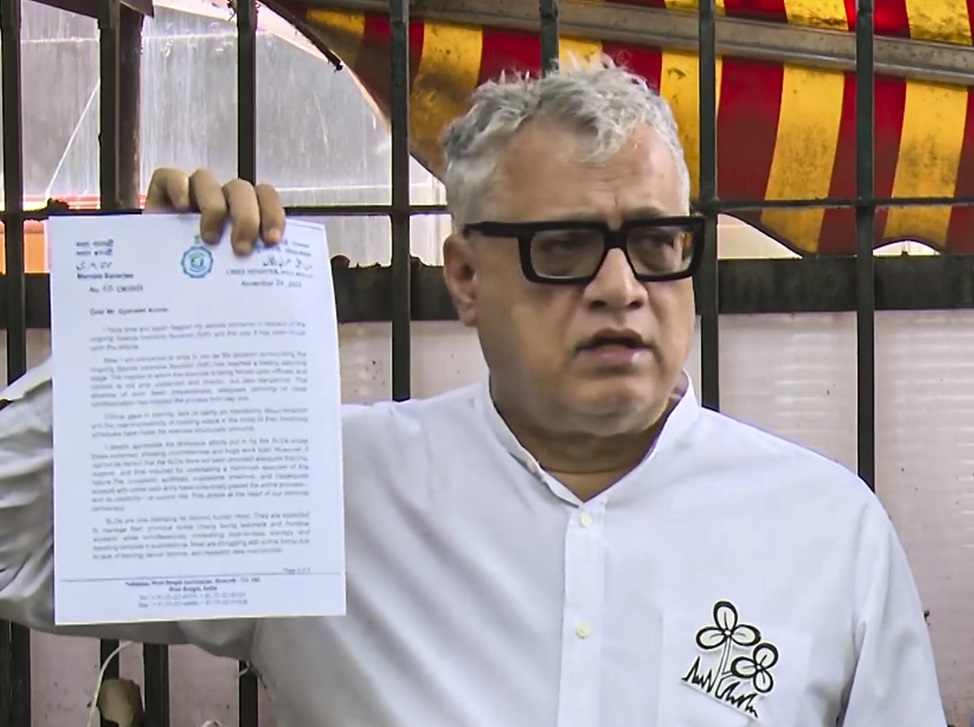
In a post on X, TMC Rajya Sabha leader Derek O'Brien shared a video of his earlier speech on the Constitution (128th Amendment) Bill, 2023 -- also known as the Nari Shakti Vandan Adhiniyam -- and underlined his party’s long-standing advocacy for women’s reservation.
He recalled that TMC chief Mamata Banerjee had raised the issue in Parliament as early as July 14, 1998.
Highlighting his party’s track record, O’Brien pointed to the proportion of women candidates fielded and elected by the TMC, stating that the party had given 41 per cent tickets to women in 2014 and currently has one of the highest shares of women MPs.
"Modi govt cannot rush through a bill in a special parliament session bang in the middle of Assembly Polls, a bill that will change the political map of India based on the 2011 census (data which is fifteen years old) in 2026 without greater discussion (sic)," TMC Deputy Leader in the Rajya Sabha Sagarika Ghose said on X.
"Mr Modi-Shah must be reminded: India is not a single-party democracy. Bulldozing and bullying is against the parliamentary spirit," she said.
In a post on X, TMC leader and former Rajya Sabha MP Saket Gokhale accused the government of running a "fake and malicious agenda " claiming it wants “early reservations for women in Parliament”.
"In reality, Modi is using women as an excuse to bulldoze his real agenda of delimitation (which is redrawing boundaries of Lok Sabha & Assembly seats in states to benefit the BJP)," he alleged.
He said that at the time of passage of the bill on women's reservation in 2023, opposition parties had expressed concern that its implementation would be delayed, but the government had ignored them, and said it would happen after the Census in 2026.
"Now, suddenly, just when Bengal and Tamil Nadu are going to elections, Modi decides that delimitation will be done before the 2026 Census. Instead of conducting delimitation based on India’s actual population, the Modi government has come up with its own unknown formula," he said.
He questioned the connection between delimitation and women's reservation, and what is stopping the government from implementing it on the existing 543 seats without delimitation.
The Union Cabinet has cleared draft bills to operationalise the Nari Shakti Vandan Adhiniyam ahead of the 2029 Lok Sabha elections. The proposed changes include increasing the strength of the Lok Sabha from 543 to 816 seats, with 273 seats reserved for women.
The legislative package is expected to include a Constitution amendment bill to modify provisions of the Act, alongside amendments to the Delimitation Act to enable redrawing of constituencies in line with the expanded House strength.
Another bill is also likely to extend the implementation of the reservation framework to Union Territories with legislatures, including Delhi, Jammu and Kashmir and Puducherry.
_vb_90.jpeg)