Karnataka High Court terms manual scavenging as "most inhuman"
Issues directions for implementation of Manual Scavengers Act, 2013

This report was first published in barandbench.com and has been posted here without any alterations or editing. To read the original report, CLICK HERE
Terming manual scavenging as a "most inhuman" practice, the Karnataka High Court on Wednesday issued a slew of directions to ensure the proper implementation of the Prohibition of Employment as Manual Scavengers and their Rehabilitation Act, 2013 (Manual Scavengers Act).
Before passing these directions, a Bench of Chief Justice Abhay Shreeniwas Oka and Justice Vishwajith Shetty observed that the Indian Constitution, in no way, permits any form of manual scavenging.
"There can be no dispute that our Constitutional philosophy does not permit any form of manual scavenging. Right of a citizen to live with dignity is an integral part of the fundamental rights guaranteed to the citizens under Article 21 of the Constitution of India. The preamble of the Constitution shows that the Constitution seeks to protect the dignity of an individual. There can be no dispute that manual scavenging is most inhuman and it infringes the fundamental rights guaranteed under Article 21."
The Court also held that if any citizen is forced to do manual scavenging, it would be a gross violation of his/her fundamental right conferred by Article 21 of the Constitution of India.
The following are the directions issued to the State government:
To place on record the details about the number of First Information Reports registered for the offences punishable under the Manual Scavengers Act, the details of the cases in which charge sheets were filed, the details of the cases which are pending and the details of the cases which resulted in conviction.
The figures of cases which resulted in acquittal to be also placed on record.
To produce necessary material to show that the District Level Survey Committees as contemplated by sub-clause (c) of Rule 2 of the Manual Scavengers Rules have been duly constituted.
To call for data from all districts for ascertaining whether the District Level Survey Committees have conducted surveys of manual scavengers and whether the Committees have published the final list of Manual Scavengers of the respective districts.
To place on record the necessary details as regards the constitution of the State Level Survey Committees as well as the details regarding the number of meetings the Committee has held.
To place on record comprehensive data about the survey of insanitary latrines throughout the State and the details about the conversion/demolition of insanitary latrines;
To place on record the details relating to final publication of the district-wise final lists of Manual Scavengers and the publication of State level final list of Manual Scavengers;
To issue directions to all local authorities to implement the provisions of the Manual Scavengers Act and the Rules by specifically referring to the obligations and duties under various provisions. The compliance by the local authorities shall be monitored regularly by the State Level Monitoring Committee.
To direct all local authorities to comply with the obligations under subsections (2) and (3) of Section 4 and to immediately ascertain the requirement of number of sanitary community latrines within their respective jurisdictions and thereafter, facilitate the construction of such latrines.
To immediately initiate an awareness campaign on a large scale for elimination of the practice of open defecation and ensure that all local authorities comply with their obligation of eliminating the practice of open defecation in their jurisdiction. The State government shall take help of NGOs and the Karnataka State Legal Services Authority to conduct the campaigns in rural areas;
To place on record the steps taken for rehabilitation of manual scavengers as provided in Section 13 by stating whether there are any schemes of Central and State government for the rehabilitation of manual scavengers as contemplated by Section 13.
This apart, the Court also directed the Karnataka High Court Legal Services Committee and all the District Legal Services Authorities to convene meetings with all the stakeholders to assist them in complying with the directions of the Court and for implementation of the Manual Scavengers Act.
Further, under Article 47 of the Constitution, which is a part of the Directive Principles of the State Policy, the State is under an obligation to endeavour to improve the standard of living of its people, the judgment states.
The detailed judgment also saw the Bench highlighting the the major differences between the old act (Employment of Manual Scavengers and Construction of Dry Latrines (Prohibition) Act, 1993) and the 2013 Act.
It said that the definition of 'manual scavenger' in the 2013 Act is much wider than the definition of 'manual scavenger' under clause (j) of Section 2 of the old Act.
"Under sub-section (1) of Section 5 of the Manual Scavengers Act, there is a complete prohibition on manual scavenging. Under Section 3 of the old Act, the State Government was required to issue a notification for prohibiting engagement or employment of any person for manual scavenging"...Thus, under the old Act, the prohibition was not automatic. The provisions of the new Act are more comprehensive."
On the point of implementation of the past orders issued by the Court and compliance reports filed by the State, the Bench stated,
"We have found that there is hardly any implementation of the provisions of the Manual Scavengers Act and the Rules in the State of Karnataka. Therefore, this is a case where continuous monitoring will be necessary and the power of issuing continuing mandamus will have to be exercised."
These directions were issued in a batch of pleas seeking the abolition of the practice of manual scavenging in the State. The Bench had reserved its order in November.
Two petitions were filed before the High Court seeking a ban on the practice of manual scavenging in the State. The first plea was filed by All India Central Council of Trade Unions (AICCTU), through Advocate Clifton D'Rozario.
Senior Advocate Jayna Kothari appeared for the Karnataka State Legal Services Authority in the the second petition.
The Court has directed the State government to file compliance affidavits by January 30, 2021. The matter will be heard next on February 2, 2021.
[Read judgment]
Manual scavenging.pdf Preview
Courtesy: www.barandbench.com
Let the Truth be known. If you read VB and like VB, please be a VB Supporter and Help us deliver the Truth to one and all.
Protest against demolition drive turns violent in Kolkata, 3 cops injured
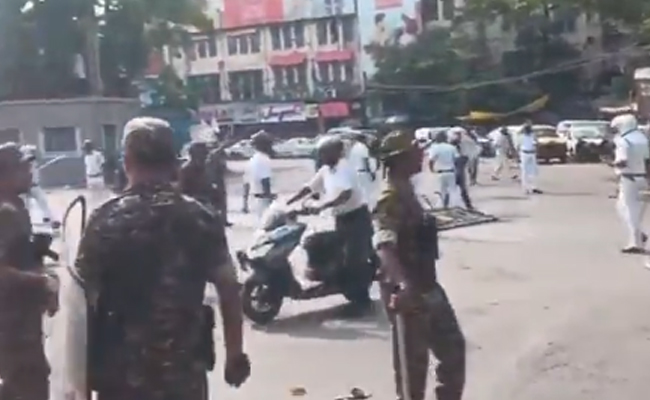
Kolkata (PTI): A protest against the recent bulldozer action in Kolkata's Tiljala turned violent on Sunday as demonstrators hurled stones at police personnel in the minority-dominated Park Circus area, injuring at least three officials and damaging several vehicles.
The flare-up came days after bulldozers rolled into Tiljala as part of the West Bengal government's demolition drive against alleged illegal constructions following the factory fire that killed two persons earlier this week.
On Sunday afternoon, a large number of people gathered near Park Circus Seven Point Crossing to protest against the anti-encroachment drive and attempted to block roads, police said.
As police tried to disperse, what they described as an "unlawful assembly", a section of protesters allegedly resorted to stone-pelting, triggering chaos in the area.
Several vehicles parked along the roadside, including those carrying central forces, were vandalised, officials said.
Heavy deployment of Kolkata Police and central forces was made in the area after the clashes. Route marches and intensified patrolling were undertaken in adjoining localities to prevent further escalation and restore normalcy.
Kolkata Police Additional Commissioner Ashesh Biswas said action has already been initiated against those involved in the violence.
"Some people tried to block the road. It was an illegal gathering. The police were trying to disperse them, and there was pelting of stones. Three of our colleagues were injured," Biswas told reporters.
"We have already arrested a few people," he said.
The officer said police followed standard operating procedures, and efforts were underway to identify all those involved in the violence.
"There was an attack on the police. We will see who is behind it and arrest everyone. Strict legal action will be taken," he added.
While the police maintained the agitation was linked to administrative action against illegal buildings, some locals claimed that grievances over alleged restrictions on the use of loudspeakers during religious prayers and curbs on offering prayers on roads had also contributed to the tensions.
The developments come close on the heels of tension in Kolkata's Rajabazar area on Friday, where a standoff broke out after a group of people allegedly attempted to offer prayers on a public road despite restrictions on blocking traffic.
According to police sources, a large contingent of personnel reached the area and asked people to vacate the road, after which the situation turned tense briefly.
Members of the local community argued that holding Friday prayers on roads had been a long-standing practice in the locality, while the administration maintained that keeping roads clear was necessary for traffic movement and maintenance of law and order.
Police, however, did not indicate any direct connection between the Rajabazar incident and Sunday's violence in Park Circus.
Authorities also did not immediately disclose the number of persons arrested in Sunday's clashes or whether any protesters sustained injuries during the confrontation.