Karnataka offers extensive incentives in its proposed IT policy

Bengaluru (PTI): Karnataka has proposed a new Information Technology Policy for 2025–2030, offering extensive financial and non-financial incentives aimed at accelerating investments, strengthening innovation and expanding the state's tech footprint beyond Bengaluru.
The Karnataka Cabinet gave its nod to the policy 2025–2030 with an outlay of Rs 445.50 crore on Thursday after the Finance Department accorded its approval.
The policy introduces 16 incentives across five enabler categories, nine of which are entirely new, with a distinctive push to support companies setting up or expanding in emerging cities.
Alongside financial support, the government is also offering labour-law relaxations, round-the-clock operational permissions and industry-ready human capital programmes to make Karnataka a globally competitive 'AI-native' destination.
According to the policy, units located outside Bengaluru will gain access to a wide suite of benefits, including research and development and IP creation incentives, internship reimbursements, talent relocation support and recruitment assistance.
The benefits also include EPF reimbursement, faculty development support, rental assistance, certification subsidies, electricity tariff rebates, property tax reimbursement, telecom infrastructure support, and assistance for events and conferences.
Bengaluru Urban will receive a focused set of six research and development and talent-oriented incentives, while Indian Global Capability Centres (GCCs) operating in the state will be brought under the incentive net.
Incentive caps and eligibility thresholds have been raised, and the policy prioritises growth-focused investments for both new and expanding units.
Beyond incentives, the government focuses on infrastructure and innovation interventions.
A flagship proposal in the policy is the creation of Techniverse -- integrated, technology-enabled enclaves developed through a public-private partnership model inside future Global Innovation Districts.
These campuses will offer plug-and-play facilities, artificial intelligence and machine learning and cybersecurity labs, advanced testbeds, experience centres, and disaster-resistant command centres.
There will also be a Statewide Digital Hub Grid and a Global Test Bed Infrastructure Network, linking public and private research and development, and innovation facilities across Karnataka.
The government has proposed a Women Global Tech Missions Fellowship for 1,000 mid-career women technologists, an IT Talent Return Programme to absorb experienced professionals returning from abroad, and broad-based skill and faculty development reimbursements.
Shared corporate transport routes in Bengaluru and tier-two cities will be designed with Bengaluru Metropolitan Transport Corporation and other transport entities to support worker mobility.
The government said the policy is the outcome of an extensive research and consultation process involving TCS, Infosys, Wipro, IBM, HCL, Tech Mahindra, Cognizant, HP, Google, Accenture and NASSCOM, along with sector experts and stakeholder groups.
It estimates an outlay of Rs 967.12 crore over five years, comprising Rs 754.62 crore for incentives and Rs 212.50 crore for interventions such as Techniverse campuses, digital grid development, global outreach missions and talent programmes.
Let the Truth be known. If you read VB and like VB, please be a VB Supporter and Help us deliver the Truth to one and all.
Sujit Nair raises concerns over speculation of DMK-AIADMK understanding to block TVK
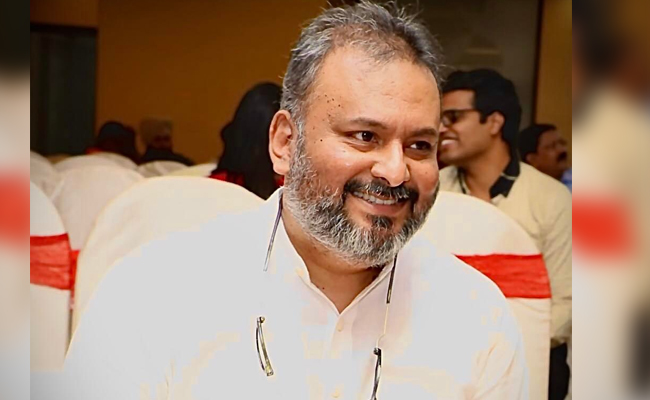
Chennai: Journalist and political commentator Sujit Nair has expressed concern over speculation that the Dravida Munnetra Kazhagam and the All India Anna Dravida Munnetra Kazhagam could explore a post-poll understanding to prevent Vijay-led Tamilaga Vettri Kazhagam from forming the government in Tamil Nadu.
In a social media post, Sujit Nair said the election verdict in Tamil Nadu reflected a clear public demand for political change and argued that the mandate should be respected irrespective of political preferences.
Referring to reports and political discussions surrounding a possible understanding between the DMK and AIADMK, he said he hoped such developments remained only speculative conversations and did not turn into reality.
Nair stated that if such an alliance were to take shape, it would raise serious questions about ideological politics in the country. He said TVK had emerged through a democratic electoral process and that the legitimacy to govern in a parliamentary democracy comes from the people’s verdict.
According to him, attempts to prevent an electoral winner from forming the government through unexpected political arrangements may be constitutionally valid, but many people could view them as politically opportunistic.
He further said that such a move could particularly affect the political image of the DMK, which has historically projected itself around ideology, social justice and opposition politics. Nair said that in ideological terms, the DMK appeared closer to TVK than to the AIADMK, and joining hands with its long-time political rival only to remain in power could weaken its broader political narrative.
He added that the same questions would apply to the AIADMK as well, as the party had spent decades positioning itself against the DMK and such an arrangement could create discomfort among its cadre and supporters.
Drawing a comparison with Maharashtra politics in 2019, Nair said he had expressed similar views when the Shiv Sena formed an alliance with the Indian National Congress and the Nationalist Congress Party after the Assembly elections.
He said post-poll alliances between long-standing political rivals often create a public perception that ideology and electoral mandates become secondary when political power equations come into play.
Nair also said such developments increase public cynicism towards politics and reinforce the belief among voters that ideology is often sidelined after elections.
He maintained that the Tamil Nadu verdict was emphatic and said respecting both the spirit and substance of the mandate was important for the credibility of democratic politics.