Karnataka poised to lead India's space tech growth: Minister Priyank Kharge
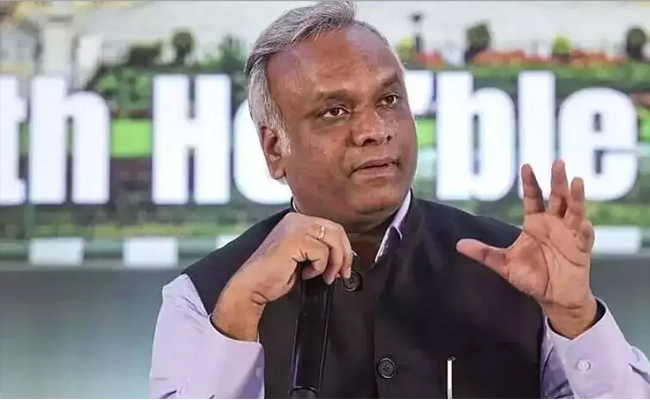
Bengaluru (PTI): Karnataka is well-positioned to power India’s next phase of growth in the global space economy, state IT Minister Priyank Kharge said on Monday.
He added that the Space Tech Policy 2025-2030 marks a major step towards positioning the state as India’s leading space technology hub.
The policy aims to help Karnataka capture 50 per cent of the national space technology market and 5 per cent of the global space economy by 2034, Priyank said.
Outlining the vision behind the policy, which was announced last month during the Bengaluru Tech Summit, Priyank stated that the state has set clear and measurable goals to accelerate growth in the space sector.
"Through this policy, Karnataka aims to mobilise investments of USD 5 billion, support over 500 space start-ups and MSMEs, create more than 50,000 high-skill jobs, and enable companies in the state to design and launch over 50 satellites in the coming years," he said, in a statement.
ALSO READ: Bomb threat at Mangaluru RTO turns out to be hoax
Reiterating Bengaluru’s legacy as India’s technology and innovation capital, the minister noted that the city has consistently transformed innovative ideas into nationally and globally significant missions.
"From satellites and aerospace to robotics and deep tech, Bengaluru has been the place where India’s global aspirations take shape. This ecosystem has been built over decades with the establishment of institutions such as HAL, NAL, and ISRO," he said.
The minister added that the Space Tech Policy 2025-2030 represents the next phase of Karnataka’s technology-led growth.
"The policy is designed to strengthen the state’s leadership across both upstream space technologies—covering deep-tech research, manufacturing, and core systems—and downstream innovation, where space-based applications are developed to address real-world challenges," he said.
According to the statement, key focus areas under the policy include supporting companies engaged in next-generation space capabilities such as space technology manufacturing, deftronics, and advanced wireless communications for defence and strategic applications.
To enable this, the state will establish dedicated space manufacturing clusters, develop common testing and validation facilities, and leverage Karnataka’s strong institutional linkages with organisations such as ISRO and DRDO.
"With this policy, Karnataka will create an ecosystem where innovation, manufacturing, and services companies in the sector can thrive," Priyank said.
"The state is now well-positioned to power India’s next phase of growth in the global space economy," he added.
Let the Truth be known. If you read VB and like VB, please be a VB Supporter and Help us deliver the Truth to one and all.
21 hours raid fetch nothing for ED, claims Karnataka Cong MLA’s son
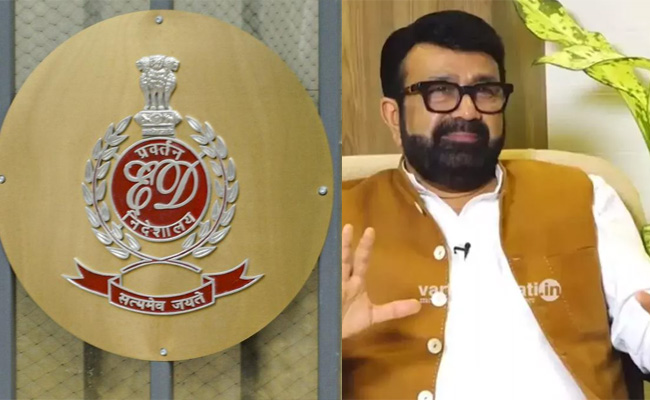
Bengaluru (PTI): Karnataka Congress MLA N A Haris' son Mohammed Haris Nalapad on Tuesday claimed that the 21 hours of search by the ED in his house and other locations did not fetch anything.
The Enforcement Directorate on Monday raided the premises of the two sons of Haris (Mohammed Haris Nalapad and Omar Farook Nalapad), Aqeeb Khan, grandson of ex-Union cabinet minister K Rahman Khan and an alleged crypto hacker named Srikrishna Ramesh alias Sriki in a crypto currency-linked money laundering case.
More than a dozen premises in the city have been covered as part of the action executed under the provisions of the Prevention of Money Laundering Act (PMLA).
"My grandfather is 89-year-old. There is not a single bad mark. My father (N A Haris) is a four-time MLA. There is not a single accusation against him. Their only intention was to target myself and my brother. As simple as that," Mohammed Nalapad, who is a former Karnataka Youth Congress president, told reporters.
According to him, the ED officials carried out raids for 21 hours.
"After 21 hours of search, they took away only two mobile phones from our house. They did not get a single paisa. The ED will testify it," the Congress leader said.
Exuding faith in the law, he said he is ready to fight the case in court.
"Me and my father have opted for politics and we are in public life. You can call me whatever you want but I have not done anything wrong," Mohammed Nalapad said.
Regarding his relationship with Sriki, he said he knew him but had no clue what he was doing.
"I have never said that either me or my brother do not know Sriki. But how will I know what he does in his house? Can his crimes be linked to us," he asked.
The money laundering case stems from some Karnataka Police FIRs and chargesheets filed in a 2017 case of hacking of national and international websites, stealing of bitcoins and sale of these 'stolen' virtual digital assets (VDA) through crypto platforms by the alleged hacker Sriki and his associates.
The Nalapad brothers and Aqeeb Khan are alleged to be the beneficiaries of the proceeds of crime generated through this alleged crypto-linked crime, the ED said.