Karnataka power tariff to rise by 36 paise per unit from April 1

Bengaluru, Mar 20 (PTI): Electricity consumers in Karnataka will have to pay an additional 36 paise per unit starting from April 1 as a surcharge, following a recent directive.
The move comes after the Karnataka Electricity Regulatory Commission (KERC) allowed energy supply companies (ESCOMs) to recover the government's share of pension and gratuity (P&G) contributions from consumers.
The P and G contributions will be revised for financial years 2026-27 and 2027-28, with consumers paying 35 paise and 34 paise per unit, respectively.
"In accordance with the Government of Karnataka's order, the Commission allows ESCOMs to recover the government’s portion of pension and gratuity contributions uniformly from their consumers as 'P&G Surcharge (Government Portion),' stated the KERC order dated March 18.
"The aforesaid levy shall come into effect from April 1, 2025, and remain in force for the entire duration of the control period, commencing from FY 2025-26 and concluding in FY 2027-28, or as decided by the government from time to time," it added.
State BJP president B Y Vijayendra criticised the move, stating that since the "anti-people" Congress government came to power in Karnataka, the only guarantee it has implemented is "price hikes".
"People of the state must be cautious about the 36 paise increase in power tariffs, as the current government is a pickpocket government. On one hand, they claim to be implementing guarantee (populist) schemes, while on the other, they are burdening the people with price hikes and taking back the money," he alleged.
Energy Minister K J George clarified that the pension and gratuity issues of Karnataka Power Transmission Corporation Ltd (KPTCL) and ESCOM staff have been undertaken in accordance with a Karnataka High Court order issued in March 2024, and following this, the KERC has implemented a tariff hike.
"Our government has not increased the electricity rates by 36 paise per unit. The hike follows the Karnataka High Court's order, allowing the KPTCL and ESCOM staff to recover customer pension and gratuity payments. Based on this, the KERC has issued the directive. As a result, for the financial year 2025-26, the rate has been raised by 36 paise per unit," George's office said in a statement quoting him.
Noting that after the dissolution of the Karnataka Electricity Board (KEB) and the formation of KPCL and five ESCOMs, the then BJP government, for the first time in March 2022 submitted a proposal to the KERC, requesting approval to recover pension and gratuity contributions from customers, he said, "However, KERC did not approve the proposal at that time. Following the High Court's order, KERC has (now) issued a new directive."
Let the Truth be known. If you read VB and like VB, please be a VB Supporter and Help us deliver the Truth to one and all.
Meet Kerala's Dr. Santosh Kumar who has served in various warzones; latest in Gaza
Read his experiences from Gaza, in Vartha Bharati's interview
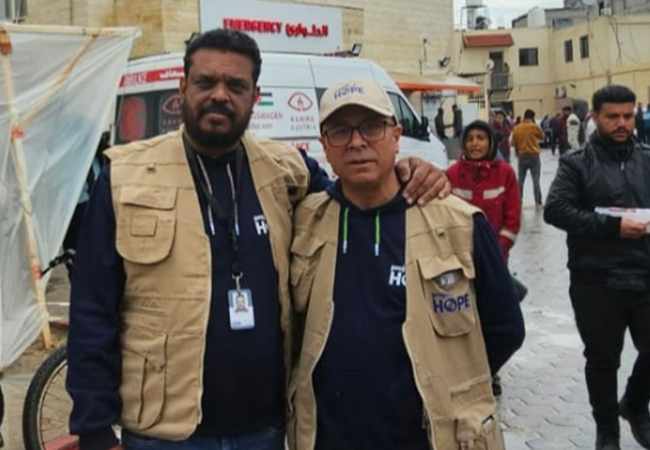
He has walked through some of the world’s most dangerous places, not as a witness, but as a doctor treating people when everything around them is falling apart. Dr. Santhosh Kumar from Kerala has spent years working in war zones and crisis-hit regions with Doctors Without Borders, often stepping in where medical systems no longer exist.
Most recently, he served in Gaza, where large-scale violence has left thousands struggling for basic medical care. Even after returning, his work there is not over. He is preparing to head back to Gaza later this month, continuing his role on the frontlines of a humanitarian crisis.
In this interview, he speaks about what he has seen, the challenges of working in conflict zones, and what it means to be a doctor when survival itself becomes uncertain.
Excerpts from the interview below:
Question: You had just come back from Ukraine after a long stretch of work. What made you say yes again, this time for Gaza, without even taking a break?
Dr. Santosh Kumar: I had just returned from Ukraine, and physically, yes, I was tired. But when the call came for Gaza, it didn’t feel like something I could say no to. Situations like these don’t wait for you to rest. When there is such a large-scale humanitarian crisis unfolding, you don’t think in terms of convenience. You think about where you are needed the most. For me, the decision was simple, if I have the skills and the experience, I have to be there.
Question: Do you remember your first night in Egypt before entering Gaza? What was going on in your mind at that moment?
Dr. Santosh Kumar: That night was very heavy. You are standing at the edge of something you already know is going to be intense, but you still don’t know what exactly you are walking into. There is always a mix of thoughts about the people inside, about what kind of medical situation you will face, and whether the system there is even functioning. At the same time, you prepare yourself mentally to adapt quickly. You try to stay calm, because once you cross over, there is no time to process emotions.
Question: When you finally reached Gaza, what was the first thing that told you this was going to be very different from any other place you’ve worked in?
Dr. Santosh Kumar: It is very important to understand what is happening there. This is not a war. This is a genocide. When you see the scale of destruction, the number of civilians affected, and the complete breakdown of basic systems, it becomes very clear that this is different. As doctors, we are trained to respond to emergencies, but here, the situation goes beyond a typical conflict setting. Understanding that reality is important before you even begin your work.
Question: You’ve spoken about that smell when you entered Gaza. It’s something people don’t usually talk about. What did that moment feel like for you?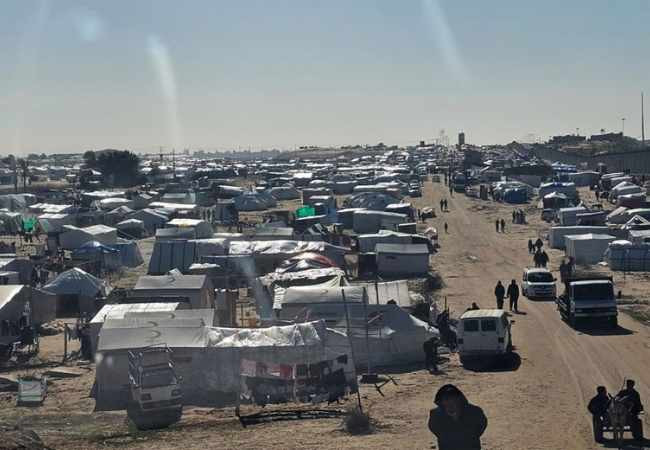
Dr Santosh Kumar from the Gaza war front.
Dr. Santosh Kumar: The first thing that hits you is not what you see, but what you smell. It’s very difficult to explain, but it stays with you. There is this constant mix in the air the smell of medicines, of wounds, of poor sanitation, and something deeper that comes from a complete breakdown of systems. You can feel the suffocation almost immediately.
The healthcare system has collapsed. Sanitation has collapsed. People don’t even have access to basic facilities. When all of that comes together, it creates an environment where the air itself feels heavy. It is not something you experience in a typical conflict zone.
Question: When you saw people living in tents, without even basic dignity, did it hit you immediately, or did it take time to sink in?
Dr. Santosh Kumar: It hits you almost instantly, but at the same time, the full reality takes time to process. You see thousands of people living in makeshift tents, without proper water, sanitation, or healthcare. The system is completely broken.
If people are not dying from bombs or bullets, they are dying from diseases. There are very limited places for basic human needs like excretion, and the queues are so long that people are forced to wait for hours. In some cases, people are collapsing or dying while waiting..jpg)
Photograph by Dr. Santosh Kumar
This is not just about displacement. It is about the loss of dignity at every level. As a doctor, you are trained to deal with emergencies, but here, the scale and the nature of suffering are very different. It takes time for that to fully sink in, even if the shock is immediate.
Question: You’ve seen many war zones. What was it about Gaza that disturbed you the most compared to others?
Dr. Santosh Kumar: In most conflict zones, even if the situation is bad, some systems still function at some level. In Gaza, what I saw was a complete collapse. There is no proper healthcare system, no sanitation, nothing functioning the way it should. The scale is also very different. The number of people affected, and the intensity of the situation, makes it much more disturbing than many other places I have worked in.
Question: Can you describe one scene that still hasn’t left your mind?
Answer: There is no one single scene. That’s the reality. Every day, things are happening around you. People keep coming in with injuries. Families bring their relatives, sometimes in critical condition, sometimes already gone. It becomes a continuous cycle. There is no one moment you can isolate, because the entire environment is like that all the time.
Question: When you saw children coming in injured… or sometimes not even making it… how do you process that as a doctor and as a human being?
Dr. Santosh Kumar: As a doctor, you focus on what you can do in that moment. You don’t have the luxury to process everything emotionally when you are working. You have to keep going, patient after patient. But as a human being, it does affect you. You see children, you see families, and you understand what they are going through. Still, during work, you have to stay focused on treatment.
Question: There’s a part where you mentioned people losing even their basic dignity. How difficult is it to witness that, knowing you can’t fix it immediately?
Dr. Santosh Kumar: It is difficult, but we have to be clear about our role. We are not there to fix everything. We are there to treat patients. The situation around us may be chaotic. When patients die, sometimes people even blame us. But in that environment, you have to stay focused on your responsibility. Treating people remains our priority.
Question: When you have more patients than you can treat, how do you decide who gets treated first? How do you live with those decisions?
Dr. Santosh Kumar: Like I said, the number of patients is always more than what the system can handle. In such situations, you follow basic medical priorities. You treat those who can be saved with immediate intervention. It is not an easy decision, but in these environments, you have to be practical.
You don’t have the luxury to think too much about each decision at that moment. You focus on doing the maximum possible with the limited resources you have. That becomes your approach.
Question: There are moments where you know someone could have survived if there were proper resources. How do you carry that weight?
Dr. Santosh Kumar: That is something you are aware of all the time. You know that with better facilities, better access, some of these lives could have been saved. But like I said earlier, we are not there to fix the entire system. We are there to treat with what we have.
You cannot carry every single outcome with you while you are working. If you do that, you won’t be able to continue. You accept the limitations and focus on the patients you can help.
Question: After coming back, do these memories stay with you? Or do you learn to switch off?
Dr. Santosh: The memories stay. You don’t completely switch off from something like this. What you see there, it stays with you in some form.
But over time, you learn how to manage it. Because if you keep holding on to everything, it becomes very difficult to continue this kind of work. So you carry it, but you also learn how to move forward.
Question: A lot of young people today see such things only through social media. What do you think they are missing?
Dr. Santosh Kumar: What you see on social media is only a small part of the reality. It doesn’t show you the full picture. It doesn’t show the scale, the continuous nature of the suffering, or what people are going through every single day.
Like I said, when you are physically present there, you understand how different it is. Social media can inform you, but it cannot make you fully understand the situation.
Question: How can youngsters build real empathy, not just momentary sympathy that fades after scrolling?
Dr. Santosh Kumar: Empathy comes from understanding and consistency. It is not about reacting to one post or one video. It is about staying aware, learning more about the situation, and trying to understand what people are going through.
It also means thinking beyond immediate reactions. If you want to build real empathy, you have to stay connected to the issue, not just for a moment, but over time.
Question: For someone who genuinely wants to help, where do they even begin?
Dr. Santosh Kumar: You don’t have to start with something big. You can begin by educating yourself, understanding the ground realities, and supporting credible organisations that are working in these areas.
Helping is not always about being physically present in a conflict zone. There are many ways to contribute, even from where you are.
Question: Do you think you need to be a doctor or specialist to make a difference in such situations?
Dr. Santosh Kumar: No, not at all. Of course, medical professionals have a specific role, but these situations require support in many forms. There are people working in logistics, coordination, communication, and many other areas.
Everyone has a role to play depending on their skills.
Question: What role can students or young professionals play from where they are?
Dr. Santosh Kumar: They can start by being informed and responsible. They can support the right initiatives, raise awareness in a meaningful way, and contribute in whatever capacity they can.
Like I said, you don’t have to be on the ground to make a difference. What matters is how consistently and responsibly you engage with the issue.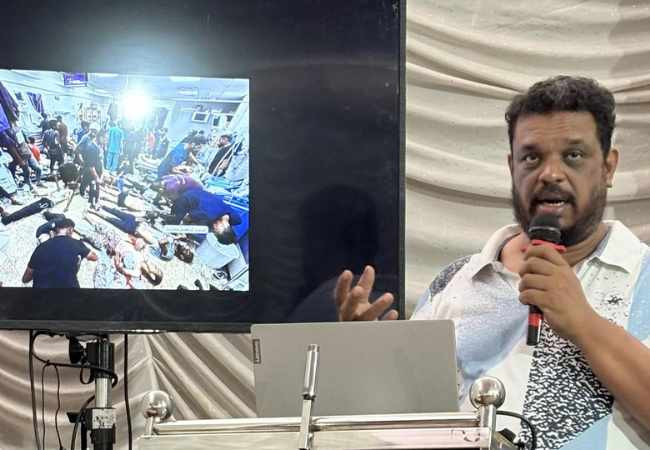
Dr. Santhosh Kumar recounts his experience in Gaza at the Quantum Century exhibition in February 2026. (Courtesy: The Hindu)
Question: After everything you’ve seen in Gaza, has it changed how you look at life?
Dr. Santosh Kumar: It does change you in some ways. When you see people struggling for the most basic things, food, water, safety, you start looking at life a little differently. Things we often take for granted become much more real.
At the same time, like I said, you learn to keep moving forward. You cannot keep thinking about everything all the time. You take what you have seen, and you continue with your work.
Question: If there’s one thing you want people to understand about Gaza beyond headlines and politics, what would that be?
Dr. Santosh Kumar: The most important thing is to understand the reality on the ground. This is not just about headlines or numbers. These are real people, living in extremely difficult conditions.
And like I said earlier, it is important to understand that what is happening there is not a war. It is a genocide. Unless people understand that, they won’t fully understand the situation.
Question: And finally, what keeps you going? What makes you still say yes, even after seeing so much pain?
Dr. Santosh Kumar: Like I said, this is something I chose a long time ago. From my early years, I have been involved in this kind of work. So for me, it is a commitment.
You don’t think about it every time as a new decision. You just continue doing what you believe is your responsibility. That is what keeps me going.