Karnataka PUC students to write 80-mark examination starting academic year 2023-24; Details here
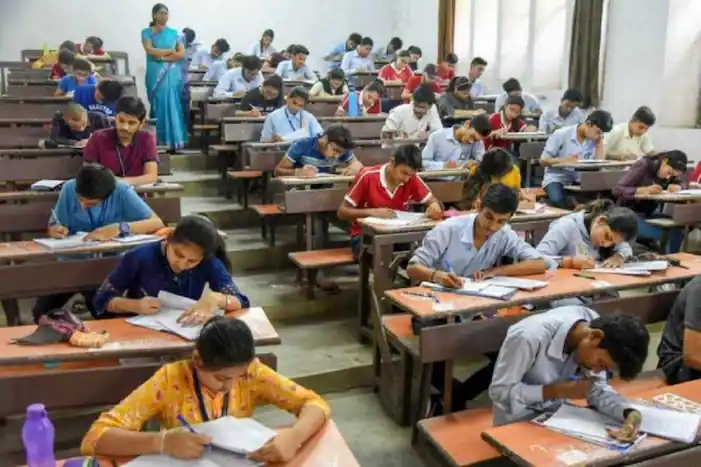
Bengaluru: The Karnataka government has made a significant decision to implement a 20:80 evaluation formula for Pre-University Course (PUC) exams in subjects without practicals, starting from the academic year 2023-24. According to a report by The Indian Express, this new evaluation pattern will involve an 80 marks examination and the remaining 20 marks will be awarded based on internal assessment.
The adoption of this evaluation pattern aligns with the Central Board of Secondary Education (CBSE)'s evaluation system. The primary objective behind this move is to reduce test anxiety and stress among students, while also promoting their professional skills through internal evaluation. Additionally, this approach aims to ensure uniformity in student performance.
As per the report, the 20 marks for internal assessment will be awarded based on the students' performance in the first and second unit tests, mid-term examination, as well as project and assignment marks. The remaining 80 marks will be allocated for the annual examination. Repeaters and private candidates will be required to answer a 100 marks question paper.
ALSO READ: Jain monk's murder issue rocks Karnataka Assembly, govt rejects BJP's demand for CBI probe
The government order, also states that students must score a minimum of 24 marks to pass the annual examination. In cases where a student is absent for one of the first and second short-term examinations or the mid-year examination, the marks obtained in the remaining two exams will be converted to 10 marks and averaged. If a student has appeared for only one short examination or mid-year examination, half of those marks will be converted to ten.
Furthermore, if a student does not appear for any short or mid-year examination, and fails to submit any projects or assignments, they will need to secure 35 marks out of 80 to pass the annual examination. The department will provide a list of project or assignment titles to students, specific to the lectures in each subject, within their respective districts. The college principals are responsible for overseeing the internal evaluation process, which includes the fair allocation and recording of marks to prevent any confusion.
Let the Truth be known. If you read VB and like VB, please be a VB Supporter and Help us deliver the Truth to one and all.
K'taka bypolls: Bagalkot records 43.75 per cent turnout till 1 pm, 37.17 pc in Davanagere South
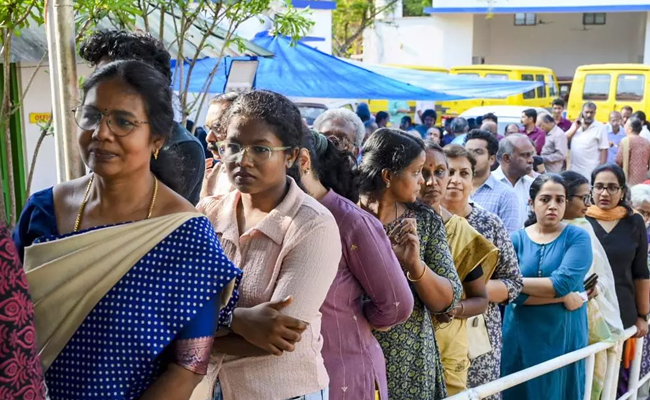
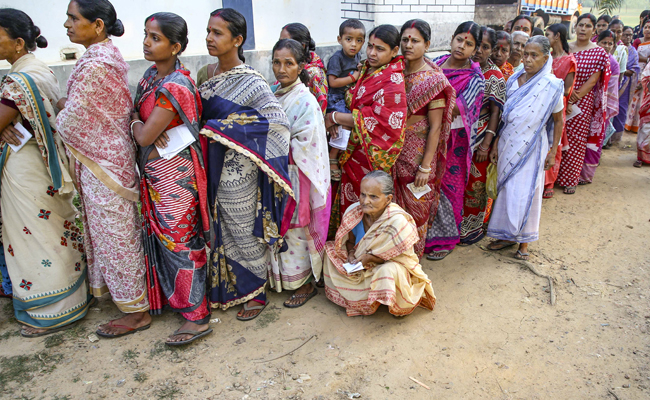
Bengaluru (PTI): At least 43.75 per cent of voters in Karnataka's Bagalkot, where polling for a by-election is underway, exercised their franchise by 1 pm on Thursday.
Davanagere South recorded a turnout of 37.17 per cent, the Chief Electoral Officer's (CEO) office said.
The bypolls were necessitated due to the demise of senior Congress MLAs H Y Meti (Bagalkot) and Shamanur Shivashankarappa (Davanagere South).
While the ruling Congress faces the challenge of retaining both seats, the BJP is aiming to wrest them and deliver a setback to its rival, which is currently witnessing an "internal power struggle" over leadership.
A total of over 2.59 lakh eligible voters are expected to cast their votes at around 319 polling stations in Bagalkot, where nine candidates are in the fray.
In Davanagere South, over 2.31 lakh eligible voters are expected to vote across 284 polling stations, with 25 candidates contesting.
The BJP has fielded former MLA and 2023 defeated candidate Veerabhadrayya Charantimath from Bagalkot, and a fresh face, Srinivas T Dasakariyappa, from Davanagere South.
The Congress has given tickets to family members of the late legislators in both constituencies. Bagalkot candidate Umesh Meti is the son of H Y Meti, while Samarth Mallikarjun from Davanagere South is the grandson of Shamanur Shivashankarappa.
Samarth's father, S S Mallikarjun, is a minister in the Siddaramaiah-led Cabinet and in charge of Davanagere district, while his mother, Prabha Mallikarjun, is a Member of Parliament from the region.
The BJP is looking to make gains in the bypolls and energise its cadre ahead of the 2028 Assembly elections. For the Congress, retaining both seats is crucial, as a loss could be seen as a negative verdict on the performance of the Siddaramaiah-led government.
In the 2023 Assembly elections, H Y Meti defeated BJP's Charantimath by a margin of 5,878 votes in Bagalkot, while Shivashankarappa defeated BJP's B G Ajay Kumar by 27,888 votes in Davanagere South.