Karnataka: 'Reading Campaign' begins at govt, aided schools
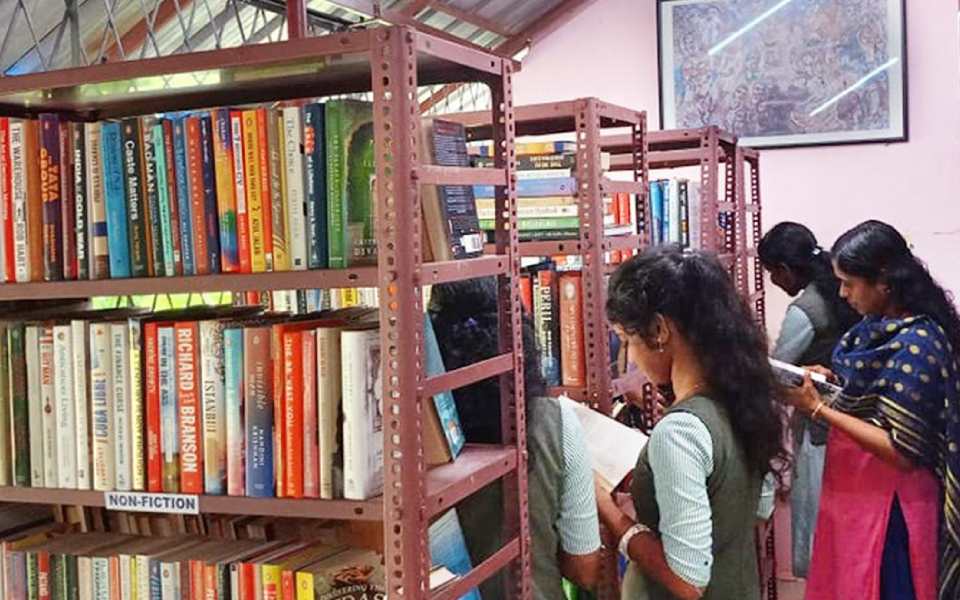
Bengaluru: The Department of School Education in Karnataka has officially kickstarted a ‘Reading Campaign’ across all government and aided schools on Tuesday. The initiative strives to develop and enhance reading skills among students from classes 1 to 7.
Schools have been provided with a variety of activities designed to integrate reading into the students' daily routines. This campaign will run in two phases for a period of 21 days.
Emphasising the critical role of books in improving comprehension and expanding knowledge, the department stressed that these activities should not interfere with regular teaching hours. “The reading activity must be done during morning assembly time or during the first class of the day or during the library hours fixed as per the school time table and should not disturb the regular teaching hours of the school,” the circular mentioned.
The school children will be provided with story books suitable for their age. If there is no reading material available, then the teachers can utilise the materials provided by the department which are in PDF format, officials from the department explained to the Deccan Herald.
Additionally, teachers are required to document the reading activities through photographs and share them on WhatsApp groups that include local officials, parents, and members of the School Development and Monitoring Committee.
Let the Truth be known. If you read VB and like VB, please be a VB Supporter and Help us deliver the Truth to one and all.
Heavy rain, hailstorms lash parts of Uttarakhand; all districts put on high alert
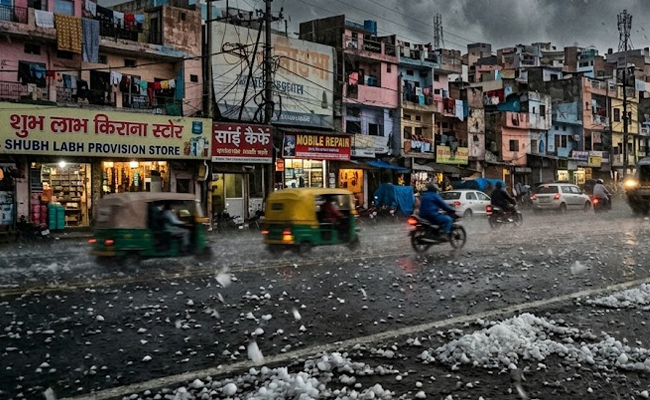
Dehradun (PTI): Heavy rain and hailstorms accompanied by strong winds lashed several districts of Uttarakhand on Sunday morning, prompting the state administration to put all district authorities on high alert.
The sudden change in weather caused uprooted trees to block roads and disrupted power supply at various locations.
Disaster Management and Rehabilitation Secretary Vinod Kumar Suman chaired a review meeting with district officials to assess the situation.
The India Meteorological Department (IMD) has forecast light to moderate rain and thunderstorms at most places across all districts for Monday and Tuesday. Snowfall is expected in regions situated at altitudes of 4,000 metres and above.
An 'orange alert' remains in place for Dehradun, Haridwar, Tehri, Pauri, Nainital, Champawat, and Udham Singh Nagar. These districts are likely to witness isolated heavy rain, hailstorms, and intense to very intense spells of rain accompanied by gusty winds reaching speeds of 40-50 kmph, the IMD said.
The weather office predicted that maximum temperatures across the state are likely to fall by 3-5 degrees Celsius over the next three to four days. During the past 24 hours, maximum temperatures remained "markedly below normal" in the plains and ranged from "markedly" to "appreciably" below normal in the hilly regions.
Dehradun experienced dark, overcast skies early Sunday, creating night-like conditions during morning hours. The city recorded a maximum temperature of 34.7 degrees Celsius, 5.3 degrees Celsius below the seasonal average.
For the state capital, the forecast predicts a partly to generally cloudy sky with a high of 31 degrees Celsius and a low of 19 degrees Celsius.
Significant rainfall was recorded across the state after 8.30 am on Sunday, with Jollygrant receiving 21.6 mm and Mohakampur recording 19.8 mm. Other areas, including Mukteshwar (15.0 mm), Mussoorie (13.4 mm), and Pithoragarh (8.5 mm), also saw measurable precipitation.
Secretary Suman directed officials to clear blocked roads on priority to ensure public convenience. Specific instructions were issued regarding the Char Dham Yatra, ordering that helicopter services must operate strictly according to weather conditions to ensure pilgrims' safety.
Isolated places in the remaining hilly districts are also expected to experience thunderstorms with lightning and intense rain spells.