
Speaker Ramesh Kumar disqualifies 14 more rebel MLAs ahead of trust vote on Monday
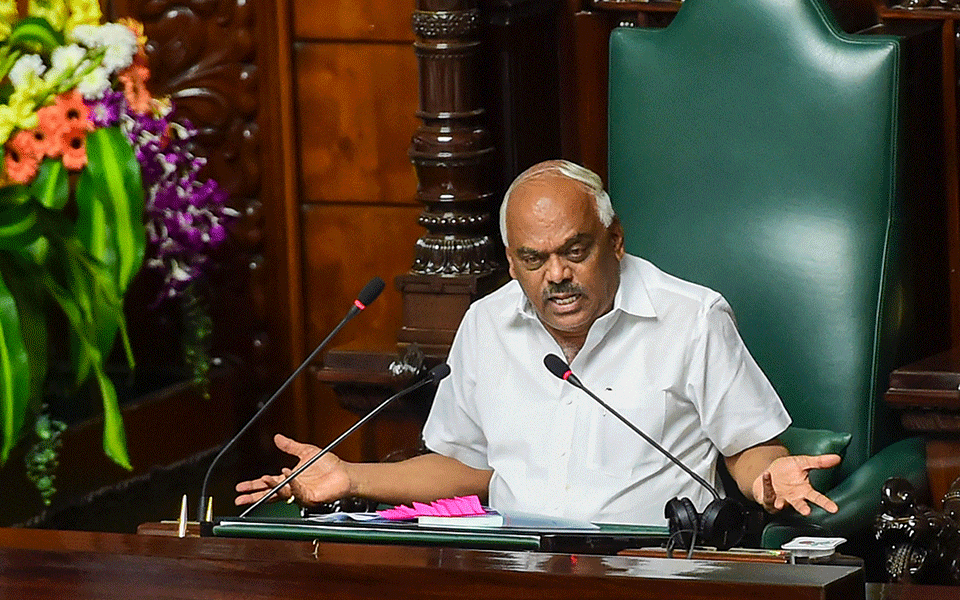
Bengaluru: Karnataka Assembly speaker K R Ramesh Kumar on Sunday disqualified 14 more rebel MLAs under the anti-defection law till the end of the assembly term in 2023, a day ahead of Chief Minister B S Yediyurappa seeking the trust vote in the assembly to prove his majority.
Eleven Congress MLAs and three JDS lawmakers faced the axe from the speaker, who pronounced his ruling at a hurriedly called news conference, two days after Yediyurappa took the oath as chief minister after the collapse of the Congress-JDS coalition government.
The Speaker's action would have no bearing on the fate of the Yediyurappa government, as with disqualification of the errant MLAs with immediate effect, their absence would reduce the effective strength of the House, making it a smooth affair for the BJP.
The absence of 20 MLAS--17 rebels, also one each legislator from Congress, BSP and Independent--during the vote of confidence motion moved by the Congress-JDS coalition government headed by H D Kumaraswamy had led to its downfall after weeks of drama marked by murky political intrigues and court battle.
With the disqualification of 17 rebel MLAs --14 from the Congress and three from JDS -- on Sunday, the effective strength of the 224-member assembly excluding the Speaker, who has a casting vote in case of a tie, is 207. The magic figure required will be 104.
BJP along with the support of one independent has 106 members, Congress 66 (including nominated), JD(S) 34 and one BSP member, who has been expelled by the party for not voting for the Kumaraswamy government during the trust vote.
"I have used my judicial conscience... I am 100 per cent hurt" said the Speaker, when asked about his controversial decision on disqualification being called into question and allegations about his conduct in the entire issue.
The Speaker's sudden move also comes with indications from the BJP that it was mulling moving a no-confidence against him if he doesn't voluntarily give up the post when the assembly meets on Monday.
Kumar said he was taking the action based on the petitions moved by the Congress and JDS to disqualify the rebel MLAs, who had also submitted resignations as assembly members and were absent during the trust vote sought by the H D Kumaraswamy headed government, leading to its downfall.
He said he had rejected the request by the rebel MLAs to give him four weeks more to appear before him on the issues of their resignations and disqualification plea against them.
The Speaker had made it clear when he disqualified three rebel MLAs earlier that a member disqualified under the anti-defection law cannot contest or get elected till the end of the term of the present House, a contention which has been challenged by the BJP, rebel MLAs and several legal experts.
Reading out the names of errant MLAs, the speaker said, "they cease to be MLAs with immediate effect till the expiry of the 15th assembly (in 2023)," adding, "with responsibility and fear I have taken this decision."
"The way I am being pressurised mentally as Speaker to deal with all these things, I am pushed into a sea of depression,' said an emotional Kumar.
The disqualified MLAs are: Pratap Gowda Patil, B C Patil, Shivram Hebbar, S T Somashekar, Byrati Basavaraj, Anand Singh, Roshan Baig, Munirathna, K Sudhakar and MTB Nagaraj and Shrimant Patil (all Congress).
Other party MLAs Ramesh Jarkiholi, Mahesh Kumatalli and Shankar were disqualified on Thursday. JD(S) members who faced action are: Gopalaiah, A H Vishwanath and Narayana Gowda.
The BJP slammed the Speaker's action, calling it "unfair and violative of the law" which, it said, had been taken "yielding to the pressure from a party".
"It is a motivated and defective order," said senior BJP leader Govind Karjol, adding, the rebels would challenge it in the Supreme Court, where they were certain to "get justice."
The MLAs had quit on their own and their resignations should have been accepted, Karjol said. Karnataka Congress welcomed the Speaker's decision to disqualify the rebel MLAs.
"The court of the public will also give the appropriate punishment to these legislators who have betrayed their parties and people who voted them by joining hands with BJP to bring down the coalition government," the party tweeted.
Congress Legislature Party leader Siddarmaiah, in a tweet, termed the Speaker's decision as "a victory for democracy".
"I believe this decision will put an end to the shabby culture of selling oneself by disregarding the public mandate for selfish motives and the greed for power," he said.
JD(S) too, in a tweet, welcoming the Speaker's decision, said, "the Speaker has sent a strong message to those who tried to uproot democracy by disqualifying legislators who fell for allurements of power and money, disregarded public mandate and violated the party whip."
The Speaker justified his pronouncing the order swiftly just a day before the session, saying he had do it in view of the assembly meeting on Monday, where the "specific agenda" was to take up the motion of confidence and pass the crucial appropriation bill.
On the move by the BJP to subject him to the no-confidence motion, the speaker said, "let it come. You will see how I will behave. I will be in the chair...I will discharge my duties...let's see what happens.."
On the disqualification issue, he said, "this cannot be a drama and manipulation" and asserted that he had conducted himself in a "gentlemanly manner" in dealing with the matter.
He said he had also received a complaint against expelled BSP MLA Mahesh, who skipped the trust vote process on Tuesday violating a directive from the party to vote for the Kumaraswamy government.
A bench headed by Chief Justice Ranjan Gogoi in its order on Wednesday last gave the Assembly Speaker the freedom to decide on the resignation of the 15 MLAs within such time-frame as considered appropriate by him.
It had also ruled that the rebel MLAs cannot be compelled to attend the assembly proceedings.
The Congress and the JD(S) had sought disqualification under the anti-defection law of the rebel lawmakers who, however, were undeterred by it and skipped the assembly proceedings during the crucial confidence vote Tuesday.
76-year old Yediyurappa was sworn in as Chief Minister for a fourth time on Friday in a sudden twist to the protracted high voltage political drama with a big challenge to manage numbers staring him in the face.
Shortly after taking the oath, Yediyurappa had said he would move a motion of confidence in the assembly on July 29 to prove his majority, apparently confident of winning it with the expectation that 16 rebel Congress and JDS MLAs may abstain as they did on Tuesday last, giving him the edge.
He took the oath, two days after the Congress-JDS coalition government crumbled under the weight of a rebellion by a big chunk of its lawmakers, 20 of whom were absent for the voting that led to the defeat of its trust vote by 99-105.
With the MLAs' disqualification, Yediyurappa is expected to have a smooth sail in the Assembly on Monday.
Let the Truth be known. If you read VB and like VB, please be a VB Supporter and Help us deliver the Truth to one and all.
Kerala court sentences man to life imprisonment for doc's murder in hospital
_vb_42.jpeg)
Kollam (PTI): A teacher convicted in the sensational murder of Dr Vandana Das inside a hospital here was sentenced to life term on Saturday, and the prosecution said it will move an appeal seeking death penalty for the accused. The victim's family also batted for "maximum punishment".
Dr Das was brutally killed inside a taluk hospital in May 2023 by G Sandeep.
Kollam Additional District and Sessions judge P N Vinod sentenced Sandeep to a total of 30 years for various offences under the then Indian Penal Code (IPC) and said that after he serves that period, his life imprisonment for Das' murder will commence.
The court also imposed a fine of Rs 2.35 lakh on the convict.
Though the prosecution had sought death penalty for the accused during the arguments on sentence, the court was of the view that the case does not fall under the rarest-of-rare category to warrant the maximum punishment.
It was also of the view that there was a chance of the convict getting reformed as he told the court that the rest of his life would be one of repentance, the order on sentence said.
"At the same time, I agree with the stand of the prosecution to the effect that the sentence should commensurate with the gravity of the crime and the sentence should not only be reformative, but should also have a deterrent effect."
"In my view, the said objective can be achieved by directing that the term sentences that will be imposed will run consecutively and life sentence that has to be imposed will commence only after the expiration of terms sentences," the judge said.
After the verdict, special public prosecutor (SPP) Prathap G Padickal told reporters outside the court that he will recommend to the prosecution to file an appeal seeking enhancement of the life imprisonment to death penalty.
The victim's father said that the verdict has come as a relief for the family, but that he cannot authoritatively say whether his late daughter has got justice. He indicated his dissatisfaction with the punishment, saying that steps will be taken to seek its enhancement after discussions with the public prosecutor.
Dr Das' mother said that the family can only wish for the maximum punishment and it was up to the court to decide what sentence should be given. She said that the family will go in appeal, but declined to comment on whether her daughter got justice.
She tearfully said that she wants the convict to suffer the same pain that her daughter underwent "as he stabbed her 27 times".
The court on March 17 had convicted Sandeep for various offences under the IPC, including murder, destruction of evidence and wrongful restraint.
It had also held him guilty under the provisions of the Kerala Healthcare Service Persons and Healthcare Service Institutions (Prevention of violence and damage to property) Act 2012.
Sandeep was brought to the taluk hospital by the police for medical treatment during the small hours of May 10, 2023 and he went on a sudden attacking spree using a pair of surgical scissors kept in the room where his leg injury was being dressed.
A school teacher by profession, he had initially attacked the police officers and another person who had accompanied him to the hospital and then turned on the young Dr Das, who could not escape to safety.
She was stabbed several times and later succumbed to her injuries in a private hospital in Thiruvananthapuram where she was rushed following the attack.
Dr Das was a native of the Kaduthuruthy area of Kottayam district and the only child of her parents.
She was a house surgeon at Azeezia Medical College Hospital and was working at the Kottarakkara taluk hospital as part of her training.
Sandeep had called the emergency number 112, claiming that his life was in danger. When local police located him, he was standing close by his home, surrounded by local residents and his relatives, and had a wound on his leg following an alleged quarrel.
He was then taken to the hospital for dressing the wound.

_vb_97.jpeg)
_vb_62.jpeg)