Karnataka to once again approach CWRC expressing inability to release water to TN, says CM
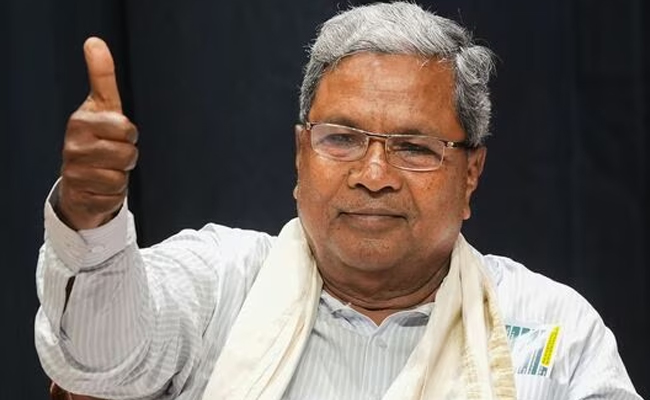
Bengaluru (PTI): Karnataka Chief Minister Siddaramaiah on Wednesday said the state will once again file a petition before the Cauvery Water Regulation Committee (CWRC) expressing its inability to release Cauvery river water to Tamil Nadu.
CWRC on Tuesday had recommended that Karnataka release 5,000 cusecs of water every day for the next 15 days to the neighbouring state.
The Chief Minister, who today held a "special emergency meeting" following the CWRC recommendation, said his government will consult its legal team regarding releasing water and take a decision, and will also once again move the Supreme Court explaining the factual situation on the ground.
"We will once again file a petition before the CWRC stating that we don't have water, so can't release water, so reconsider (the recommendation). Let's see what they will do, based on that we will once again file a petition in the Supreme Court and we will try to inform the court the factual situation on the ground," Siddaramaiah said.
Speaking to reporters after the meeting here, he said, "meanwhile, we will discuss with the legal team whether to release 5,000 cusec per day or not. Deputy Chief Minister D K Shivakumar is going to Delhi to discuss with the legal team on this and also regarding filing a petition. Keeping all this in mind, we will take a decision afterwards."
Other than Shivakumar, who is also Minister in-charge of Water Resources, Ministers of the Cauvery basin region, former Chief Ministers of all parties, senior Ministers of the state cabinet, Lok Sabha and Rajya Sabha members were invited to participate in the emergency meeting.
However, B S Yediyurappa and Basavaraj Bommai of the BJP and H D Kumaraswamy of the JD(S) did not attend the meeting citing prior commitments.
Noting that the meeting was called following the CWRC's recommendation to release water, the CM said whether Cauvery or any other inter-state disputes, all parties have taken a unanimous stand so far, and have not indulged in politics on the issues of land, water, language and state's borders.
He further said he has explained the legal implications at the meeting, amid demands from various quarters not to release water.
Pointing out that the CWRC is a recommendatory body and has only made a recommendation, Siddaramaiah said, the state is going to appeal to them stating that Karnataka was not in a position to release water as there is no (adequate) water for crops and for drinking purposes.
He said he had written to Prime Minister Narendra Modi seeking time to lead an all-party delegation, but there has been no response so far. "I will once again write another letter to the PM highlighting the factual position on ground, if he gives time, we will go and meet him."
MPs have also said that they too will exert pressure on the Centre, the CM said.
Observing that the Parliament session is starting from September 18, he said the government is considering calling a meeting of state's MPs and central Ministers from Karnataka there during the session.
"On the whole we want to inform about our situation to the whole country, Supreme Court, CWRC and Cauvery Water Management Authority (CWMA). It is not our intention not to release water, but the situation is that there is no water-- we want to make people and all concerned understand this," he said, adding, representatives of all the parties who attended the meeting have agreed to this.
Let the Truth be known. If you read VB and like VB, please be a VB Supporter and Help us deliver the Truth to one and all.
AIITA welcomes Karnataka’s ban on obscene songs in school events
Bhatkal: The Karnataka unit of the All India Ideal Teachers Association (AIITA) has welcomed the Karnataka government’s decision to strictly ban school children from dancing to obscene songs during educational and cultural programmes in government, aided, and private schools across the state.
AIITA Karnataka State President M. R. Manvi congratulated the government for taking what he termed an important step to preserve the sanctity of education.
“Such decisions to safeguard the dignity of school children and uphold the values of education are the need of the hour. This rule should not be limited to government schools alone but must be strictly implemented in all private educational institutions as well,” he said.
He further urged the government to address other concerns within school programmes.
“The government should not only prohibit obscene dances in the name of school anniversaries, but also ensure that plays and dialogues that incite religious hatred are avoided. Schools should be centres of harmony, not platforms for spreading hatred,” he added.
According to a recent circular issued by the Department of School Education and Literacy, obscene dances are adversely affecting the mental health and moral values of students.
In this regard, schools have been advised to use songs that promote nationalism, positive thinking, the greatness of Kannada culture, and value-based traditions instead of inappropriate content during programmes.
The circular also emphasises that students should be dressed in decent attire.
AIITA also backed the department’s warning that disciplinary action would be taken against head teachers if such guidelines are violated. The association has further demanded that district Deputy Directors of Public Instruction strictly monitor the implementation of these rules.