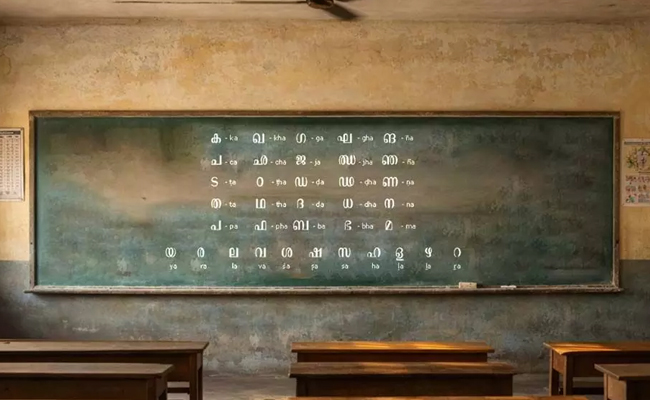
Bengaluru (PTI): The Karnataka Border Areas Development Authority (KBADA) has said the Kerala governor has promised a thorough review of the Malayalam Language Bill, 2025, following concerns raised over its impact on Kannada-speaking linguistic minorities in Kasaragod district.
A KBADA delegation met Kerala Governor Rajendra Vishwanath Arlekar on Wednesday and submitted a memorandum to him seeking the stalling and reconsideration of the Bill, which mandates Malayalam as the first language from Classes 1 to 10 in all government and private Kannada-medium schools in the district.
"The bill proposed by the Kerala government is wholly unconstitutional and is against the interests of the large number of Kannada-speaking linguistic minorities residing in Kasaragod district of Kerala," the KBADA said in a press release.
ALSO READ: Minneapolis mayor says ICE officer's killing of motorist was 'reckless' and wasn't self-defence
It pointed out that a similar bill was rejected by the president in 2017 and noted that the Union Ministry of Minority Affairs has repeatedly advised Kerala to protect the interests of linguistic minorities. It cited constitutional safeguards under Articles 30, 347, 350, 350A and 350B, which it said are being violated.
According to the KBADA, constitutional provisions mandate the appointment of Kannada teachers in Kannada-medium schools, installation of Kannada signboards at police stations, railway stations and national highways in Kasaragod, use of Kannada in official correspondence in public offices and recruitment based on the local linguistic-minority population.
The KBADA also sought regular bi-monthly meetings by the Kasaragod district collector's committee to address minority issues.
The press release warned that enforcing the Bill would force Kannada-speaking students to learn Malayalam even if they are unfamiliar with the language, adversely affecting their education and future prospects, especially if they pursue higher studies outside Kerala.
It said the move would have far-reaching consequences for students who have studied in Kannada as their mother tongue.
The delegation comprised KBADA Secretary Prakash V Mattihalli, member Subbaiahkatte, Tekkekere Shankaranarayana Bhat, Jayaprakash Narayana Tottetodu, president of Kerala Kasapa, advocate Muralidhara Ballukarya and Sukesh A, President of the Kerala State Teachers' Association, along with other Kannadigas from Kasaragod.
"The Hon'ble Governor assured the delegation that the bill would be stalled, thoroughly reviewed, and that the interests of Kannadigas in Kasaragod would be safeguarded," the KBADA said.
Let the Truth be known. If you read VB and like VB, please be a VB Supporter and Help us deliver the Truth to one and all.
Guatire (Venezuela)(AP): Venezuela released a number of imprisoned high-profile opposition figures, activists and journalists — both citizens and foreigners — Thursday in what the government described as a gesture to “seek peace” less than a week after former President Nicolás Maduro was captured by US forces to face drug-trafficking charges.
President Donald Trump, who has been pressuring Maduro allies now leading the country to fold to his vision for the future of the oil-rich nation, said the releases came at the request of the United States.
In the interview on Fox News on Thursday night, Trump praised the government of acting President Delcy Rodríguez, saying: “they've been great. ... Everything we've wanted, they've given us.”
Jorge Rodríguez, brother of the acting president and head of Venezuela's National Assembly, said a “significant number” of people would be freed, but as of late Thursday night it was still not clear who or how many people would be released.
The US government and Venezuela's opposition have long demanded the widespread release of imprisoned politicians, critics and members of civil society. The Venezuelan government insists it doesn't hold political prisoners.
“Consider this a gesture by the Bolivarian (Venezuelan) government, which is broadly intended to seek peace,” he announced.
High profile releases
----------------------
Among those released was Biaggio Pilieri, an opposition leader who was part of Nobel Peace Prize winner María Corina Machado's 2024 presidential campaign, according to Foro Penal, an advocacy group for prisoners based in Caracas. Also released was Enrique Márquez, a former electoral authority and candidate in the 2024 presidential election, the organisation said.
Videos posted by journalists on social media show Márquez and Pilieri embracing loved ones on the streets outside the prison. One video showed Márquez beaming and video-calling family members, saying, “Soon I will be with you all.”
Five Spanish citizens — including the prominent Venezuelan-Spanish lawyer and human rights activist Rocío San Miguel — were also released in the afternoon and, as the night wore on, reports trickled out of more detainees walking free. Relatives who were waiting for hours outside one of the prisons on the outskirts of Caracas briefly chanted, “Libertad! Libertad!”
Venezuela's government has a history of releasing people imprisoned for political reasons — including real and perceived opponents — during moments of high tension to signal openness to dialogue. The releases on Thursday were the first since Maduro was deposed.
Human rights groups and members of the opposition were encouraged by the move, though it wasn't clear yet what it represented — whether the growing pains of a government in transition or a symbolic overture to placate the Trump administration, which has allowed Maduro's loyalists to stay in power as it exerts pressure through crippling sanctions.
Nothing brings back the 'stolen years'
----------------------------------------
For opposition leader Machado – whom Trump has snubbed by endorsing Rodríguez to lead the transition — the gesture was “an act of moral restitution."
“Nothing brings back the stolen years,” she said in an audio message from exile addressed to families of released detainees, urging them to take comfort in the knowledge that “injustice will not be eternal and that the truth, though badly wounded, eventually prevails.”
Alfredo Romero, president of Foro Penal, expressed cautious hope "that this is indeed the beginning of the dismantling of a repressive system in Venezuela ... and not a mere gesture, a charade of releasing some prisoners and incarcerating others.”
Despite a widespread crackdown during the tumultuous 2024 election — in which the government said it detained 2,000 people — Venezuela's government denies that there are prisoners unjustly detained, accusing them of plotting to destabilise Maduro's government.
Romero's organisation said that as of December 29, 2025, there were 863 people detained in Venezuela “for political reasons.”
The Spanish government said Thursday that five of its citizens, including dual national San Miguel, had been released from custody in Venezuela and would soon return to Spain.
Speaking to Spanish broadcaster RNE, Spanish Foreign Minister José Manuel Albares identified the other Spanish nationals released as Andrés Martínez, José María Basoa, Ernesto Gorbe and Miguel Moreno.
Two of them, Martínez and Basoa, were arrested in Venezuela in September 2024 and accused of plotting to destabilize Maduro's government as Spanish spies — allegations vehemently denied by Spain.
Spain's El País newspaper reported Thursday that another freed detainee, Gorbe, was arrested in 2024 on allegations of overstaying his visa.
Families wait outside prisons
-------------------------------
As the news of the release broke Thursday, families of detainees rushed to prisons across the country, seeking information on their loved ones.
Pedro Durán, 60, was among those hoping to reunite with his brother Franklin Durán as he waited outside a prison in the town of Guatire, around 25 miles (43 kilometers) outside of Caracas. Durán said his brother was detained in 2021 on charges of trying to overthrow Maduro's government — an accusation his family denies.
Durán, who has been living in Spain, heard rumours on Wednesday that the government could release a number of detainees and immediately bought a plane ticket from Madrid to Caracas to find his brother.
“I don't have words to express the emotion I'm feeling,” Durán said. “We're feeling a lot of hope ... We're just waiting now.”
Despite the anticipation, fear persists.
“Of course everyone here is very scared, but what more could (the government) do to us that they haven't done already,” he added.
'A bargaining chip'
Ronal Rodríguez, a researcher at the Venezuelan Observatory at the University of Rosario in Bogotá, Colombia, said the government releases prisoners at politically strategic moments.
In July last year, Venezuela released 10 jailed US citizens and permanent residents in exchange for the repatriation of over 200 Venezuelans deported by the Trump administration to El Salvador, where they had been held in a prison built to house criminal gangs.
“The regime uses them like a bargaining chip,” he said of prisoners in Venezuela. It will be telling to see not only how many people the government releases, he said, but also under what conditions and whether the releases include anyone high-profile.
On Wednesday, the Trump administration sought to assert its control over Venezuelan oil, seizing a pair of sanctioned tankers transporting petroleum and announcing plans to relax some sanctions so the US can oversee the sale of Venezuela's petroleum worldwide.
Both moves reflect the administration's determination to make good on its effort to control the next steps in Venezuela through its vast oil resources after US President Donald Trump pledged after the capture of Maduro that the US will “run” the country.
Trump on Thursday night said that Machado may be visiting Washington next week and that he may be meeting with her.
“I understand she's coming in next week some time and I look forward to saying hello to her,” Trump said in the Fox News interview with Sean Hannity. “And I've heard that she wants to do that.”