KERC increases electricity tariffs for commercial, industrial consumers
Bengaluru (PTI): The Karnataka Electricity Regulatory Commission has reduced electricity tariffs for agricultural pump sets for 2025–26 from the earlier uniform rate of Rs 8.30 per unit to a range of Rs 6.57 to Rs 7.79 per unit across the state.
However, the Commission has increased tariffs for select commercial and industrial consumers by 10 paise to a maximum of 95 paise per unit.
As per the Commission’s order, the revised tariffs are as follows: LT-3a (low-tension commercial) consumers will pay a fixed charge of Rs 235 per kW and an energy charge of Rs 7.10 per unit, while LT-5 (industrial) consumers will be charged Rs 165 per HP as fixed charges and Rs 5.20 per unit as energy charges.
In the high-tension segment, HT-2a (industrial) consumers will pay a demand charge of Rs 365 per kVA and an energy charge of Rs 6.70 per unit, while HT-2b (commercial) consumers will pay Rs 390 per kVA as demand charges and Rs 6.90 per unit as energy charges.
The revised tariffs were notified in an order issued on March 3 after the Commission allowed a review petition filed by five state-run electricity supply companies—Bangalore Electricity Supply Company, Mangalore Electricity Supply Company, Chamundeshwari Electricity Supply Corporation, Hubli Electricity Supply Company and Gulbarga Electricity Supply Company.
The order, however, does not specify the date from which the revised tariffs will come into effect.
In its earlier tariff order dated March 27, 2025, the Commission had fixed the LT-4a tariff uniformly at Rs 8.30 per unit across all ESCOMs.
Consumers in the LT-4a category — primarily agricultural pump set users — are provided free power supply, with the state government reimbursing the cost through subsidies.
According to the order, the petitioners informed the Commission that despite the Government of Karnataka allocating Rs 16,021 crore towards subsidies for free power supply to LT-4a consumers, the ESCOMs would not be able to fully recover the cost of electricity supplied under the earlier tariff structure.
The Commission noted that this would leave distribution companies with no option but to demand payment of the balance amount from farmers, leading to “unexpected and undue hardship” for the agricultural community, which it described as the backbone of the state’s agricultural production.
The reduction in the LT-4a tariff would, however, result in a revenue shortfall of Rs 2,362.47 crore compared to the tariffs considered in the order under review.
Observing that it was necessary to safeguard farmers’ interests while ensuring that ESCOMs reasonably recover costs, the Commission said the review petition could be allowed under the provisions of the Code of Civil Procedure, 1908.
The petitioners informed the Commission that the Government of Karnataka has allocated an additional Rs 2,362.47 crore, supplementing the existing budgetary provision of Rs 16,021 crore, recognising that the entire financial burden should not be passed on to consumers and must be partially borne by the government.
The petitioners further stated that they will mobilise Rs 1,107.60 crore through miscellaneous revenue.
“The balance shortfall to be met by increasing tariffs for industrial and commercial consumers, amounting to Rs 1,254.88 crore, appears reasonable and justifiable,” the Commission added.
Let the Truth be known. If you read VB and like VB, please be a VB Supporter and Help us deliver the Truth to one and all.
RCB beat DC by 9 wickets in IPL
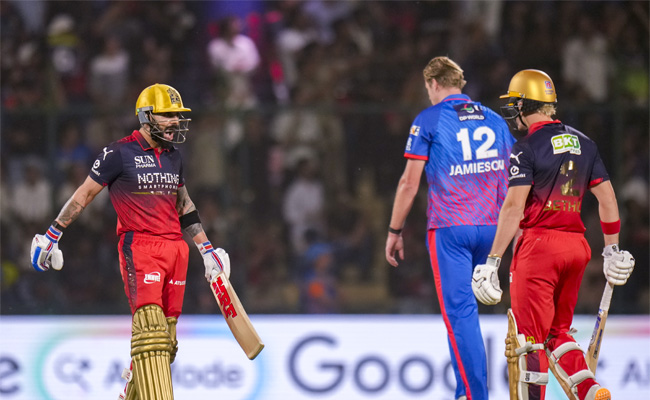
New Delhi (PTI): Royal Challengers Bengaluru continued their impressive run, thrashing Delhi Capitals by nine wickets in their IPL match here on Monday.
Opting to bowl, pace duo of Bhuvneshwar Kumar (3/5) and Josh Hazlewood (4/12) shared seven wickets, while Rasikh Salam Dar (1/21) and Syuash Sharma (1/7) also contributed as RCB bowled out DC for 75 -- lowest score of this season.
For DC, Abishek Porel (30), David Miller (19) and Kyle Jamieson (12) provided some respectability to the total after being reduced to 8 for 6 in 4th over.
In reply, Devdutt Padikkal (34), Jacob Bethell (20) and Virat Kohli (23) completed the chase in 6.3 overs.
Brief Score:
DC: 75 all-out in 16.3 overs (Abishek Porel 30; Bhuvneshwar Kumar 3/5, Josh Hazlewood 4/12).
RCB: 77 for 1 in 6.3 overs (Devdutt Padikkal 34; Kyle Jamieson 1/42).