Kiran Mazumdar-Shaw meets CM Siddaramaiah, Deputy CM Shivakumar
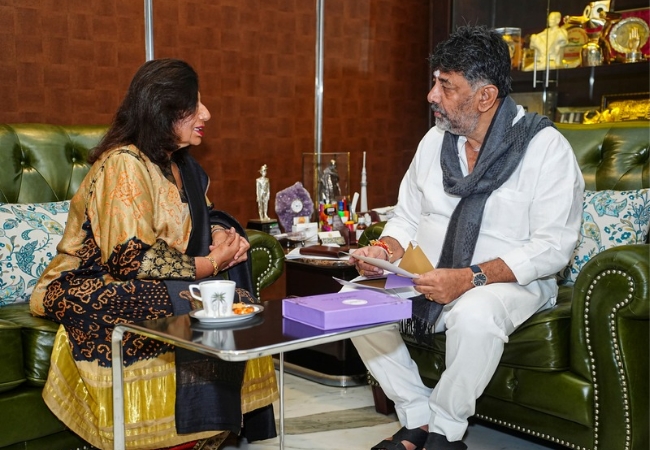
Bengaluru (PTI) : Biocon chief Kiran Mazumdar-Shaw on Tuesday met Chief Minister Siddaramaiah and his deputy D K Shivakumar to greet them on the occasion of Deepavali, and assured cooperation and support for Bengaluru's development.
Shaw has been critical of Bengaluru's infrastructure woes by highlighting them through her social media posts, and has been repeatedly urging the state government to intervene.
Shivakumar, who is also the Minister in-charge of Bengaluru Development, later told reporters that Shaw has assured cooperation and support of the industry for the development of Bengaluru.
"Biocon chief Kiran Muzumdar-Shaw visited Cauvery (CM's official residence) and wished Chief Minister Siddaramaiah on Deepavali. Legislative Council Chairman Basavaraj Horatti was present on the occasion," the CM's office said in a statement.
Shaw met Shivakumar at his Sadashivanagar residence in Bengaluru.
Asked whether there was any discussion regarding Bengaluru with Shaw, Shivakumar, said, "Of course, they (industry leaders) have agreed that they are going to cooperate with the development of Bengaluru and they will not hurt Bengaluru. They will support the system."
He added that he has called a meeting of local bodies adjacent to the Greater Bengaluru Authority area. "I will be visiting those areas on Thursday and on Friday. I will be calling a meeting. Those areas will be part of the development. There is a huge difference in tax between those areas and Bengaluru Corporation (GBA). We have to see to it that all those areas are also developed."
Noting that IT/BT and other industries have said that they will cooperate for Bengaluru development, the Deputy CM said he will call them for a meeting.
"Now I'm visiting all the five corporations and meeting people there. After that I will be calling IT/BT people separately...I will discuss it with them. I have sought their cooperation," he added.
The state government has come under criticism over the poor state of roads and traffic issues in the city for some time now, with industry veterans like former Infosys CFO Mohandas Pai and Shaw repeatedly openly urging the state government to immediately intervene.
Faced with mounting criticism from industry leaders, Shivakumar, had recently urged them to stop "hurting" the city and the state that have contributed to their growth.
Pointing out that the government was making all efforts to fix the issues, he had appealed to industry leaders not to forget their "roots"'--Bengaluru, Karnataka, and its people--and asked them to be patient, stressing that "there is a limitation for everything."
With the Deputy CM subsequently alleging that Shaw and Mohandas Pai had some "personal agenda", as they did not raise any issues relating to Bengaluru infrastructure during the BJP regime, Shaw, rejecting it, had posted on 'X', "Not true. Both T V Mohandas Pai and I have criticised deteriorating infrastructure in our city to previous BJP & JDS Governments. Our agenda is clear, clean up and restore roads."
Later in the day, Shaw also met veteran BJP leader and former CM B S Yediyurappa at his residence.
She also called on BJP MLA and former Deputy CM C N Ashwath Narayan at his residence.
"It was a pleasure to receive Ms. Kiran Shaw, Founder & Executive Chairperson of Biocon, at my residence today. She visited to invite me to a family function, and I congratulated her on being ranked the 3rd richest woman in the world," Narayan posted on 'X'.
Let the Truth be known. If you read VB and like VB, please be a VB Supporter and Help us deliver the Truth to one and all.
Udhayanidhi accuses BJP of not releasing funds for TN
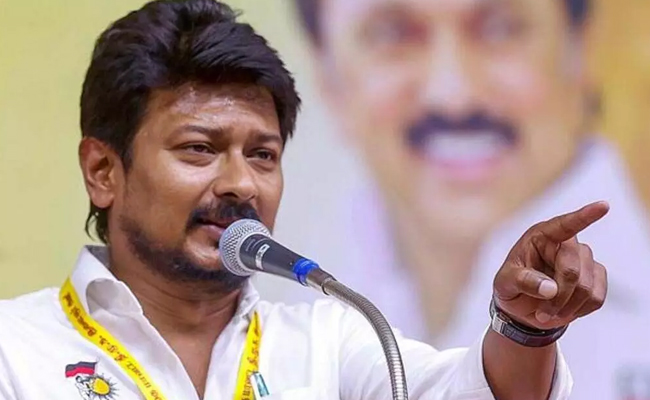
Gobichettipalayam (PTI): Tamil Nadu deputy chief minister Udhayanidhi Stalin on Saturday charged the BJP government at the Centre with not releasing funds to the state and accused it of "snatching" TN's rights.
Addressing a poll rally at Gobichettipalayam in the western Erode district, the DMK youth wing chief claimed the Centre has not released funds to the tune of Rs 3,000 crore for education.
"They (union government) have snatched all our rights," he charged.
With regard to the Centre's proposal for delimitation, he said chief minister M K Stalin was the first person in the country to raise the voice against the union government's move. He claimed that it was a "huge victory" for the INDIA alliance, as the bill was defeated for lack of majority after the opposition voted against it in the Lok Sabha.
Listing out various welfare measures implemented by the DMK government, he said the existing "Kalaignar Magalir Urimai Thogai" (monthly financial assistance for women) will be doubled to Rs 2,000 if DMK was voted to power again.
The deputy chief minister charged that the BJP and AIADMK have tried to stall it by moving the court. "At present more than 1.3 crore women have benefited from the scheme", he said.
"Similarly, the breakfast scheme for the government school students will be extended till Class VIII", he said adding "more than 35 lakh college students across the state will be getting free laptops once the DMK government is formed".
Udhayanidhi also pointed out at the "Illatharasi" poll promise, providing Rs 8,000 worth of coupons to non-income tax paying women where they could buy or replace any household appliances of their choice.
Elections to 234 Assembly seats in Tamil Nadu will be held on April 23 and the results declared on May 4 following counting of polled votes.