KSCAA seeks CBDT intervention on delays in trust registration, renewal
Bengaluru: The Karnataka State Chartered Accountants Association (R) (KSCAA) has submitted a detailed representation to the Chairman of the Central Board of Direct Taxes (CBDT), Ravi Agarwal, seeking urgent administrative intervention to streamline the registration and renewal process for charitable trusts under Sections “12AB” and “80G” of the Income-tax Act, 1961.
The representation was sent by KSCAA President CA Shivaprakash Viraktamath and Secretary CA Siddartha S Javali on January 7.
In its representation, KSCAA, established in 1957, described itself as a premier professional body representing Chartered Accountants in Karnataka.
It stated that the association has consistently engaged with the Income Tax Department, the CBDT, and other stakeholders through workshops, seminars, policy discussions, and formal representations to promote efficient tax administration, compliance, transparency, and accountability.
The association noted that it acts as a link between taxpayers and policymakers and contributes to the development of a practical and effective tax framework.
KSCAA acknowledged the legislative intent behind the registration framework for charitable institutions, which is to ensure that only genuine organisations engaged in bona fide charitable activities receive statutory benefits.
However, it stated that the current manner of administration has resulted in widespread hardship to genuine institutions. According to the association, prolonged delays, procedural uncertainty, and disproportionate compliance burdens have shifted the process from facilitative verification to excessive procedural scrutiny, thereby diluting the spirit of the law and affecting public confidence in the system.
Highlighting major issues, KSCAA stated that a large number of applications for registration and renewal under Sections “12AB” and “80G” remain pending. It noted that more than 17,000 applications are pending in Karnataka alone and that all these applications are required to be disposed of on or before 31 March 2026 as per statutory timelines.
The association pointed out that manpower constraints at the level of the Commissioner of Income Tax (Exemptions), long queues for hearings, and limited hearing capacity have led to delayed responses, repeated requisitions, and procedural bottlenecks.
The association also raised concerns regarding transparency and institutional confidence in the registration and renewal process. While stating that no specific instance of wrongdoing was being alleged, KSCAA said there is growing apprehension among charitable institutions and professionals due to delays, discretionary practices, and lack of clarity.
It noted that applicants are often subjected to unexplained delays, repeated notices, mechanical communications, and summary rejections on hyper-technical grounds, which do not appear to be connected to the statutory objective of examining the genuineness of charitable activities. According to KSCAA, such practices have created a perception that applications progress only through “extraneous or unofficial considerations”, thereby undermining confidence in the integrity of the process.
Under other issues, KSCAA pointed out procedural deficiencies in notice issuance, including instances where information already uploaded with “Form 10AB” is sought again. It also expressed concern over rejections without examination on merits, which may result in cancellation of registration under Section “12AB” and potential taxation of accreted income under Section “115TD”, leaving affected trusts with litigation as the only remedy.
The association emphasised the need for manpower augmentation and rationalisation of jurisdiction, stating that uneven distribution of cases has led to disparities in timelines and outcomes.
It also highlighted concerns over the scope of enquiry under Sections “12AB” and “80G”, noting that applicants are being asked to furnish information related to hostel registrations, pollution control certificates, building stability certificates, and similar approvals. KSCAA stated that while such compliances may be relevant under other laws, the scope of enquiry under the Income-tax Act should be confined to charitable objects, genuineness of activities, and application of income.
KSCAA further warned of the risk of inconsistent outcomes and avoidable litigation in the absence of standardised guidelines.
It also sought clarification on the applicability of the provison to Section “12AB(1)”, introduced by the Finance Act, 2025 with effect from 1 April 2025, which provides for a 10-year registration period. The association requested that this benefit be extended to trusts already in the renewal cycle, as the amendment came into force before the relevant due dates.
Additionally, it suggested the introduction of a limited rectification or condonation mechanism to cure procedural defects such as incorrect section selection or inadvertent omissions.
Referring to larger public interest considerations, KSCAA stated that charitable organisations play a vital role in social welfare, employment generation, and grassroots development, and that delays or denial of registration can adversely affect the communities they serve.
The KSCAA urged the CBDT to take urgent administrative and policy-level action in view of the large pendency, the statutory deadline of 31 March 2026, and the importance of the charitable sector.
The association recommended making the registration and renewal process under Sections “12AB” and “80G” completely faceless, strengthening supervisory oversight to address systemic issues, augmenting manpower or redistributing jurisdiction, limiting enquiries primarily to documents filed with “Form 10AB”, providing reconsideration for applications rejected due to non-appearance, adopting a risk-based selective scrutiny model for renewals, and extending the benefit of the proviso to Section “12AB(1)” to existing renewal cases.
The representation was signed by CA Babitha G, Chairperson of the Representation Committee, on behalf of KSCAA.
Copies were marked to the Union Finance Minister Nirmala Sitharaman, Minister of State for Finance Pankaj Chaudhary, Revenue Secretary Arvind Shrivastava, PCCIT Karnataka and Goa Preeti Garg, and Chief Commissioner of Income Tax (Exemption), New Delhi, Sunita Puri.
Let the Truth be known. If you read VB and like VB, please be a VB Supporter and Help us deliver the Truth to one and all.
Mamata alleges BJP disrupted her Bhabanipur rally, Suvendu claims 'she's nervous'
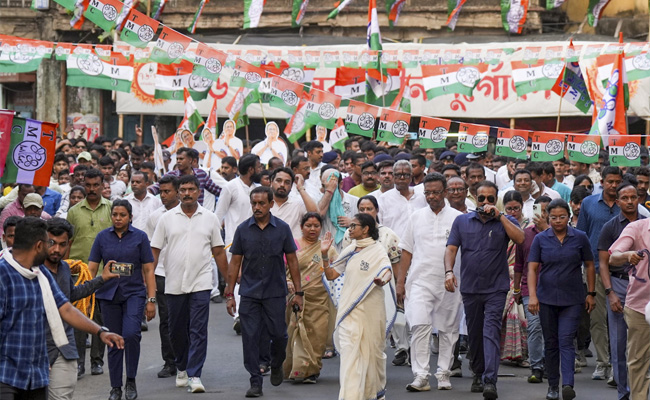
Kolkata (PTI): Chief Minister Mamata Banerjee cut short her speech at a rally in her Bhabanipur constituency, alleging that the BJP was deliberately playing loud music from a nearby public meeting.
A peeved Banerjee said despite having the required permission of the Election Commission, her rally in Chakraberia was disrupted by the BJP, "who want to capture Bengal by intimidation and threat".
"It is not possible for me to go ahead with this meeting. If they can do such a thing in my constituency, imagine how undemocratic the BJP is. If they behave like this, I have to take legal action," she said.
"This is an insult, humiliation. BJP is stepping on our toes to instigate trouble. Not possible to address the gathering in this situation. I am leaving the stage. Please vote for me in your protest," she added.
Banerjee was then seen calling someone over and venting her grievances.
Before leaving the stage, she said, "I will hold a rally tomorrow at the same spot."
TMC supporters then rushed towards the BJP rally, which was later addressed by Leader of the Opposition Suvendu Adhikari, but security personnel intervened and prevented the situation from escalating.
TMC workers later staged a demonstration outside the local police station and filed a complaint, alleging that the BJP violated the model code of conduct.
A senior TMC leader said another complaint will also be lodged with the Election Commission.
Asked about Banerjee's allegations, Adhikari told reporters after the rally he held nearby, "Her reaction shows she is nervous about the imminent loss."
"There was no violence, no obstruction in her meeting and her behaviour shows her nervousness. On May 4, people of Bhabanipur will celebrate the victory of the BJP," he claimed, alleging that the TMC also tried to disrupt his meeting by playing loud music.
South Kolkata's Bhabanipur, one of the battleground seats in the West Bengal elections, will vote in the second phase on April 29.