K'taka Home Secretary and DG to speak to Maharashtra counterparts on safety of Kannadigas: CM Bommai
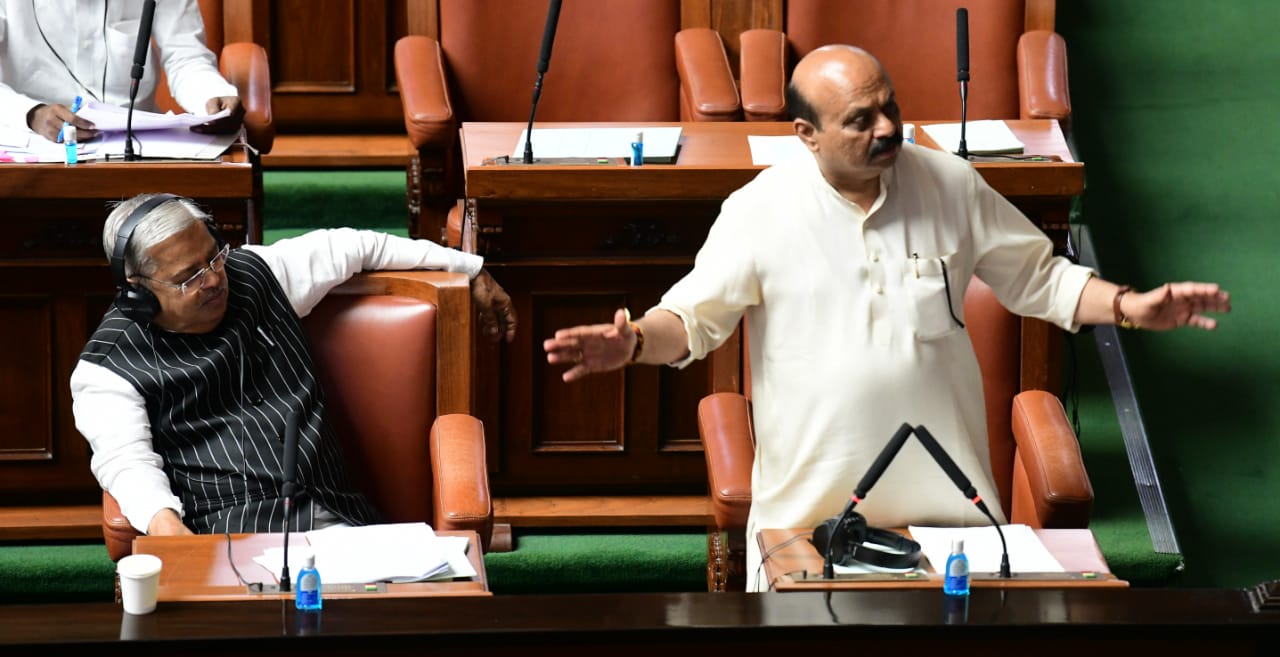
Belagavi, Dec 18: Amid reports of attack and defacing of vehicles with Karnataka registration in Maharashtra, Chief Minister Basavaraj Bommai on Saturday said it is the duty of the government in the neighbouring state to maintain law and order there.
He also said that the state's Home Secretary and Director General of Police will speak to their Maharashtra counterparts on providing safety to Kannadigas there, and protection to state's buses and other vehicles.
"Maintaining law and order in Karnataka is our responsibility and we are taking strong steps to maintain it. Law and order in Maharashtra is the responsibility of the government there. Regarding the recent incident in Maharashtra, our police officials had spoken to their counterparts there," Bommai told reporters here.
"Let our officials speak first, thereafter if the need arises, I will," he said in response to a question whether he will be speaking to the Maharashtra Chief Minister.
There have been reports of vehicles bearing Karnataka numbers being defaced with black ink and attacked in Maharashtra's Kolhapur, allegedly by some Shiv Sena activists.
Recently some miscreants had even torched a Kannada flag in Kolhapur, and the incident had created an uproar in the state.
Responding to a question regarding Shiv Sena MP Sanjay Raut's tweet calling for Marathas to unite with a video of alleged desecration of Shivaji Maharaj's statue, claiming that it was from Bengaluru, Bommai said, responsible people should not incite anybody at any given time.
"Shivaji Maharaj, Sangolli Rayanna, Kittur Chennamma are fighters, who fought for the country, in their name, if we start fighting and dividing, it will be a disservice to them. Any responsible person should not incite people to violence and take law and order into their hands," he said.
Karnataka will not allow anybody to take law and order into their hands, he added.
Let the Truth be known. If you read VB and like VB, please be a VB Supporter and Help us deliver the Truth to one and all.
Road crash in UP leaves 10 dead
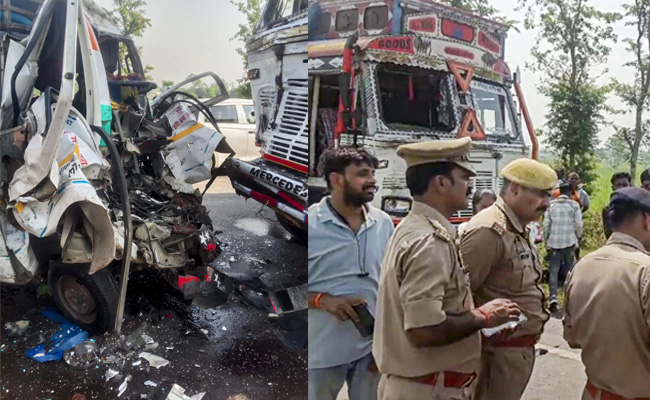
Lakhimpur Kheri (UP) (PTI): Ten people were killed when a van collided head-on with a truck on the Sisaiya-Lakhimpur national highway on Monday, police said.
The van was going to Sisaiya from Lakhimpur when the accident took place between Unchgaon and Bharehta villages.
Circle Officer of Dhaurahra, Shamsher Bahadur Singh, said all nine passengers travelling in the van and the driver were killed.
District Magistrate of Lakhimpur Kheri Anjani Kumar Singh told reporters that the van collided with a truck coming from the opposite direction, leading to nine casualties on the spot, while one succumbed to injuries at the district hospital.
Circle Officer, Dhaurahra, Shamsher Bahadur Singh told PTI, "Efforts are on to establish the identity of other deceased persons."
The seven of the deceased have been identified as Jaideep Singh (25), Pawan (23), Sohan (21), Ram Goyal (42), Sahajram (35), Pappu (18), all residents of Bahraich district and Adnan Khan (15), a resident of Lakhimpur Kheri district, police said.
Condoling the loss of lives in the accident, Uttar Pradesh Chief Minister Yogi Adityanath in a post on X, said, "The loss of life in the unfortunate road accident in Lakhimpur Kheri district is deeply distressing and heart-wrenching. My condolences are with the bereaved families."
"I have directed the local administration to provide prompt and adequate assistance to the injured and the victims. I pray to Lord Shri Ram to grant the departed souls a place at His divine feet and to bestow a speedy recovery upon the injured," Adityanath said on X.
Deputy Chief Minister Keshav Prasad Maurya and Brajesh Pathak too condoled the loss of lives in the accident.
"The loss of lives resulting from the road accident in Lakhimpur Kheri district is deeply tragic and heart-wrenching. My deepest condolences go out to the bereaved families," Maurya said.