K'taka Legislative Council adopts resolution urging Centre to include 56 pc quota in 9th Schedule
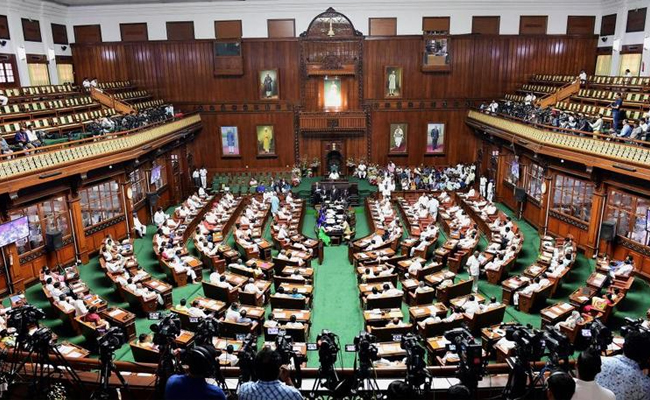
Belagavi (PTI): Karnataka Legislative Council has adopted a resolution asking the central government to include the state's 56 per cent reservation decision in the ninth Schedule of the Constitution.
The resolution was adopted by the Council in the absence of the opposition members on Friday, as they had earlier staged a walkout dissatisfied with Chief Minister Siddaramaiah's reply to the debate on North Karnataka's development.
The resolution urging for the inclusion of the state's notifications and orders, increasing the reservation in employment and education for Scheduled Castes, Scheduled Tribes and Backward Classes from 50 per cent to 56 per cent in Schedule-9 of the Constitution of India, was moved by Law and Parliamentary Affairs Minister H K Patil.
ALSO READ: KSRTC to run 1000 special services to clear Christmas rush
According to official sources, the demand for inclusion in the Ninth Schedule of the Constitution is aimed at providing legal protection from the 50 per cent cap on reservations, imposed by the Supreme Court in the Indra Sawhney case.
The House also adopted six resolutions urging the Centre to address long-pending issues, in the absence of opposition members.
The resolutions include: Urging the Government of India to immediately establish the All India Institute of Medical Sciences (AIIMS) in Raichur district; to transfer at least 25 per cent of the 73 national-level institutes currently in Bengaluru to the North Karnataka region; to immediately declare the Upper Krishna Project Phase-III (UKP-III) as a national project, release central funds and demand gazette notification of the final award of the Krishna Water Disputes Tribunal-II (KWDT-II).
The resolutions demand the release of Rs 5,000 crore adjustment grant to the Kalyana Karnataka Regional Development Board from the Central Government on the Vidarbha development model; to protect farmers by fixing equal ethanol procurement quotas without discrimination, and, in accordance with the ethanol production capacity of Karnataka, based on the availability of sugarcane and other raw materials, were also passed.
A resolution was also adopted urging the Centre to expedite the necessary approvals from the Forest and Wildlife Boards for the ambitious Kalasa-Banduri Nala Diversion Project for drinking water supply, in accordance with the judgment of the Mahadayi Tribunal.
Similar resolutions were adopted in the Legislative Assembly on Thursday.
Let the Truth be known. If you read VB and like VB, please be a VB Supporter and Help us deliver the Truth to one and all.
Maharashtra sets up state vaccination task force to strengthen immunisation programme

Mumbai (PTI): The Maharashtra government has set up a State Vaccination Task Force to strengthen the regular immunisation programme and review the progress of related campaigns, a health department official said on Monday.
The State Vaccination Task Force will comprise at least 29 members and will be headed by the administrative head of the health department, he informed.
The government has also constituted separate district-level and municipal vaccination task forces to improve implementation and address challenges at the grassroots level, he said.
Municipal task forces, chaired by respective civic commissioners, have been constituted in view of the vast urban population in Maharashtra and the role of civic bodies in implementing different health programmes.
The district-level task forces will function under the chairmanship of collectors.
"Complete immunisation of children at the appropriate age is an extremely simple, cost-effective and highly effective measure to reduce child mortality and the prevalence of diseases among kids. Immunisation is a powerful tool for reducing illness in children," maintained the official.
To ensure full vaccination of all children, the state government implements various campaigns from time to time as per the central government guidelines, he pointed out.
"Active participation and cooperation of other relevant government departments are essential (in making these campaigns successful)," according to the official.
The state-level body will review the regular immunisation programme, associated campaigns and vaccine-preventable diseases in detail. It will also conduct focused assessments of high-risk districts and municipal corporations, including vacancies at district, municipal and sub-district levels, availability of cold chain equipment, resource gaps and training requirements, he noted.
The state task force will review allocation and utilisation of funds for immunisation and ensure timely action by officers concerned based on reports from district and municipal task forces and state-level monitoring mechanisms, the official said.
It will also ensure active coordination and participation of other government departments in immunisation drives, while district and municipal task forces will carry out similar functions at their respective levels, the official added.