K'taka tired of 40% commission, wants 100% commitment: Shashi Tharoor
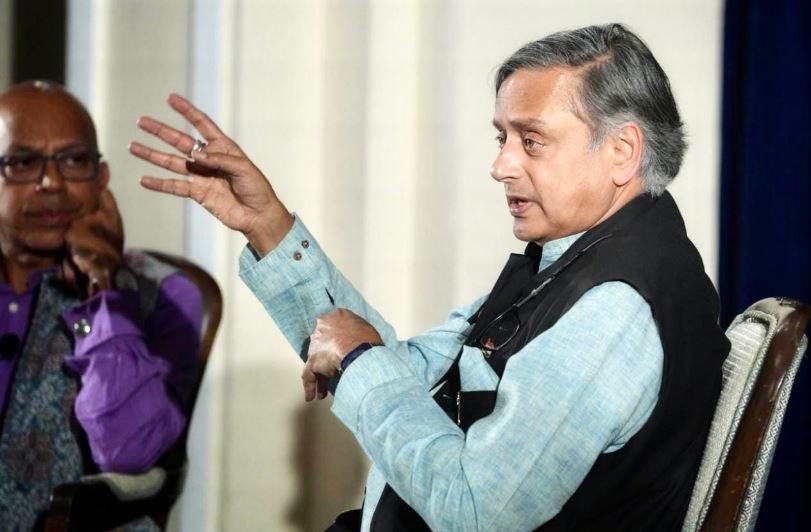
Bengaluru, Apr 9: Former union minister Shashi Tharoor on Sunday said people in Karnataka were tired of "40 per cent commission" and wanted "100 per cent commitment" that the Congress party would give if it were voted to power in the upcoming Assembly election.
He also said that the Congress was prepared to tackle the "serious deficiencies" in state-level and urban-level governance in Bengaluru and the entire state of Karnataka.
"I think the people in this state are tired of the 40 per cent commission. What they want is 100 per cent commitment and that's what we will give 100 per cent commitment to the well-being of the people of Karnataka," the Thiruvananthapuram MP said at a press conference here.
In poll-bound Karnataka where the Assembly election is just a month away, the Congress has been accusing the BJP-led state government of collecting 40 per cent commission from contractors, unaided private schools and even some religious institutions on the grants that they receive from the government.
Tharoor said the state was being badly governed and that the infrastructure in Bengaluru was becoming an embarrassment.
"Our message is very simple. We have seen, unfortunately, over four years now, bad governance. When there is bad governance and there is nothing to see, people inevitably wonder what they need a government for," Tharoor said.
There were essential needs of the people that had not been met and the Congress party had already come out with a number of "very specific policies" to fulfill those needs, the Congress leader said.
He added that the Congress was coming up with policies such as ensuring that unemployed graduates and unemployed diploma-holders could get some support from the State so that they can live with self-respect while they search for jobs. He also said the Congress was planning to honour the Gruha Lakshmi' -- the homemakers -- so that they could get some compensation for their unpaid labour.
Tharoor said the Congress "is pledging to improve the infrastructure of Bengaluru which used to be the pride of Karnataka and India but which is now becoming an embarrassment."
"So whether it is state-level governance or urban level governance, we feel that there are serious deficiencies that the Congress government is ready and prepared to tackle," the Congress MP said.
To a question on some Congress leaders joining the BJP, he pointed out that several MLAs and MLCs too had joined the Congress from other parties in the past few months.
"Well if you look at the Karnataka situation, five MLAs, two MLCs, 11 former MLAs, four former MLCs and one former MP have all joined the Congress, literally in the last few months. It does suggest that the people from other parties are seeing the Congress as an inevitable victorious party in Karnataka," Tharoor said.
He, however, said he was disappointed with the Congress members who had joined the BJP, and said they could have joined a party that shared the values and principles of the Congress instead.
He wondered how they could go to a party that has the opposite set of values and principles.
"That I find difficult to understand. That's where my disappointment (lies) with some of the people who have gone to the dark side, as one might say. I think they will sadly have to repent their choices as they see how they are treated in their new home," Tharoor said.
Let the Truth be known. If you read VB and like VB, please be a VB Supporter and Help us deliver the Truth to one and all.
Pune journalist booked on voyeurism charge for filming woman at lodge

Pune (PTI): Police have registered a case of voyeurism against a television journalist in Pune for allegedly filming a woman in an objectionable position without her consent at a lodge in the city, officials said on Saturday.
The FIR was filed against Rohan Kadam under Bharatiya Nyaya Sanhita (BNS) sections 77 (voyeurism) and 3(5) (common intention) at the Vishrambaug police station here, while the complaint mentions that he was accompanied by three other journalists, they said.
The incident took place on April 8 when the accused had checked into a room at a lodge in Budhwar Peth, which houses a red light area.
In her complaint, the woman said that while she was wearing her saree after establishing "physical relations with a customer", she realised that an unidentified person was filming her through a net above the partition wall between the rooms.
She opened the door of her room and knocked on the adjacent door, asking the person to come out, the FIR said.
"The woman sought clarification from Kadam, who gave vague answers and refused to show his phone. When the lodge operator, the woman and others questioned him, he claimed that they were a group of four journalists conducting a sting operation," it said.
Police said Kadam was assaulted when he allegedly tried to flee from the spot.
The woman later approached the Vishrambaug police station and lodged a complaint.
"We have registered a case in this regard and further probe is on," a police officer said.
Meanwhile, the Pune Union of Working Journalists (PUWJ) has written a letter to city Police Commissioner Amitesh Kumar, seeking action against the journalist for the alleged act.
In the letter, the journalists' body said there were murmurs that some journalists and others were trying to ensure that no offence is registered in the matter.
"We do not agree with this and clarify that PUWJ will not come in the way of the probe," the letter stated.