Land given for industries will be recovered if they don't start even after years: Murugesh Nirani
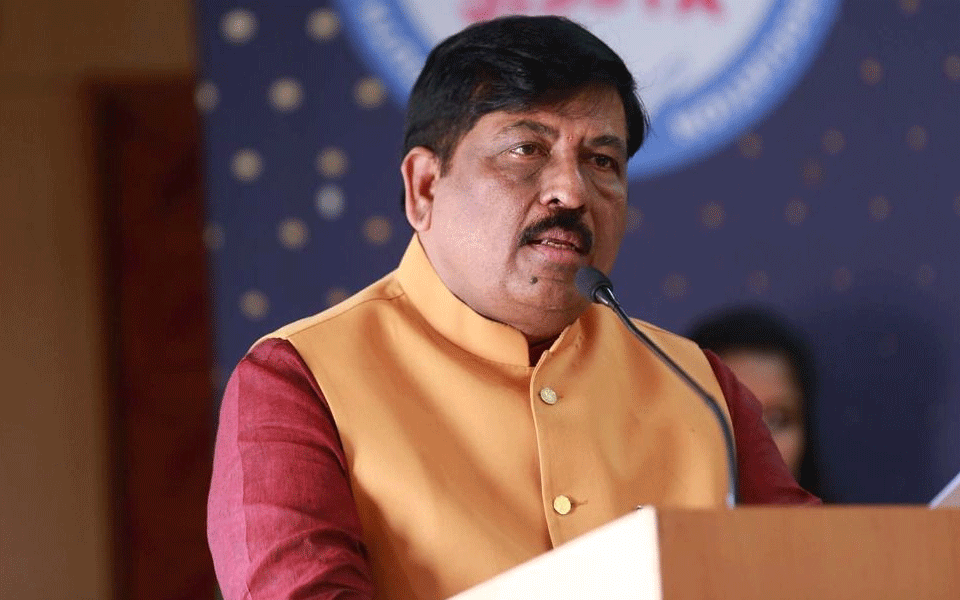
Belagavi(PTI): Karnataka Large and Medium Industries Minister Murugesh Nirani on Friday said the government would recover lands allotted to more than 500 industries for not starting their ventures even after several years of approving the project.
Replying to Congress MLA N H Shivashankar Reddy's query in the State Assembly, Nirani said the government has already identified the allotted lands where industries were not started even after five to 20 years of sanction.
Sale deed will not be done till they start the industries in full scale and they cannot use the industrial land for real estate purpose. Else we will recover the land," he said.
The Minister further said 15 per cent of industrial land must be reserved for residential purposes. Replying to MLA S Ramappa's query, Nirani denied the role of middlemen in the land acquisition process and said compensation is paid to farmers directly.
He said the State-level single-window agency has approved 16 projects in Harihar Taluk in Davangere district with an expected investment of Rs 217.34 crore and creation of 908 jobs.
Cargill has set up starch manufacturing unit at a cost of Rs 630 crore and 85 per cent Kannadigas are employed. The government has approved Mangaluru Refinery Petro Chemicals Company's 2G ethanol unit at a cost of Rs 966 crore and 47 acres of land has been allotted and lease deed process is under way, Nirani told the House.
Reiterating government's position on providing jobs to local people, Nirani, while replying to MLA Amrut Desai, said the government is committed to provide jobs to locals as per Dr Sarojini Mahishi report and also to the kin of farmers who sold their land for industries.
Let the Truth be known. If you read VB and like VB, please be a VB Supporter and Help us deliver the Truth to one and all.
Two tribal girls gangraped in Chhattisgarh's Surguja; three arrested, three juveniles detained

Ambikapur (PTI): Two tribal girls were raped allegedly by six persons, including three juveniles, in a village in Chhattisgarh's Surguja district, a police official said on Thursday.
Three accused have been arrested and three minors were detained in connection with the incident that took place on the night of April 24 under Sitapur police station limits, he informed.
"The motorcycle-borne accused intercepted the victims when they, along with two other friends, were returning home on foot after attending a wedding. Two of the girls managed to escape. The two victims, one aged 15 years and another 13 years, were forced onto a motorcycle, taken to a secluded place and sexually assaulted," he said.
One of the victims returned home the same night and informed her family the next day, following which a case was registered under Bharatiya Nyaya Sanhita and Protection of Children from Sexual Offences (POCSO) Act at Sitapur police station on April 26 for gangrape and other offences, he said.
Medical examinations of the victims were conducted at the Sitapur Community Health Centre on April 26 and 27, the official said.
"Initial medical reports did not confirm sexual assault. However, after the victims' families expressed dissatisfaction with the findings, the girls were sent for fresh medical examination at the district hospital in Ambikapur. Based on this medical report, all six accused were taken into custody by April 30," he said.
The arrested accused have been identified as Anand Bek (27), Vikas Tigga (24) and Manish Khalkho (18), all residents of the Sitapur area. The three juveniles, two of them aged 17 years, have been detained, he said.