Lockdown: Deve Gowda appeals to PM Modi to look into issues of farmers, labourers
_vb_27.gif)
Bengaluru: Former prime minister H D Deve Gowda has appealed to Prime Minister Narendra Modi to look into the plight of farmers, labourers and the middle class people as the impact of the 21-day nationwide lockdown has been the most on them.
"In such times of crisis, we should see to it that there is no disruption in farming activities by ensuring proper marketing channels to agricultural produce, especially perishables. Only then we can sustain our long battle against this pandemic," Gowda tweeted.
In another tweet, he said, "The savings of daily wage labourers and the middle class is deteriorating day by day. Some are not able to afford even essentials for their survival. I request Hon'ble PM to look into this situation with utmost urgency".
The former prime minister also drew the attention of "overcrowding" at the isolation centres.
"There is an immediate need to increase 'testing' for #COVID19. Increased testing will avoid overcrowding of Government isolation centers," he tweeted.
Let the Truth be known. If you read VB and like VB, please be a VB Supporter and Help us deliver the Truth to one and all.
Rajnath, Shah, other Union ministers change social media profile photos to 'Op Sindoor' logo
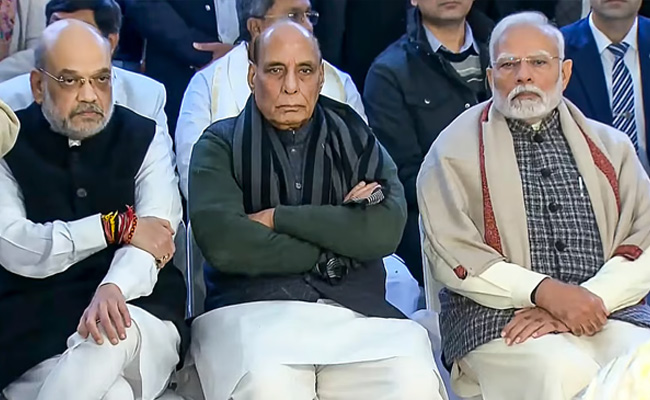
New Delhi (PTI): Defence Minister Rajnath Singh, Home Minister Amit Shah, External Affairs Minister S Jaishankar and other top ministers on Thursday changed the display pictures on their social media profiles to mark the first anniversary of Operation Sindoor following a call by Prime Minister Narendra Modi.
The prime minister, earlier in the day, shared a digital poster depicting the now widely recognised logo of Operation Sindoor and urged others to do the same as a mark of respect to the armed forces.
Operation Sindoor was launched in response to the deadly Pahalgam terror attack, with Indian forces conducting precision strikes on multiple terror infrastructure in Pakistan and Pakistan-Occupied-Kashmir (PoK).
After launching the military operation, the Indian Army, in a post on X, at 1:51 am on May 7 had said, "Justice is served. Jai Hind!"
On its first anniversary, the Indian military on Thursday said, Operation Sindoor -- "precise in action, eternal in memory" -- reflected the country's determination to defend its sovereignty with courage, coordination and strength.
The Army, the Navy, the Indian Air Force, the Headquarters Integrated Defence Staff (HQ IDS) and the defence ministry also updated the display pictures on their social media profiles to mark the anniversary.
Defence Minister Singh, while updating his profile photo on X, said Operation Sindoor stands as a "powerful symbol" of national resolve and preparedness, and that their actions reflected unmatched precision, and set a "benchmark" for modern military operations.
"On the anniversary of Operation Sindoor, we salute the valour and sacrifices of our armed forces, whose courage and dedication continue to safeguard the nation. Their actions during the operation reflected unmatched precision, seamless jointness and deep synergy across services, setting a benchmark for modern military operations," he wrote.
"Operation Sindoor stands as a powerful symbol of national resolve and preparedness, showing that our armed forces are always ready to act decisively when it matters most. It also stands testament to India’s steady advance towards achieving #Atmanirbharta, enhancing capability while reinforcing resilience," he added.
The Ministry of External Affairs, led by its minister Jaishankar, also marked the anniversary, and reasserted and amplified India's diplomatic stand on this operation.
"A year ago, #OperationSindoor demonstrated the nation's resolve to defend itself against cross-border terrorism from Pakistan. With its decisive actions, India ensured accountability for terrorist actions. And underlined that such a serious threat to peace and security will be effectively countered. Under the leadership of PM @narendramodi, India stands strong and determined to convey a message of zero tolerance for terrorism," the EAM posted on X.
Earlier in a separate post, Jaishankar too changed his profile picture and posted an image of the Operation Sindoor logo on the timeline.
Home Minister Shah, in a post on X, said, "Operation Sindoor stands as an epochal mission of India that will always remind our enemies of the infallible striking power of our armed forces."
After Indian forces had launched the operation in the early hours of May 7, Pakistan later also launched offensives against India, and all subsequent counter-offensives by India were also carried out under Operation Sindoor.
The military conflict between the two nuclear-armed neighbours, lasting nearly 88 hours, halted after they reached an understanding on the evening of May 10.
Union Culture and Tourism Minister Gajendra Singh Shekhawat, Education Minister Dharmendra Pradhan, Railway Minister Ashwini Vaishnav, Environment Minister Bhupendra Yadav, Women and Child Development Annapurna Devi and Jal Shakti Minister C R Paatil too updated their profile photos.
The Indian Army in an early morning post wrote, "#OperationSindoor India's resolute response calibrated and precise. Committed to safeguarding sovereignty and its people. #JusticeServed Jai Hind".
It also shared a video clip encapsulating the circumstances that led to the decisive military action in the early hours of May 7 last year, as well as some footage offering a glimpse to the military might of India.
"India will identify, track and punish every terrorist and their backers," PM Modi had earlier said in his address, whose excerpt is part of the widely shared clip.
Recalling the military action launched on the intervening night of May 6-7, the Indian Air Force put out the anniversary post on X at 1:05 AM.
"Operation Sindoor Justice served. Precise in action, eternal in memory-Operation Sindoor continues. India forgets nothing-India forgives nothing. #operation #Sindoor #operationsindoor #IAF," the IAF posted.
The Headquarters Integrated Defence Staff (HQ IDS) also posted the anniversary message at 1:05 AM, saying, "Symbol of national resolve #OpSindoor JAI HIND #OpSindoor #indianarmedforces #NationalSecurity".
The Indian embassies in the US, the UK, Spain, France, Germany and Italy also updated their display pictures on their social media profiles.
The embassies in France, Germany, Spain and Italy posted on X in French, German and Italian, amplifying the message of the Indian leadership on Operation Sindoor's anniversary in the respective countries.
The Indian Embassy in the UK posted on X, "One year of #OperationSindoor A tribute to India’s resolve, unity, and unwavering stand against terrorism. Saluting the courage and sacrifice of our armed forces who protect the nation with pride and honor. #OpSindoor #IndiaAgainstTerrorism #IndianArmedForces #NationalSecurity #IndiaFirst #SaluteOurForces #JaiHind #OperationSindoorContinues".
The Indian embassy in Israel also changed its profile photo on X and reposted PM Modi's post, and the X account of the embassy in Iran too changed the display picture to the logo of Operation Sindoor.
The Indian Navy in an early morning post on X said Operation Sindoor reflected India's determination to defend its sovereignty with courage and strength.
"Nation's Resolve. Forces United In moments that test a nation's will, the Indian Defence Forces stand united - resolute in purpose, precise in action and unwavering in commitment. #OperationSindoor reflects India's determination to defend its sovereignty with courage, coordination and strength. #OpSindoor #NationFirst #IndianNavy @HQ_IDS_India @adgpi @IAF_MCC," the Navy posted and changed its profile photo.