Lockdown distress: Karnataka govt announces Rs 1,610 crore package
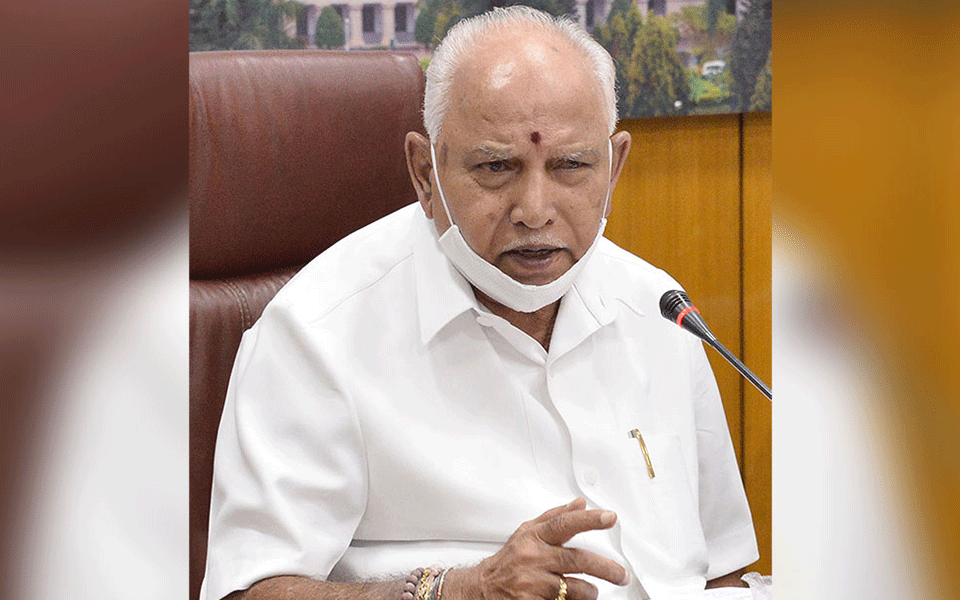
Bengaluru: The Karnataka government on Wednesday announced a Rs 1,610 crore relief package for the benefit of those in distress due to the COVID-19-induced lockdown.
The measures announced by the Chief Minister B S Yediyurappa would bring relief to farmers, flower-growers, washermen, auto rickshaw and taxi drivers, MSMEs, large industries, weavers, building workers and barbers.
The government also announced a 11 per cent excise duty hike, which is in addition to the six per cent announced in the budget.
People from all sections of society are facing financial difficulties due to lockdown of more than one and a half months, the Chief Minister noted.
Flower growers have destroyed their flowers following lack of demand for their produce due to the lockdown. It is estimated that farmers cultivated flowers in about 11,687 hectares.
Realising the problems facing flower growers, the government announced a compensation of Rs 25,000 per hectare limited to a maximum extent of one hectare for the crop loss.
Farmers who have grown vegetables and fruits were not able to market their produce, and the government has decided to announce a relief package for them.
Covid-19 has also affected service professionals such as barbers and washermen (dhobis) both in urban and rural areas, and it has been decided to provide a one time compensation of Rs 5,000 each to benefit about 60,000 washermen and about 2,30,000 barbers.
A decision has also been taken to help about 7,75,000 Auto & Taxi drivers by providing one time compensation of Rs 5,000 each.
MSMEs have also suffered huge production losses due to the lockdown. It takes some time for them to revive, Yediyurappa said. The monthly fixed charges of electricity bills of MSMEs will be waived for two months.
Payment of fixed charges in the electricity bills of the large industries would be deferred without penalty and interest for a period of two months.
The Chief Minister also announced certain benefits for electricity consumers of all categories.
The state government has already announced Rs 109 crore weavers loan Waiver scheme, of which Rs 29 crore has been released during 2019-20.
Balance amount of Rs 80.00 crore would be released immediately. This would help weavers get fresh loans to continue their occupation.
The Chief Minister also announced a new scheme, Weaver Samman Yojana (Nekarara Sammana yojane) for the benefit of the suffering weavers.
Under this scheme, the government would deposit Rs 2,000 directly into the bank account of the handloom weaver through DBT. This will benefit about 54,000 handloom weavers in the state. There are 15.80 lakh registered building workers in the state.
The government has already transferred Rs 2,000 to the bank account of 11.80 lakh building workers through DBT.
Action has already been initiated to transfer Rs 2,000 to the accounts of the remaining four lakh construction workers soon after verifying beneficiaries bank account details.
In addition to this, the government has decided to transfer additional amount of Rs 3,000 to building workers through DBT.
The above compensation would be provided with an estimated cost of Rs 1,610.00 crore, which would help those who are in distress due to lockdown , the Chief Minister added.
Let the Truth be known. If you read VB and like VB, please be a VB Supporter and Help us deliver the Truth to one and all.
Steel mirrors deployed in Mysuru to discourage public urination
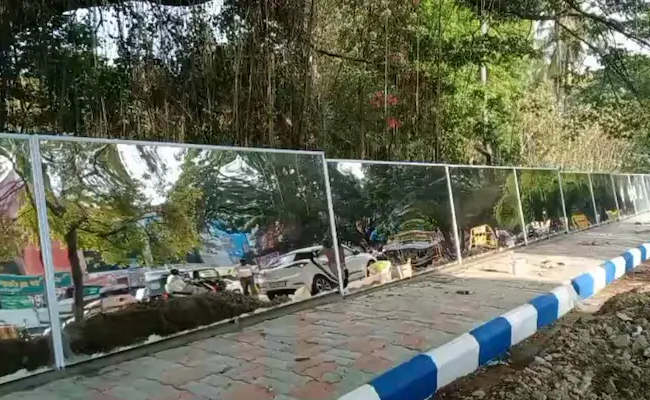
Mysuru (PTI): Fed up with people relieving themselves along roadsides, the Mysuru City Corporation has adopted a unique strategy to curb the practice and promote civic sense by installing reflective steel mirrors along pavements, officials said on Friday.
In what officials described as a first-of-its-kind initiative, the Corporation installed stainless steel sheets with a mirror finish along an 80-metre stretch opposite the Mysuru Suburban Bus Stand.
Officials said the reflective sheets are intended to confront anyone attempting to urinate in public with their own reflection, thereby discouraging the act psychologically.
“The idea is to maintain cleanliness and hygiene, prevent public nuisance, and promote civic sense. It is a simple yet psychological approach that encourages self-awareness through reflection,” officials added.
Soon after the mirrors were installed, videos of the initiative went viral on social media, with many people appreciating the administration’s innovative attempt to address public urination. At the same time, some users pointed out the lack of basic civic sense among people.
Several social media users also suggested that more public toilets, maintained in a hygienic condition, were needed to further discourage open urination.
Explaining how the idea originated, Nitesh Patil, Administrator and Regional Commissioner of the Mysuru City Corporation, told PTI that despite a public toilet being located next to the bus stand, many people continued to urinate in the open.
Even fines and warnings failed to deter them from relieving themselves against vacant compound walls, leaving behind a foul smell.
“One of our engineers came up with this idea, and we decided to implement it. The initiative has received a very positive response from the public, social media, and the press. We are now planning to identify more such locations in the city and install similar reflectors,” he said.
According to him, to ensure that the installation is both effective and visually appealing, LED lighting that switches on along with the streetlights has also been added, causing the stretch to glow at night and enhancing the city’s appearance.
Patil said the initiative had helped create civic awareness while also beautifying the city.
“We want our city to be clean and hygienic. We aspire to become the cleanest city in the country,” he added, recalling that Mysuru secured third place nationally in the Swachh Survekshan Awards 2024–25 last year.