Lokayukta police submits report to Special Court in MUDA case involving CM Siddaramaiah
Mysuru (Karnataka) Jan 25 (PTI): The Lokayukta police have submitted their report to the Special Court in Bengaluru regarding the MUDA alternative site allotment case, which involves Karnataka Chief Minister Siddaramaiah and his wife.
The report was submitted on Friday, ahead of the court hearing scheduled for January 27.
According to sources, the report was initially set to be submitted a day before the hearing. However, since January 25 was a fourth Saturday and a court holiday, the Lokayukta police advanced the submission to January 24.
Officials from the Mysuru Lokayukta remained tight-lipped about the contents of the report and refused to disclose any details.
The case stems from an FIR registered against Siddaramaiah and others on September 27, 2024.
Following a complaint by RTI activist Snehamayi Krishna, the special court in Bengaluru had directed the jurisdictional Lokayukta police in Mysuru on September 25 to conduct an investigation.
As per the complaint, a piece of land originally owned by Devaraju was sold to B M Mallikarjuna Swamy on August 25, 2004. The land, initially classified as agricultural, was later converted for non-agricultural use.
On October 6, 2010, Mallikarjuna Swamy transferred the land to his sister, B M Parvathi, the wife of CM Siddaramaiah. Beginning in 2014, Parvathi submitted multiple requests to Mysuru Urban Development Authority (MUDA) seeking compensation for the acquired land.
Subsequently, on December 12, 2021, then-MUDA Commissioner D B Natesh allotted 14 alternative sites on a 50:50 ratio. However, in light of the controversy, Parvathi returned all the sites to MUDA on October 3, 2024.
Let the Truth be known. If you read VB and like VB, please be a VB Supporter and Help us deliver the Truth to one and all.
Ayush signs off with silver at Badminton Asia Championships
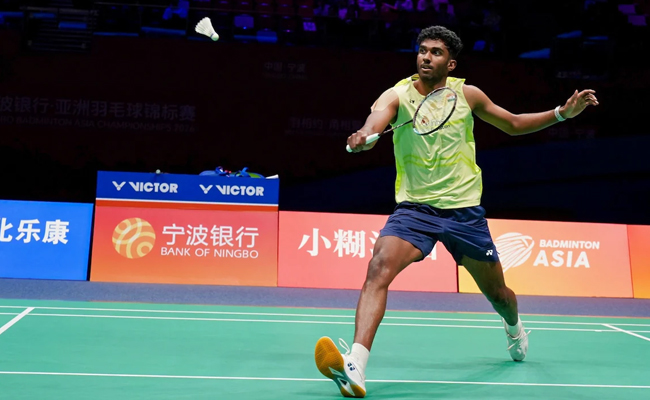
Ningbo (China) (PTI): India's Ayush Shetty signed off with a silver medal after his giant-killing run ended in a straight-game loss to world No. 2 Shi Yu Qi in the final of the Badminton Asia Championships here on Sunday.
The 20-year-old from Mangalore struggled to find his rhythm, going down 8-21, 10-21 to the reigning world champion from China, as India's 61-year wait for a men's singles gold at the event continued.
Despite the loss, it was a creditable campaign from the unseeded youngster, who became only the second Indian men's singles player after Dinesh Khanna to reach the final of the continental showpiece.
Khanna remains the only Indian singles champion at the event, having won the title in 1965. Since then, only the men's doubles pair of Satwiksairaj Rankireddy and Chirag Shetty have lifted the trophy, winning it in 2023.
World No. 25 Ayush entered the contest on the back of defeats to Shi at the Malaysia Super 1000 earlier this year and the Indonesia Masters last season. However, he had played with far greater control and attacking clarity this week, toppling world No. 1 Kunlavut Vitidsarn, world No. 4 Jonatan Christie and world No. 7 Li Shi Feng en route to the final.
However, the Indian, a product of the Padukone-Dravid Centre for Sports Excellence in Bengaluru, failed to counter the tactical discipline of Shi, who used his repertoire of strokes and deception to deny Ayush the opportunity to play his natural attacking game.
Shi dictated the geometry of the court from the outset, controlling the net exchanges and forcing Ayush into the forecourt battle early. The variation in the Chinese player’s game blunted the Indian’s attack, as his smashes lacked precision and he succumbed to scoreboard pressure, leading to rushed shot-making.
Shi Yu Qi logged the opening points with two fine net dribbles to race to a 4-0 lead, as Ayush’s smashes lacked precision early on and he trailed 2-6. A long rally ended with the Chinese player going wide, offering the Indian some respite. A deceptive net shot helped Shi move to 7-4, and he extended the lead to 11-6 as Ayush struggled for control, committing a string of unforced errors.
Shi mixed it up effectively, producing a lovely drop shot and repeatedly drawing the Indian to the forecourt with cross returns like a metronome, forcing errors. Two down-the-line smashes gave Shi a massive cushion of game points, and he sealed the opening game when Ayush sprayed a return wide.
The Indian needed a complete reset to stay alive, and he responded with a thunderous straight smash before diving on both flanks to keep the shuttle in play and move to 3-1 in the second game. Shi continued to test Ayush with backhand deceptive net strokes and pushes to the deep, but the Indian managed to retrieve everything and even found his precision in time, with an on-the-line smash confirmed by Hawk-Eye and a well-constructed rally taking him to 7-2.
However, he couldn't hold on to the momentum as the Chinese clawed back to 7-7 after two long shots and a smash into the net from Ayush. A return that kissed the backline from Shi, followed by another error from Ayush at the net and a return into the net, handed the Chinese the advantage once again at the interval, as he led 11-8.
Shi’s ability to place the shuttle into empty spaces with his repertoire of strokes, often punctuated by a fierce smash, made life difficult for the Indian as he stretched the lead to 13-8. Soon, the Chinese was up 15-9 with another powerful smash.
A body return followed by a straight smash took him to 17-9, and another long shot from Ayush further dented his chances. A perfectly angled smash into the forehand corner brought Shi within two points of victory. He then unleashed a cross-court smash to earn 10 match points and sealed the contest with a return that cramped the Indian, targeting his hip.