Man mistakenly arrested in Karnataka compensated with Rs 5 lakh
Bengaluru, Aug 1: A 56-year-old man has been compensated with Rs 5 lakh for having been wrongfully arrested in a criminal case, due to a confusion over his name.
Ningaraju N, a resident of Kalidasa Layout here, had approached the High Court claiming that in the criminal case filed in 2011, the alleged accused Raju NGN was not him.
Quashing the case against him, the HC said, It is rather shocking that a person has been arrested without ascertaining whether he was the person who was required to be arrested and that the warrant had been issued against him.
Justice Suraj Govindaraj in his judgment dated July 7 noted that, his identification was not cross-checked and verified, resulting (in) an innocent person being arrested.
The HC said that the Right of Life and Liberty guaranteed under Article 21 of the Constitution is paramount and there is a violation of the fundamental right in this case.
The court said the state was liable to compensate the arrestee for having put him through loss of liberty as also loss of reputation. The compensation was fixed at Rs 5 lakh which the court said was payable within eight weeks.
Ningaraju was arrested because the name of his father (Ningegowda) was similar to the name of the person named in the warrant.
I'm unable to comprehend as to how the name of the father being similar or even identical would have any role to play in the arrest, extrapolating the same logic if the arrest warrant has been issued for one brother, another brother or maybe even the sister could be arrested, merely, because the father name is identical.
Ningaraju was arrested on the wrong assumption that he was the ex-director of the Ms India Holiday (Pvt) Ltd, which was under liquidation.
Further, to prevent such incidents in the future the High Court directed that if Guidelines or Standard Operating Procedure are already issued to cater to this situation, training in this regard to be provided to all arresting officers.
If such a SOP is not already in place, the Director General of Police was directed to issue the guidelines as to what steps to be taken by the arresting officer before arresting a person including the verification of identity. This was directed to be issued within four weeks.
The HC will hear the matter again on September 1 to assess the compliance of the directions.
Let the Truth be known. If you read VB and like VB, please be a VB Supporter and Help us deliver the Truth to one and all.
Vijay unable to prove majority, not invited for CM oath ceremony: Sources
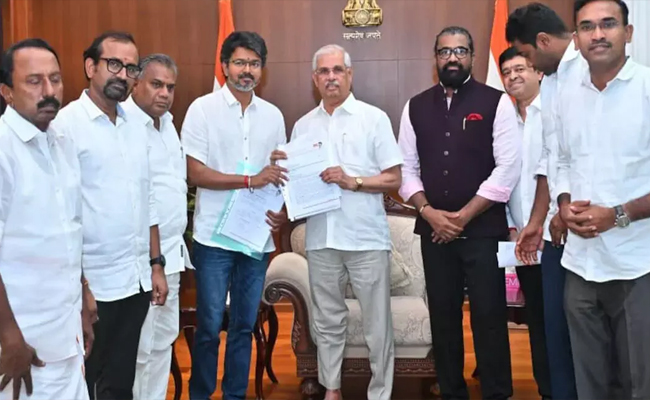
Chennai: Actor-politician Vijay has reportedly not been invited to take oath as Chief Minister of Tamil Nadu after failing to demonstrate support from the required number of MLAs, sources in Raj Bhavan said.
According to media reports that quoted sources in the office of R.N. Ravi Arlekar, Vijay could not prove the backing of 118 legislators, the majority mark in the 234-member Tamil Nadu Assembly.
Despite last-minute efforts to secure support from the Viduthalai Chiruthaigal Katchi (VCK), Amma Makkal Munnetra Kazagam (AMMK), and an IUML legislator, Vijay reportedly managed support from only 116 MLAs, falling short by two members.
Sources said Vijay failed to submit letters of support from the VCK and the Indian Union Muslim League (IUML).
Later, the IUML issued a statement clarifying that it was not part of the TVK-led alliance.
Meanwhile, AMMK leader T.T.V. Dhinakaran is also said to have informed the Governor that his party would support the All India Anna Dravida Munnetra Kazhagam (AIADMK) instead.
Earlier in the evening, Vijay had met Governor Arlekar and staked claim to form the government, stating that he enjoyed the support of 118 MLAs.