Man who threw eggs on Siddaramaiah's car a Congress worker, claims BJP leader
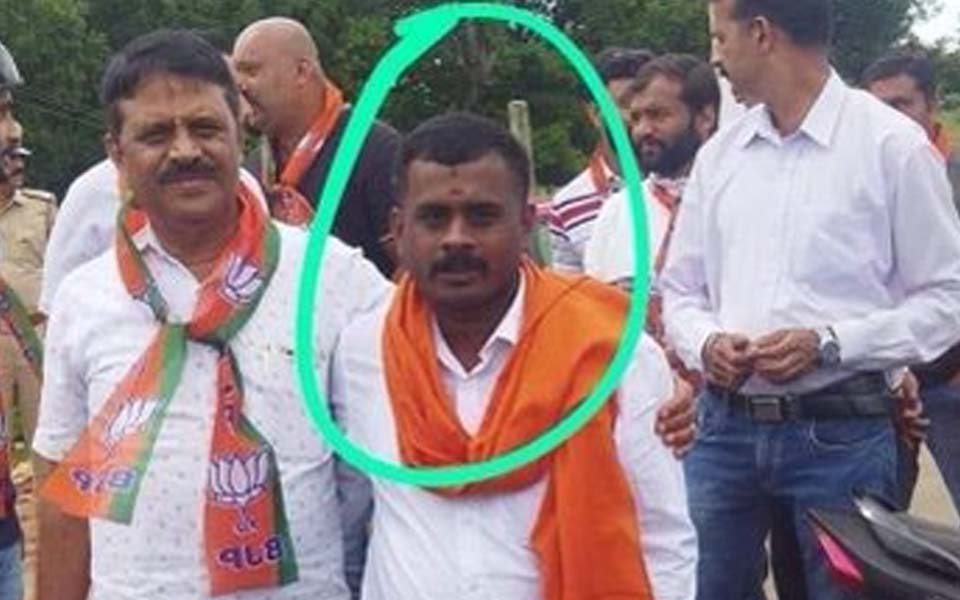
Madikeri, Aug 20: A man who hurled eggs at Leader of Opposition in the Karnataka assembly, Siddaramaiah's car during his visit to Kodagu district to inspect rain-related damages, was a Congress worker, a BJP MLA claimed on Saturday.
Sampath was among a number BJP activists who were arrested for staging a protest against Siddaramaiah on August 18.
A video of the incident in which Sampath is purportedly seen throwing eggs on Siddaramaiah's car has gone viral. However, maintaining distance from Sampath, BJP legislator M P Appachu Ranjan claimed that Sampath was not a BJP activist but a Congress worker.
Responding to the MLA's claims, Sampath said he is indeed a Congress worker and was upset with his party leader Siddaramaiah's alleged remarks made in the past that the Kodavas eat beef.
"I threw eggs because of Siddaramaiah's statement, not because of the protest (organised by BJP). Because of his (Siddaramaiah's) derogatory comments that the people of Kodagu eat beef and statements in favour of Tipu Sultan," Sampath told reporters here.
Sampath said many people in Kodagu dislike Tipu Sultan, the 18th century Mysuru ruler. "I did not like his (Siddaramaiah's) statements. I am a Hindu first and then a Congress worker," he added.
"There are photos of Sampath holding the Congress flag, shawl and banner. If it is proved that he is our party member, then we will expel him...," Ranjan told reporters.
According to the BJP MLA, Sampath is in the construction industry and works as a bar bender, while adding that Sampath's father Sundaramurthy was in the BJP.
Sampath said he had come from Somawarpet to Madikeri, the district headquarter town of Kodagu, for some personal work. He went to have food near the place where he supposedly saw the Bharatiya Janata Party Youth Wing activists protesting against Siddaramaiah's visit.
During his visit to Kodagu to inspect the rain-related damage two days ago, Congress stalwart Siddaramaiah faced the ire of the BJP Youth Wing activists who blocked the road and raised slogans against him.
The BJP leaders vented their anger against Siddaramaiah's statement following violent clashes in Shivamogga on August 15 questioning the saffron party workers for putting up Hindutva ideologue Vinayak Damodar Savarkar's poster in an area predominated by Muslims.
They were also opposing him for organising Tipu Jayanthi when he was the Chief Minister of the state. As CM, Siddaramaiah had started Tipu Jayanthi celebrations to pay tribute to the 18th century ruler of Mysuru.
Some Hindutva activists in Kodagu allege that Tipu Sultan had carried out large-scale conversion and killings of Kodavas, the native community of Kodagu district, during his rule.
During Tipu Jayanthi in November 2015, which the then Congress government had organised, widespread protests broke out in many parts of Karnataka, especially in Madikeri.
Meanwhile, Siddaramaiah and his loyalists are mulling over taking out a Madikeri Chalo', a march to Madikeri.
It is expected to be similar to the 'Ballari Chalo' movement taken out by Siddaramaiah in September 2010 against the rampant illegal mining of iron ore in the district.
ಮೊಟ್ಟೆ ಎಸೆದಿದ್ದು ಕಾಂಗ್ರೆಸ್ ಕಾರ್ಯಕರ್ತ ಎಂಬ ಕಾಗಕ್ಕ ಗುಬ್ಬಕ್ಕನ ಕತೆ ಕಟ್ಟಿರುವ @BJP4Karnataka ಉತ್ತರಿಸಬೇಕು.
— Karnataka Congress (@INCKarnataka) August 20, 2022
ಅವರು ಕಾಂಗ್ರೆಸ್ ಕಾರ್ಯಕರ್ತರೇ ಆಗಿದ್ದರೆ ಬಿಜೆಪಿ ಶಾಸಕ ಅಪ್ಪಚ್ಚು ರಂಜನ್ ಠಾಣೆಯಿಂದ ಜಾಮೀನು ಕೊಟ್ಟು ಕರೆತಂದಿದ್ದೇಕೆ?
ಕಾಂಗ್ರೆಸ್ ಕಾರ್ಯಕರ್ತನಾಗಿದ್ದರೆ ಆತ ಅಪ್ಪಚ್ಚು ರಂಜನ್ಗೇಕೆ ಆಪ್ತನಾಗಿದ್ದಾನೆ. pic.twitter.com/t1FWjZFvDk
Let the Truth be known. If you read VB and like VB, please be a VB Supporter and Help us deliver the Truth to one and all.
Vijay secures majority support, set to stake claim to form Tamil Nadu govt
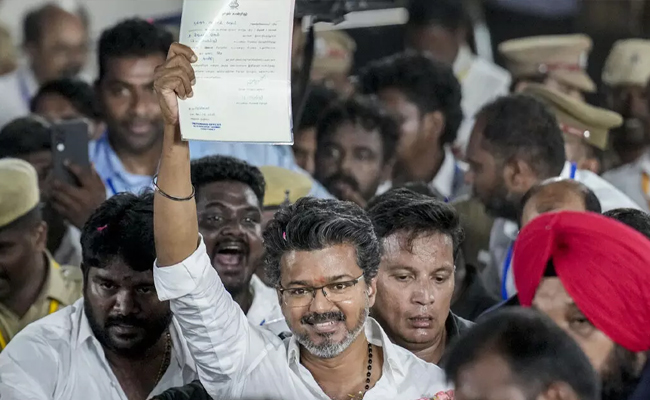
Chennai: After four days of political uncertainty and intense negotiations in Tamil Nadu, actor-politician Vijay is learnt to have secured the numbers required to form the government, sources said.
Supporters gathered outside Vijay’s residence in Chennai on Friday evening, raising slogans in support of Tamilaga Vettri Kazhagam soon after reports emerged that the party had managed to secure majority support.
Sources said Vijay is expected to meet Tamil Nadu Governor R. V. Arlekar on Friday evening to stake claim to form the government. The meeting is likely to take place around 6 pm.
In its electoral debut in the Tamil Nadu Assembly elections, TVK won 108 out of the 234 seats, dealing a major blow to the 62-year political dominance of Dravida Munnetra Kazhagam and All India Anna Dravida Munnetra Kazhagam.
However, Governor Arlekar had reportedly made it clear that the party would not be invited to form the government without proving a clear majority. Even after two rounds of discussions on Wednesday and Thursday, the Governor is learnt to have maintained his stand that letters of support from at least 118 MLAs must be submitted in the 234-member Assembly.
Apart from Vijay, TVK had the backing of 107 MLAs. Vijay had contested from Tiruchy (East) and Perambur constituencies and won both seats, meaning he would have to resign from one seat before taking oath. This increased the need for additional support.
Amid the political developments, five MLAs from the Congress party, which reportedly moved away from the DMK-led alliance, extended support to Vijay. Vijay also held discussions with leaders of Viduthalai Chiruthaigal Katchi, Communist Party of India (Marxist) and Communist Party of India.
The VCK, CPI(M) and CPI had so far been allies of the DMK. At the same time, political discussions intensified in the state over speculation that the DMK could even explore a post-poll understanding with its long-time rival AIADMK to prevent an alternative government from taking shape.
Reports had been circulating since Friday afternoon that the VCK and Left parties were likely to support Vijay. Sources later said that the VCK, CPI(M) and CPI agreed to extend the support of two MLAs each, helping TVK cross the required majority mark.
All eyes are now on the Governor’s next move and the official announcement regarding the formation of the new government in Tamil Nadu.