Mandya: Bodies of lovers found in river; ‘honour killing’ suspected
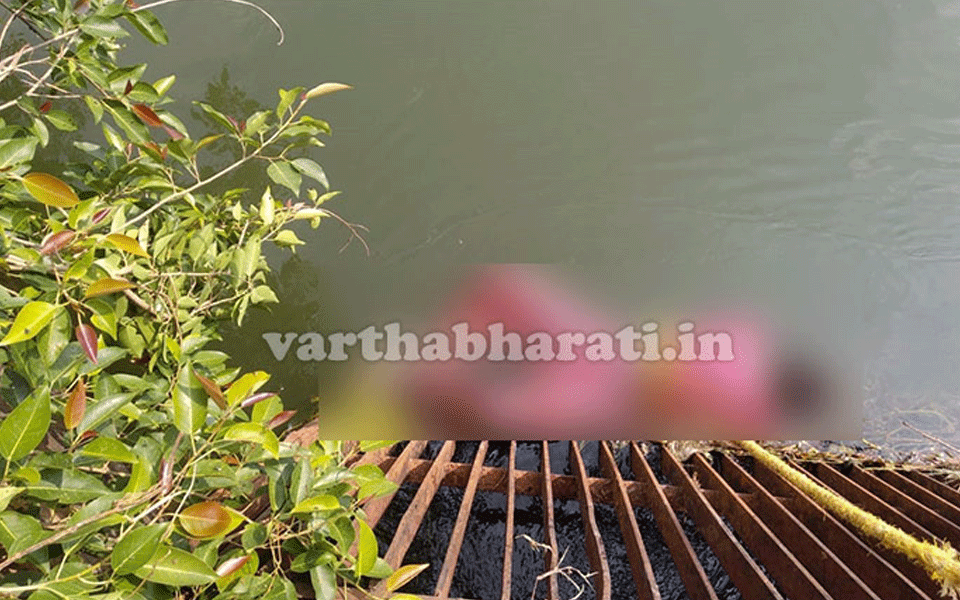
Mandya, November 16: The bodies of a newly married couple found in Cauvery river separately near Shivanasamudra in Malavalli taluk. Police suspected that the couple might have been killed by the family members of the lady as it was an inter-caste marriage.
Last Wednesday, the body of a youth aged around 26 years was found in the Cauvery river near Shivanasamudra. When the Belakavadi police rushed and fished out the body, it was found that the youth was tied with the ropes and killed him by throwing him into the river. Close on the heels of this incident, the body of the woman was also found at the same spot and she was also tied with the ropes. Since they were lovers, they might have been killed by the family members, police suspected.
When the police investigated the incident, they found that both man and woman – named Nandeesh (26) and Swathi (19)- were from Chudagoundanahalli in Hosuru taluk in Tamil Nadu. But they were from different castes. Nandeesh who was working in a hardware company and Swathi who was studying her second B Com, were loving each other for the last two years. But the family members of the girl were strongly opposed their love affair. The family members of the girl quarreled with the father of the boy. After this incident, Swathi went out of her home saying that she would bring TC from Krishnagiri college and did not return home. But she has gone with Nandeesh and stayed at his house. Both of them married recently, police said.
Later, they were in unknown place. But a relative of Swathi noticed her when she had been to a programme at Hosur on November 10 and informed her parents. Her father and four others met the couple and forced them to come along with them to the police station and compromise there. They brought them in a car to the bank of Cauvery river near Shivanasamudra through NICE road at around 3 am. After alighting them from the car, they were thrashed black and blue. Later, the accused tied Nandeesh with ropes and dumped in the river. Later, Swathi was also assaulted, tied her legs and hands and dumped in the river, police said.
Belakavadi police registered a case against five persons including Swathi’s father and her uncle. They traced the whereabouts of the accused and they might arrest the accused by tomorrow, it is said.
Let the Truth be known. If you read VB and like VB, please be a VB Supporter and Help us deliver the Truth to one and all.
Maharashtra sets up state vaccination task force to strengthen immunisation programme

Mumbai (PTI): The Maharashtra government has set up a State Vaccination Task Force to strengthen the regular immunisation programme and review the progress of related campaigns, a health department official said on Monday.
The State Vaccination Task Force will comprise at least 29 members and will be headed by the administrative head of the health department, he informed.
The government has also constituted separate district-level and municipal vaccination task forces to improve implementation and address challenges at the grassroots level, he said.
Municipal task forces, chaired by respective civic commissioners, have been constituted in view of the vast urban population in Maharashtra and the role of civic bodies in implementing different health programmes.
The district-level task forces will function under the chairmanship of collectors.
"Complete immunisation of children at the appropriate age is an extremely simple, cost-effective and highly effective measure to reduce child mortality and the prevalence of diseases among kids. Immunisation is a powerful tool for reducing illness in children," maintained the official.
To ensure full vaccination of all children, the state government implements various campaigns from time to time as per the central government guidelines, he pointed out.
"Active participation and cooperation of other relevant government departments are essential (in making these campaigns successful)," according to the official.
The state-level body will review the regular immunisation programme, associated campaigns and vaccine-preventable diseases in detail. It will also conduct focused assessments of high-risk districts and municipal corporations, including vacancies at district, municipal and sub-district levels, availability of cold chain equipment, resource gaps and training requirements, he noted.
The state task force will review allocation and utilisation of funds for immunisation and ensure timely action by officers concerned based on reports from district and municipal task forces and state-level monitoring mechanisms, the official said.
It will also ensure active coordination and participation of other government departments in immunisation drives, while district and municipal task forces will carry out similar functions at their respective levels, the official added.