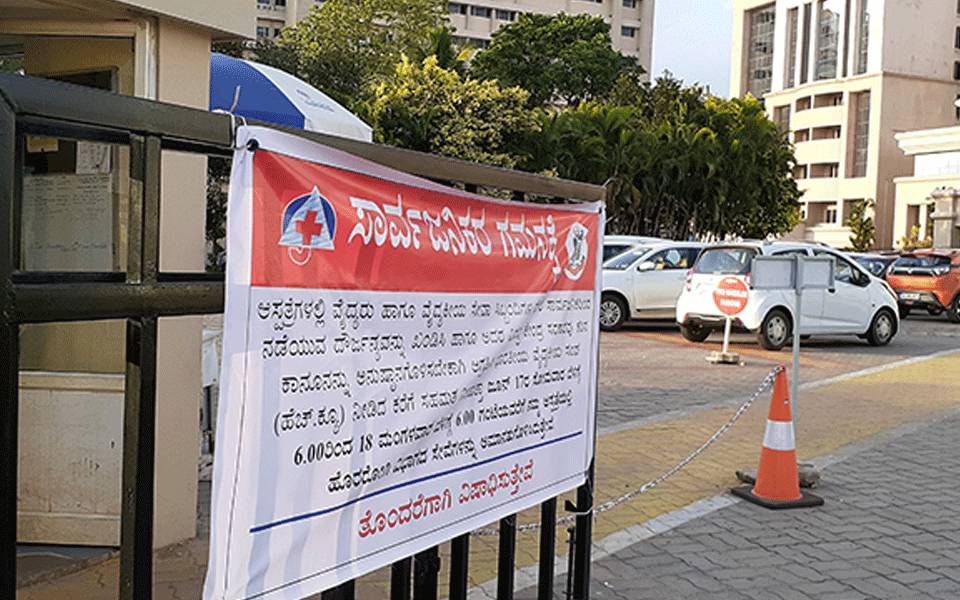
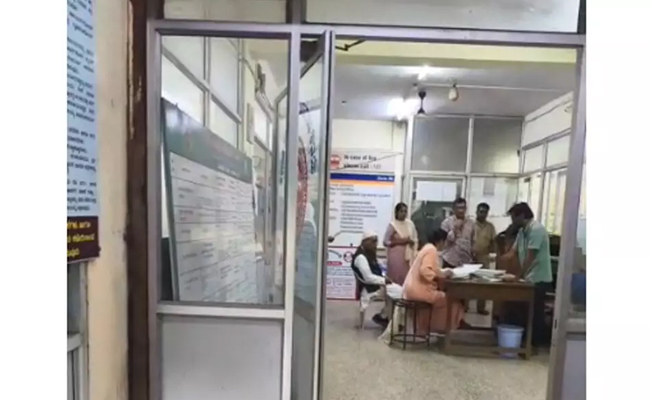
Bengaluru: Hundreds of private hospitals, nursing homes and clinics in Karnataka suspended outpatient services on Monday following a call by the Indian Medical Association to hold a day-long strike in solidarity with the doctors sitting on a protest in West Bengal.

The strike had a telling effect as people were seen struggling to get medical aid in private hospitals.

However, the government hospitals remained open as usual following a circular by the Commissioner of Health and Family Welfare.

Health department sources said there was heavy rush at government hospitals since morning.

The IMA did not heed to state Health Minister S S Patil's appeal to keep the strike symbolic and not cause much trouble to people.

"Almost all private hospitals and clinics have shut their OPD services. Emergency and pregnancy cases were taken up," Karnataka IMA president N Dhanpal told PTI.

Prominent hospitals in Bengaluru which joined the strike were Apollo Hospitals, St John's Hospital, Narayana Hrudayalaya and Sagar Hospital, Dhanpal added.

Suresh Shastry, joint director, Health and Family Welfare Department, said the strike had no effect on government hospitals.

Junior doctors in West Bengal are on strike since June 11 after two of their colleagues were attacked and seriously injured allegedly by relatives of a patient who died at the NRS Medical College and Hospital in Kolkata.

In a show of solidarity with their counterparts in Bengal, medical practitioners across the country have chosen to keep away from work.

All the private hospitals and medical colleges in Dakshina Kannada have also endorsed the strike and have called off OPD services. Emergency and pregnancy cases were being taken.

Let the Truth be known. If you read VB and like VB, please be a VB Supporter and Help us deliver the Truth to one and all.


New Delhi (PTI): An Indian-flagged crude tanker sailed out safely from the UAE's Fujairah after loading oil, despite an attack on the oil terminal, as the government on Sunday said it is closely monitoring the situation in West Asia while ensuring stable fuel supplies and maritime safety.

The vessel, Jag Laadki, carrying about 80,800 tonnes of Murban crude oil, departed Fujairah at 1030 hrs IST and is bound for India, with all crew members safe, the government said in an update on preparedness measures.

Jag Laadki is the fourth Indian-flagged vessel to have come out of the war zone unharmed.

Besides, the safe passage being an important milestone for Indian diplomacy, the cargo they are carrying is considered critical as shipping constraints in the Strait of Hormuz have impacted India's energy supplies.

"On March 14, 2026, while the Indian-flag vessel Jag Laadki was loading crude oil at the Fujairah Single Point Mooring, the Fujairah oil terminal was attacked. The vessel sailed safely from Fujairah at 1030 hrs IST today (Sunday) carrying about 80,800 tonnes of Murban crude oil and is bound for India," the update said.

"The vessel and all Indian seafarers onboard are safe."

On Saturday, two Indian-flag LPG carriers - Shivalik and Nanda Devi - carrying about 92,712 tonnes of LPG crossed the war-hit Strait of Hormuz.

Shivalik is due to reach Mundra port in Gujarat on March 16, and Nanda Devi would dock at Kandla port on March 17, according to the update.

The two ships were among the 24 ships that were stranded on the west side of the strait since the war broke out in the region.

Besides the 24 on the west side of the strait, four others were stranded on the east side.

One of the four on the east side, an India-flagged oil tanker, Jag Prakash, carrying gasoline from Oman to Africa, crossed the war-hit strait on Friday.

Jag Prakash loaded gasoline from Sohar port in Oman and is now headed to Tanga in Tanzania. It is due to reach Tanga on March 21.

The government said Indian vessels and seafarers operating in the region remain safe, and maritime operations are being closely monitored. At present, 22 Indian-flagged vessels with 611 seafarers remain on the west side of the Persian Gulf region.

India imports about 88 per cent of its crude oil, 50 per cent of its natural gas and 60 per cent of its LPG needs. Before the US-Israel strikes on Iran on February 28 and Tehran's retaliation, more than half of India's crude imports, about 30 per cent of gas and 85-90 per cent of LPG imports came from West Asian countries, such as Saudi Arabia and the UAE.

The conflict has led to a blockade of the Strait of Hormuz, the main transit route for Gulf energy supplies. While India has partly offset crude supply disruptions by sourcing oil from countries, including Russia, gas supplies have been curtailed to industrial users and LPG availability to commercial establishments, such as hotels and restaurants, has been reduced.

"The Directorate General of Shipping continues to monitor the situation in coordination with ship owners, RPSL agencies and Indian Missions," the update said. "Since the activation of the DG Shipping Control Room, 2,995 phone calls and more than 5,357 emails have been handled from seafarers, their families and maritime stakeholders seeking information and assistance."

DG Shipping has facilitated the safe repatriation of 276 Indian seafarers from the Gulf region so far, including 23 repatriations in the past 24 hours from airports and regional locations.

Ports across the country are closely monitoring vessel movements and cargo operations in view of the evolving maritime situation.

The Ministry of Shipping continues to coordinate with the Ministry of External Affairs, Indian Missions, shipping companies and maritime stakeholders to ensure the safety and welfare of Indian seafarers while maintaining the continuity of maritime trade and port operations, the update said.