MFI ordinance will be sent back to Governor with clarifications: Karnataka Home Min. G Parameshwara
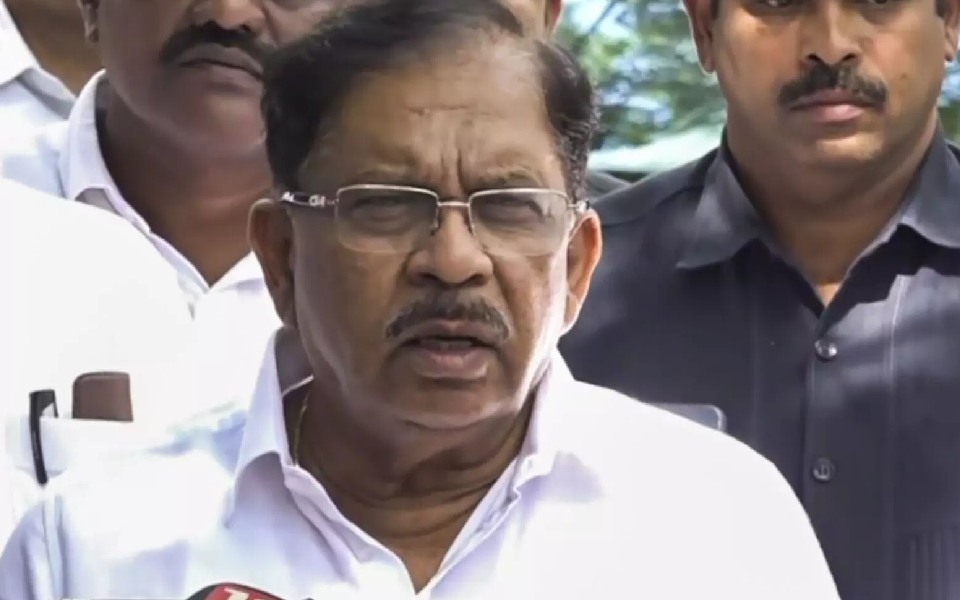
Bengaluru, Feb 8 (PTI): After the Governor returned the ordinance aimed at protecting borrowers from harassment by microfinance institutions (MFIs), Karnataka Home Minister G Parameshwara said on Saturday that the government would address his observations and send it again for his assent.
Governor Thaawarchand Gehlot has sent back the ordinance to the government, citing regulatory excesses.
The Karnataka Micro Finance (Prevention of Coercive Actions) Ordinance 2025 drafted by the government has penal provisions including a jail term up to ten years, and fine as high as Rs five lakh for violation.
The government decided on promulgating the ordinance, in response to a spate of suicides and multiple complaints from various parts of the state against predatory loan recovery methods adopted by microfinance firms.
"The Governor has returned it with certain observations, the government will reply to them and send it again (to him)," Parameshwara told reporters here.
Responding to a question on the Governor's observation regarding a higher fine, he said, "The fine is imposed on those who commit wrong, not everyone. I don't know in what context he has made the observations. We have made such provisions in the larger interest so that it becomes a deterrent."
The Governor in his observation has said the terms of punishment --10-year imprisonment and Rs 5 lakh fine -- are disproportionate compared to the provisions already available in other laws for similar offences.
In any case, he said, when the maximum amount of loan that can be lent is Rs 3 lakh, the proposed fine of Rs 5 lakh is against natural principles.
The Governor has also advised that since the budget session will commence next month, instead of bringing an ordinance in a hurry, the state must deliberate this issue in detail and bring an effective enactment in the interest of the affected people and to protect their rights.
Responding to a question on this the Home Minister said, "He has made such a suggestion as we are planning for a legislature session from March 3.
But, we wanted to put a law in place to control such incidents, as there were reports of suicide and harassment cases increasing every day."
The Governor has sought certain clarifications, and they will be given, Parameshwara said in response to a question. "Differences in perspective between the government and the Governor will be there, such things have happened earlier too and in other states too. We cannot tell the Governor not to seek clarifications."
Regarding the Governor suggesting the use of existing law instead of a new ordinance, Parameshwara said, "He has shared his perspective. Despite having certain existing laws, as it cannot be implemented, we have made provision for it in this ordinance...."
The Governor has pointed out that to control the forceful and unlawful activities of unscrupulous agencies, the state through its police and departments concerned have already got provisions under the Karnataka Money Lenders Act, 1961, Negotiable Instruments Act, 1881, The Karnataka Debt Relief Act, 1976 and Indian Penal Code, including Karnataka Police Act to deal with such discrepancies.
Gehlot said efficient implementation of existing frameworks by enforcement machinery could help regulate these problems in an efficient manner.
Let the Truth be known. If you read VB and like VB, please be a VB Supporter and Help us deliver the Truth to one and all.
TN seeks duty-free cotton imports to support textile sector: CM Vijay writes to PM
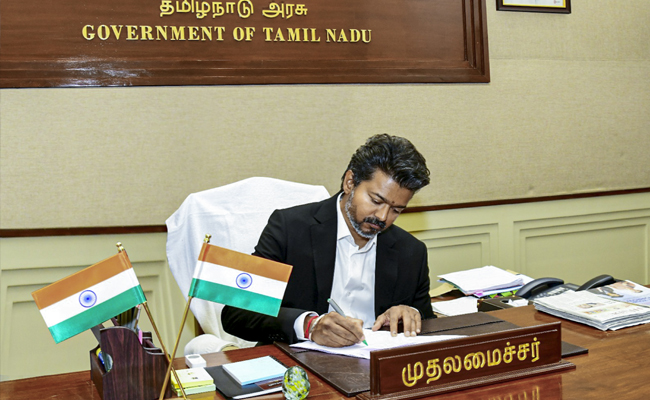
Chennai (PTI): Tamil Nadu Chief Minister C Joseph Vijay on Thursday urged Prime Minister Narendra Modi to remove the import duty on cotton.
In his first letter to Modi after taking over as chief minister of the state, he said Tamil Nadu is the country’s largest textile and apparel exporting state.
Lakhs of people are dependent on this sector for both direct and indirect employment, especially women from rural and semi-urban backgrounds, Vijay pointed out.
Stating that the industry is facing a severe crisis due to an increase in cotton prices and consequently yarn prices, he said, “I understand this is caused primarily due to a shortage in cotton production and increased trading activity in the country.”
Pointing out that the price of cotton has increased from Rs 54,700 to Rs 67,700 per candy—an increase of 25 per cent over the last two months—while yarn prices have increased from Rs 301 to Rs 330 per kg, he said, “In this situation, the continued supply of raw material can be ensured only through imports.”
However, there is an import duty of 11 per cent on cotton, he said, adding that in such a situation, permitting duty-free cotton imports will help the industry meet increasing export commitments and remain globally competitive.
Vijay said that after agriculture, the textile and apparel sector is one of the largest employment-generating sectors.
“There is a significant responsibility on the government to safeguard the employment of lakhs of people and ensure the sustainability of the textile value chain," he said.
“Hence, I request your intervention to remove the import duty on cotton from the existing 11 per cent to 0 per cent to ensure the availability of raw material. This measure will enable the textile and apparel industry to remain globally competitive, enhance exports, and protect jobs,” he added.