Minister Priyank Kharge alleges abuse, threats over demand to ban RSS events in public places
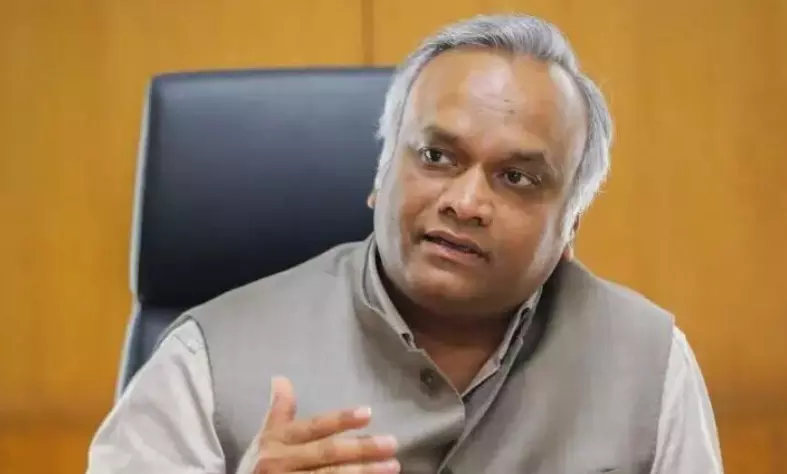
Bengaluru: Karnataka Minister for Rural Development and Panchayat Raj Priyank Kharge has accused supporters of the Rashtriya Swayamsevak Sangh (RSS) of sending him abusive and threatening messages following his call for a ban on RSS programmes in public spaces and government premises.
Kharge had recently written to Chief Minister Siddaramaiah, urging the state to prohibit RSS activities in public places, alleging that the organisation spreads “divisive ideology” among youth. In a post on his personal ‘X’ account on Tuesday, he said he had been receiving threat calls and messages ever since the letter became public.
On Wednesday morning, Kharge released a video message questioning whether trainees at the RSS’s shakhas (branches) were being taught to verbally abuse others’ mothers and sisters. “Are BJP leaders like B.Y. Vijayendra, R. Ashoka, C.T. Ravi, V. Sunil Kumar, Pratap Simha and Chalavadi Narayanaswamy ready to endorse similar abuse directed at the mothers of Prime Minister Modi or Mohan Bhagwat?” he asked.
Kharge said the abusive messages were being sent mostly by young men from economically weaker backgrounds, claiming they were being “used” by the RSS. “While the children of BJP leaders are building their future, those from poor families are being pushed into such abusive acts. If I file a case, the young man who sent the message will suffer, while those who instigated him will remain unaffected,” he said in the video.
The minister clarified that his opposition was not against any individual but against what he termed a “malignant mindset” that must be countered through the teachings of Buddha, Basavanna and Dr. B.R. Ambedkar. “My fight is not against a person but against a toxic mentality. The youth who have fallen prey to this mindset must be rescued,” he said.
Rejecting attempts to intimidate him, Kharge said he would not be deterred by abuse or threats. “My political struggle is not about power but about philosophy. I will continue to speak out against the RSS mindset and protect the youth from falling into its trap,” he added.
Let the Truth be known. If you read VB and like VB, please be a VB Supporter and Help us deliver the Truth to one and all.
Power tariffs under BESCOM to rise from May 1
Bengaluru (PTI): Power bills for consumers under the Bangalore Electricity Supply Company Limited (BESCOM) will go up from May 1, following an order issued by the Karnataka Electricity Regulatory Commission (KERC) on Friday.
The hike comes after KERC allowed the BESCOM to recover a revenue deficit of Rs 2,068 crore incurred in 2024-25, from the consumers.
As a result, for every unit of electricity consumed in 2024-25, the customers will be charged an additional 56 paise, it said.
"BESCOM shall calculate, for each of the active consumers of FY2024-25 the amount to be recovered based on their actual energy consumption during FY2024-25. Such amount shall be recovered during FY 2026-27 in equal monthly instalments, to be called as 'FY25 True up Charges', commencing from the first meter reading date falling on or after 1 May 2026 and concluding with the reading date ending on 30 April 2027," the order said.
"It is further ordered that BESCOM shall maintain a separate head of account, allocated for the purpose, to record the adjustment of the said amount to ensure full recovery of the deficit," it added.
Similarly Chamundeshwari Electricity Supply Corporation Limited (CESC) has also recorded a revenue deficit of Rs 121.71 crore and can collect an additional 15 paisa per unit for consumption in 2024-25, official sources said.