Minister Satish Jarkiholi dismisses talk of 'November revolution', says Congress won't allow it
_vb_11.jpeg)
Bengaluru (PTI): Playing down speculations about "November revolution" and major political changes in Karnataka, especially in the ruling Congress, state Minister Satish Jarkiholi on Monday said the party high command would not let any such upheaval to take place.
There have been speculations about a change in Chief Minister in the state, when the Congress government reaches the halfway mark of its five-year term in November, which is being referred to by some as "November revolution".
"I have said it many times, I'm not aware of it. It will be decided at the level of the Chief Minister, Deputy CM and party high command. I'm not aware of it, so I cannot say anything about it," Jarkiholi said responding to a question regarding the cabinet reshuffle and power sharing with leadership change.
Speaking to reporters here, the minister said, "I don't know anything about the November revolution. There is a party and there is high command, why will they let any revolution happen? They will not allow it."
When pointed out that many leaders in the party, including his friend K N Rajanna repeatedly predicting political changes in November, he said, "let's wait and see, only a few more days are left."
The state's political circles have been abuzz with speculation about a possible power-sharing arrangement between incumbent CM Siddaramaiah and his deputy D K Shivakumar.
The statement made by Siddaramaiah's son Yathindra Siddaramaiah last week that his father was at the fag end of his political life and Satish Jarkiholi is a leader with similar progressive ideological thinking, had lead to speculations.
Downplaying Yathindra's remark, Jarkiholi said he has spoken about leading the AHINDA (Kannada acronym for minorities, backward classes, and Dalits) movement (championed by Siddaramaiah), which is separate from the party and the government.
"It has nothing to do with this (CM change)....I have not asked for CM post or party (President) post and he (Yathindra) too did not speak about CM or party president post," he said.
Asked whether he would stake claim for the CM's post in 2028, he said, "let's see when the time comes. Election has to happen and depending on the situation, a decision will be taken."
To another query about some voices within the party rooting for him to take over as the Karnataka Congress President, Jarkiholi said the party high command will take a call on it.
"There is no point in me making any claims....I have not demanded, nor will I do it. I have been given the responsibility as the Minister and I'm discharging it."
Currently the state Congress President post is held by Deputy CM D K Shivakumar for an extended tenure.
Responding to a question on the demand for a Dalit CM, Jarkiholi, a leader from the ST community said, "Many, including me have said that if an opportunity is given (to Dalit) it will be good. The party will ultimately decide who and from which community."
Asked whether there was a possibility for a Dalit to become CM in the Congress party, he replied, "it may happen in the days ahead. We will have to wait, immediately there is no such opportunity. We will have to create an opportunity."
Let the Truth be known. If you read VB and like VB, please be a VB Supporter and Help us deliver the Truth to one and all.
JK: Fire breaks out in commercial building near Lal Chowk, 19 gas cylinders recovered
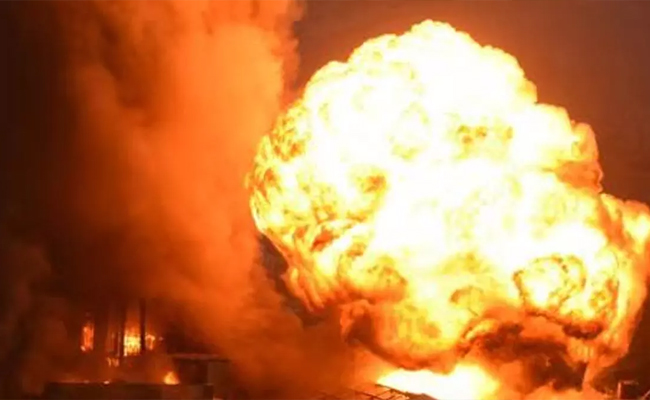
Srinagar (PTI): A fire broke out in a five-storey commercial building near the Lal Chowk city centre here on Saturday, but was doused before it could spread in the congested business hub, officials said.
They said firefighters recovered 19 gas cylinders during the operation and there were no casualties in the incident.
Assistant Director, Fire and Emergency Services, Aqib Mir, said, "The fire originated from the attic portion of the building, which houses the kitchen of a restaurant. The cause of the fire is being ascertained."
"The attic was severely damaged. There were no casualties," he said.
The firefighters managed to contain the damage by swiftly dousing the blaze using a hydraulic platform, Mir said.
During the firefighting operation, 19 gas cylinders were recovered from the spot, he said.
"We have informed the concerned police station," he added.
Mir appealed to people not to store combustible substances at home or commercial places.