Minister Umesh Katti draws flak for asking farmer to die for seeking more rice in PDS
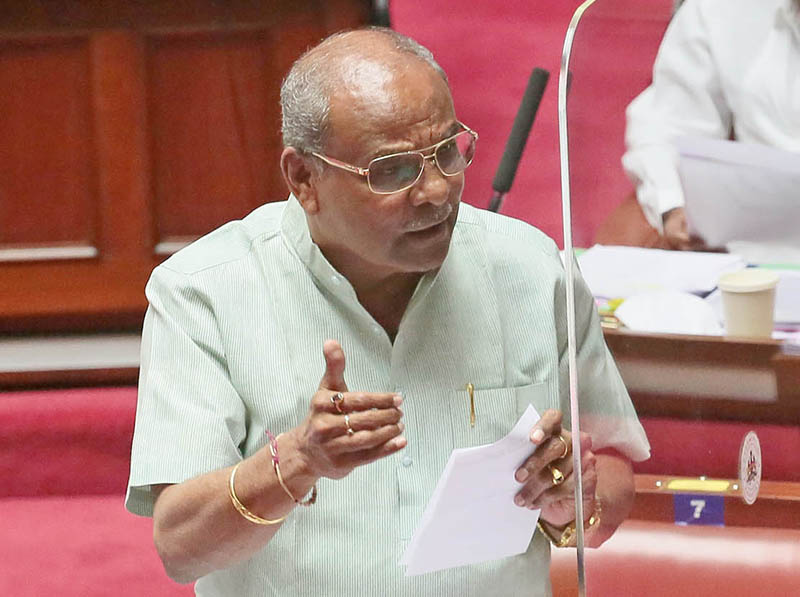
Bengaluru, Apr 28: Karnataka Food and Civil Supplies Minister Umesh Katti on Wednesday drew flak from Chief Minister B S Yediyurappa and opposition parties for reportedly asking a farmer to die when he requested enhanced supply of rice though the Public Distribution System.
Katti later withdrew his statement, tendered an apology and said he never wanted anyone to die and that everyone should prosper.
Ishwar, the farmer activist from Gadag in North Karnataka, rang up Katti on Wednesday and asked him how he expected people to survive on just two kg of rice a month when the lockdown has rendered thousands jobless.
To Ishwar's query, the minister replied that the Centre would be giving five kg foodgrains in May and June in view of the lockdown.
This did not satisfy the farmer, who then sought to know whether people should fast till that period or die.
"It's better to die. It's better that you stop the business of selling rice. Don't ring me again," Katti said.
The government had decided to give two kg of rice and three kg of ragi through PDS in South Karnataka,and two kg of rice and three kg of either maize or wheat in North Karnataka.
The minister later clarified that he never meant anyone should die and that all 6.5 crore people in Karnataka should prosper and survive.
He said the entire quota of food grains under the PDS for April, alloted by the Centre, had already been disributed.
"What can I do if someone makes such a statement? We are giving the Central quota from May 1 to May 10. No one should die and no one should ask such questions."
The Chief Minister's Office, in a statement, quoted Yediyurappa as saying that he disapproved of the remarks and that it does not behove a minister to tell a farmer to die when the latter demanded five kg of rice.
"Arrangements are being made to give five kg of rice to the people in the area who do not need wheat," he said.
Congress state chief D K Shivakumar slammed Katti's remarks and demanded that the government remove him from his post.
"BJP Minister Umesh Katti has abused a citizen & asked him to 'go die' just because he asked him why Karnataka Govt has cut Rice under PDS to just 2 kgs! "CM @BSYBJP (Yediyurappa) must immediately throw him out of the cabinet for this most insensitive statement.
Does this Govt have any shame?" Shivakumar tweeted.
Former Chief Minister H D Kumaraswamy too lambasted Katti for his statement.
"The Food and Civil Supplies Minister, who is supposed to come to the aid of the starving people in this COVID-19 pandemic, has displayed his mental distortion," he tweeted.
He said it was 'inhumane' on the part of the Minister to make such a statement.
Let the Truth be known. If you read VB and like VB, please be a VB Supporter and Help us deliver the Truth to one and all.
HC seeks mechanism on disclosure of complaints against judges after SC says no data maintained

New Delhi: The Delhi High Court sought suggestions for a framework to balance transparency and judicial independence on April 1, after the Supreme Court submitted that it does not maintain judge-specific data on complaints alleging corruption or misconduct.
The submission was made by Advocate Rukhmini Bobde. He appeared for the Supreme Court’s Central Public Information Officer, before Justice Purushaindra Kumar Kaurav in a petition filed by journalist and RTI activist Saurav Das. The case concerns an RTI application filed by Das in April 2023 seeking information on whether any complaints had been received against Justice T. Raja, former Acting Chief Justice of the Madras High Court, and if so, the number of such complaints and action taken.
According to a detailed report published by The Wire, the CPIO declined the request and stated that the information was “not maintained in the manner as sought for.” The first appellate authority upheld the decision. Although the Central Information Commission remanded the matter, the CPIO reaffirmed the refusal on similar grounds, which led Das to move the high court through Advocate Prashant Bhushan.
At the hearing, Justice Kaurav observed that the issue had wider institutional implications. It directed both sides to propose a mechanism that would protect the reputation of judges while ensuring public access to information regarding the handling of complaints. The case, Saurav Das v. CPIO, Supreme Court of India has been listed for further hearing on May 7.
During the arguments, Bhushan cited numbers released by the Union Law Ministry in Parliament in February 2026, which said that 8,630 complaints had been filed against sitting judges between 2016 and 2025. The Supreme Court provided data showing that complaints increased from 729 in 2016 to 1,102 in 2025. Bhushan questioned how aggregate data could be calculated without identifying the judges against whom complaints were filed.
Bobde responded that the data shared with Parliament reflected only total complaints against all sitting judges and did not involve judge-wise categorisation. She referred to the RTI request as a "fishing and roving inquiry." She also claimed that the Registry could not be forced to spend resources to collect material that was not stored in the format sought. She referenced the 2019 Constitution Bench decision in Supreme Court of India v. Subhash Chandra Agarwal, which allows for rejection if compliance will disproportionately divert resources, as her justification.
The high court questioned how no judge-specific information was maintained and expressed concern that disclosure of large aggregate figures without clarity on how complaints were handled could affect public perception. Justice Kaurav noted that an applicant could not be denied information solely on technical grounds relating to format.
Bhushan argued that the RTI request did not seek details of complaint contents or collegium deliberations but merely whether complaints were received and what action followed, submitting that transparency in the handling of complaints was essential to maintain public confidence.
The Supreme Court’s in-house procedure for examining complaints, adopted in 1999, provides for scrutiny by the Chief Justice of India and, where warranted, inquiry by a committee of judges. There is no statutory requirement for public reporting of outcomes.