Monsoon session of Karnataka legislature from Aug 11 to 22
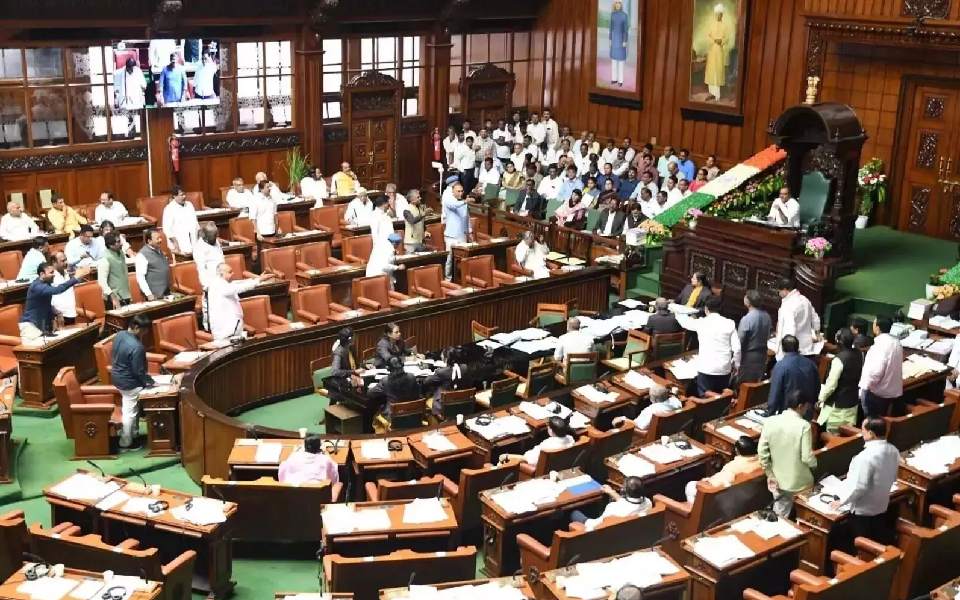
Bengaluru, Jul 18 (PTI): The monsoon session of the Karnataka legislature will be held for nine days between August 11 and 22 at the Vidhana Soudha here.
Governor Thaawarchand Gehlot has summoned the Karnataka Legislative Assembly and Council to meet in Bengaluru at 11 AM on August 11, the official notifications said.
The opposition may seek to corner the government on a host of issues, including its handling of the RCB victory celebrations that led to loss of lives due to stampede, the government taking up a new caste census, alleged discrepancies in the survey that was held to provide internal reservation among Scheduled Castes, and alleged communal killings in coastal districts, among others.
Several key Bills, including the Karnataka Crowd Control (Managing Crowd at Events and Venues of Mass Gathering) Bill, 2025; Karnataka Rohith Vemula Bill, 2025; Karnataka misinformation, fake news prohibition Bill, 2025; Karnataka hate speech and hate crimes prevention Bill, 2025, are likely to be tabled during the upcoming session.
The session has come amid rumblings within both ruling Congress and opposition BJP over the leadership issue. While there is speculation about the chief minister change in the Congress, the BJP is faced with a factional rift over the continuation of B Y Vijayendra as the party's state unit president.
Let the Truth be known. If you read VB and like VB, please be a VB Supporter and Help us deliver the Truth to one and all.
Two arrested in K'taka for assaulting minors, uploading CSAM content

Bengaluru (PTI): Two men were arrested for allegedly sexually assaulting two minor girls, recording the acts on mobile phones and uploading the videos online as child sexual abuse material, police said on Thursday.
The accused have been identified as Kiran Kumar (29), hailing from Chitradurga district, and Aditya M K (20), hailing from Shivamogga district, they said.
A probe was initiated after information was received from the NCRP portal regarding a suspected instance of creation of Child Sexual Abuse Material (CSAM) for online dissemination, police said.
Accordingly, a case was registered at Kaggalipura Police Station under relevant sections of the IT Act on May 10, they added.
Investigation revealed that two minor girl victims were exploited and videos were created and uploaded to the internet. The child victims have subsequently recorded their statements as per procedure and further necessary legal steps have been taken, Pronab Mohanty Director General of Police, Cyber Command, said in a statement.
Based on the statements of the victims, the accused persons, who allegedly assaulted the minors, recorded the acts on mobile phones and uploaded the videos online, were arrested, he said.
Following the probe, sections 65(2) (rape) and 70 (gangrape) of the Bharatiya Nyaya Sanhita, along with relevant sections of the POCSO Act, have been added to the FIR, police said.
Officials collected relevant information and on May 12, arrested the accused persons and seized three mobile phones belonging to them, in which the videos had allegedly been recorded, he said.
The accused were later produced before the court and taken into police custody for further investigation, he added.
According to him, in CSAM cases, police usually apprehend offenders who have downloaded such content or have kept them in their possession after obtaining them from elsewhere, usually the internet.
"The present case is one of the very few instances where content creators and uploaders have been apprehended," Mohanty added.