Muslim Professors Left Behind in Karnataka’s Medical Institutions
RTI reveals decline in representation & lack of opportunities in govt medical colleges & hospitals

Bengaluru: The sharp decline in the representation of qualified Muslim medical professors in teaching and administrative positions across Karnataka’s government medical colleges and super-specialty hospitals has become a matter of serious concern.
According to information obtained under the Right to Information (RTI) Act from institutions such as the Gulbarga Institute of Medical Sciences, Hassan Institute of Medical Sciences, Sri Jayadeva Institute of Cardiovascular Sciences, Indira Gandhi Institute of Child Health, and other state-run medical institutions, the total sanctioned teaching strength across both old and new medical colleges exceeds 3,486 posts. Of these, nearly 1,000 posts remain vacant. Yet, even among the filled positions, the percentage of Muslim faculty members appointed or promoted to senior roles is alarmingly low.
For instance, in the six new government medical colleges (with a total of 622 sanctioned teaching posts), only 22 faculty members belong to the Muslim minority community. In another eight colleges (with 1,376 sanctioned posts), just 30 Muslim professors are currently serving.
In four additional medical colleges with 688 sanctioned posts, 234 remain vacant. Among the older institutions, which collectively have around 800 sanctioned posts, 212 are vacant, and only a handful of Muslim professors (about seven) are eligible to hold senior administrative or leadership positions. The situation in super-specialty hospitals and autonomous medical institutes is even more worrying.
At the Rajiv Gandhi University of Health Sciences (RGUHS), there is only one registrar from the Muslim community, and none of the principals or directors (excluding temporary or unapproved positions like the current Principal of BMCRI) belong to the community. This is disheartening, given that many senior Muslim professors have decades of service, outstanding academic credentials, and unblemished records, yet continue to be overlooked for leadership roles.
Furthermore, there are serious allegations that some senior Muslim officials, who earlier held responsible posts such as Director of Kidwai Memorial Institute of Oncology, Director of KIMS Hubballi, Medical Superintendent of GIMS Kalaburagi, and Joint Director of Medical Education, were removed from office without any transparent or justified explanation by the present administration.
This trend has created a deep sense of discrimination and disappointment among Muslim professors who have dedicated their careers to medical education and public service. Despite the availability of qualified and experienced professionals, the community continues to face systematic neglect in appointments, promotions, and recognitions.
In this context, Chief Minister Siddaramaiah must personally intervene to review the representation of Muslim faculty members across all government medical colleges and super-specialty hospitals. It is essential to ensure fair and transparent consideration of eligible Muslim academics for administrative and leadership roles such as Principals, Deans, Directors, Medical Superintendents, and Heads of Departments.
The community has also urged the Congress government led by Chief Minister Siddaramaiah to introduce clear minority representation and equality guidelines in line with the constitutional principles of equality and social justice.
In January 2024, the government had appointed Dr. Syed Altaf as the in-charge Director of Kidwai Memorial Institute of Oncology. The appointment was challenged in the High Court by Dr. Lokesh. Subsequently, Dr. Syed Altaf filed a writ petition before the Division Bench of the Karnataka High Court. After hearing both sides, the Division Bench on September 9 directed that Dr. Syed Altaf be reinstated as the in-charge Director of Kidwai Institute. Notably, there are currently no super-specialty doctors (MCh) at Kidwai who are due for retirement in the next seven years.
Earlier, the state cabinet had decided on May 15 this year to extend the retirement age of super-specialty doctors from 60 to 65 years. The Finance Department approved this proposal on October 10. Following this, Dr. Balaji S. Pai, Professor of Neurosurgery at Bangalore Medical College and Research Institute (BMCRI), received an extension of service from June 1.
Similarly, Dr. Sujata Rathod, Director of the Directorate of Medical Education, was granted an extension on June 30. Earlier, Jayadeva Institute Director Dr. Ravindranath’s tenure was extended by three years, and Dr. C. N. Manjunath’s tenure had also been extended twice, each time by three years.
Given these precedents, the community demands to know why similarly qualified and senior Muslim professors have been repeatedly denied such opportunities.
Let the Truth be known. If you read VB and like VB, please be a VB Supporter and Help us deliver the Truth to one and all.
Udhayanidhi accuses BJP of not releasing funds for TN
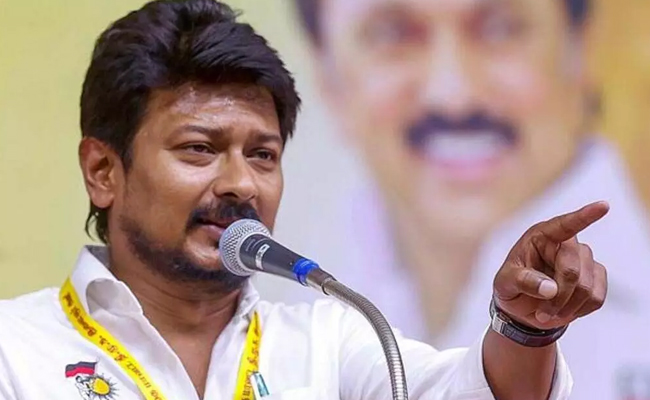
Gobichettipalayam (PTI): Tamil Nadu deputy chief minister Udhayanidhi Stalin on Saturday charged the BJP government at the Centre with not releasing funds to the state and accused it of "snatching" TN's rights.
Addressing a poll rally at Gobichettipalayam in the western Erode district, the DMK youth wing chief claimed the Centre has not released funds to the tune of Rs 3,000 crore for education.
"They (union government) have snatched all our rights," he charged.
With regard to the Centre's proposal for delimitation, he said chief minister M K Stalin was the first person in the country to raise the voice against the union government's move. He claimed that it was a "huge victory" for the INDIA alliance, as the bill was defeated for lack of majority after the opposition voted against it in the Lok Sabha.
Listing out various welfare measures implemented by the DMK government, he said the existing "Kalaignar Magalir Urimai Thogai" (monthly financial assistance for women) will be doubled to Rs 2,000 if DMK was voted to power again.
The deputy chief minister charged that the BJP and AIADMK have tried to stall it by moving the court. "At present more than 1.3 crore women have benefited from the scheme", he said.
"Similarly, the breakfast scheme for the government school students will be extended till Class VIII", he said adding "more than 35 lakh college students across the state will be getting free laptops once the DMK government is formed".
Udhayanidhi also pointed out at the "Illatharasi" poll promise, providing Rs 8,000 worth of coupons to non-income tax paying women where they could buy or replace any household appliances of their choice.
Elections to 234 Assembly seats in Tamil Nadu will be held on April 23 and the results declared on May 4 following counting of polled votes.