Must not allow communal exclusion in Karnataka: Kiran Mazumdar-Shaw
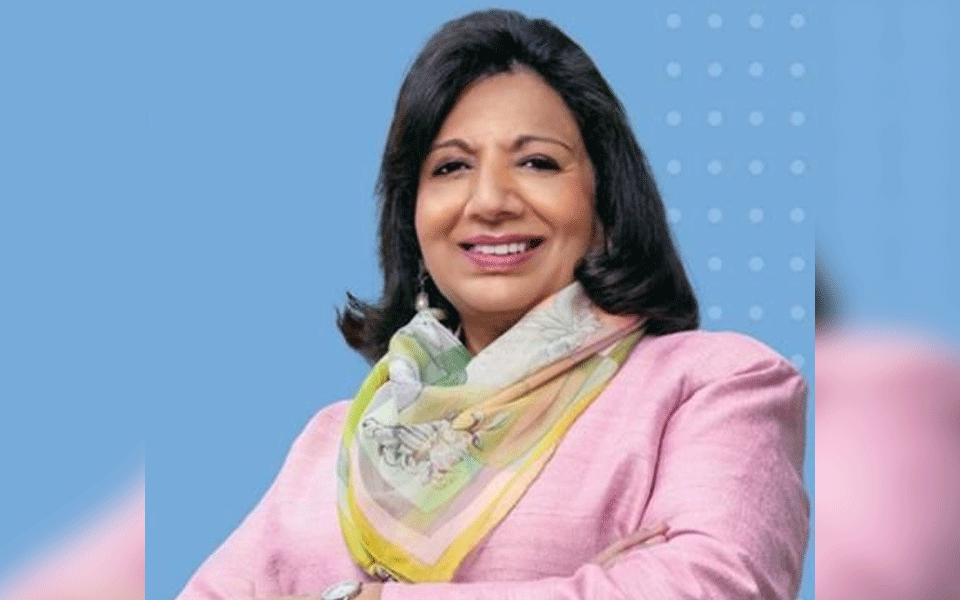
Bengaluru(PTI): With Biocon chief Kiran Mazumdar-Shaw requesting him to resolve "growing religious divide" in Karnataka, Chief Minister Basavaraj Bommai on Thursday called upon all sections of society to observe restraint before going public on social issues, as they can be resolved through discussions.
He said Karnataka is known for peace and progress and sought cooperation from everyone in maintaining it, as Mazumdar-Shaw, while pointing out that the State has always forged inclusive economic development, expressed worry that if IT/ BT sectors became communal it would destroy its global leadership.
"Karnataka has always forged inclusive economic development and we must not allow such communal exclusion- If ITBT became communal it would destroy our global leadership. @BSBommai please resolve this growing religious divide," she said.
Her tweet was in response to incidents of denial of permission to non-Hindu traders and vendors to carry on business around temples during annual temple fairs and religious events in some parts of the state.
Responding to a question on the tweet, Bommai said, "Several issues have come up for discussion in the State, the issue on uniform for students has been decided by the High Court. On other issues my appeal to those concerned is that we have been leading our lives all these years, based on our beliefs. Everyone should cooperate in maintaining peace and order."
"Karnataka is known for peace and progress, and every one should observe restraint and see to it that it is not affected. When social issues arise, there is a possibility for us to discuss and resolve it.
So before going public, everyone should observe restraint," he added.
Initially, banners were placed during the annual Kaup Marigudi festival in Udupi district, which said non-Hindu vendors and traders should not be allowed entry, and the temple management paid heed to the request of certain pro-Hindu organisations.
Later, similar banners were displayed at Padubidri temple festival also, and at a couple of temples in Dakshina Kannada district as well.
When the matter came up in the Legislative Assembly recently, the BJP government sought to distance itself from it by citing a rule which states that no property, including land, building near the place of worship shall be leased to non-Hindus.
Also, recently some right-wing groups have given a call to boycott halal meat, ahead of 'varshadodaku', the day after Ugadi when many communities in the state have a non-vegetarian feast.
BJP national general secretary C T Ravi on Tuesday called halal food "economic jihad".
Karnataka has always forged inclusive economic development and we must not allow such communal exclusion- If ITBT became communal it would destroy our global leadership. @BSBommai please resolve this growing religious divide🙏 https://t.co/0PINcbUtwG
— Kiran Mazumdar-Shaw (@kiranshaw) March 30, 2022
Let the Truth be known. If you read VB and like VB, please be a VB Supporter and Help us deliver the Truth to one and all.
Two arrested in K'taka for assaulting minors, uploading CSAM content

Bengaluru (PTI): Two men were arrested for allegedly sexually assaulting two minor girls, recording the acts on mobile phones and uploading the videos online as child sexual abuse material, police said on Thursday.
The accused have been identified as Kiran Kumar (29), hailing from Chitradurga district, and Aditya M K (20), hailing from Shivamogga district, they said.
A probe was initiated after information was received from the NCRP portal regarding a suspected instance of creation of Child Sexual Abuse Material (CSAM) for online dissemination, police said.
Accordingly, a case was registered at Kaggalipura Police Station under relevant sections of the IT Act on May 10, they added.
Investigation revealed that two minor girl victims were exploited and videos were created and uploaded to the internet. The child victims have subsequently recorded their statements as per procedure and further necessary legal steps have been taken, Pronab Mohanty Director General of Police, Cyber Command, said in a statement.
Based on the statements of the victims, the accused persons, who allegedly assaulted the minors, recorded the acts on mobile phones and uploaded the videos online, were arrested, he said.
Following the probe, sections 65(2) (rape) and 70 (gangrape) of the Bharatiya Nyaya Sanhita, along with relevant sections of the POCSO Act, have been added to the FIR, police said.
Officials collected relevant information and on May 12, arrested the accused persons and seized three mobile phones belonging to them, in which the videos had allegedly been recorded, he said.
The accused were later produced before the court and taken into police custody for further investigation, he added.
According to him, in CSAM cases, police usually apprehend offenders who have downloaded such content or have kept them in their possession after obtaining them from elsewhere, usually the internet.
"The present case is one of the very few instances where content creators and uploaders have been apprehended," Mohanty added.