"Naavu Bharateeyaru" writes to Karnataka CM seeking exit from 'authoritarian lockdown' on May 3
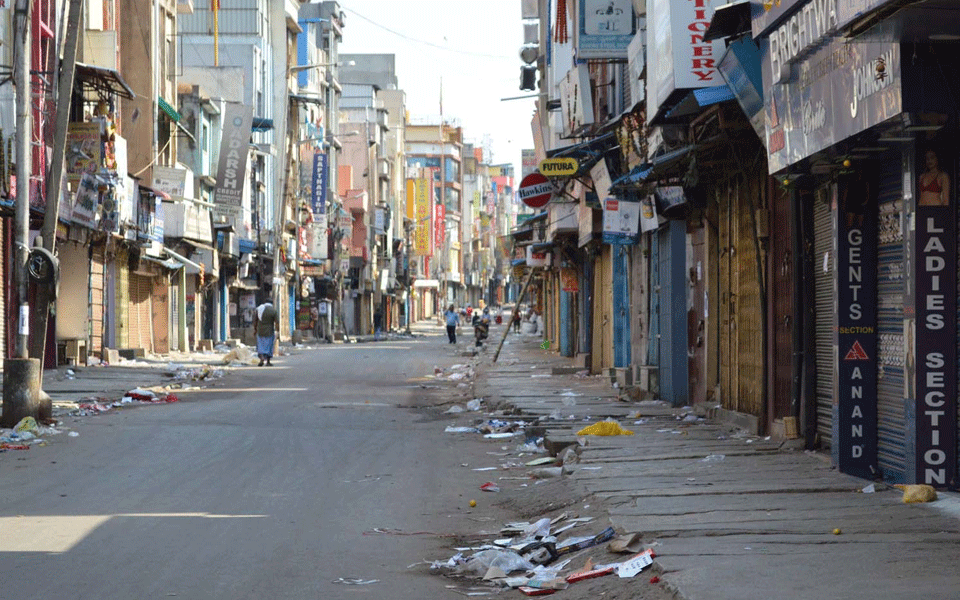
Naavu Bharateeyaru, a social welfare coalition working with various slum communities, workers unions, transgender communities and minority community members in Bangalore has written to Karnataka Chief Minister demanding an exit from the lockdown from May 03 in a manner that minimises economic and social distress, while being based on sound public health guidelines without violating human rights.
Naavu Bharateeyaru has been engaged in relief distribution, especially amongst migrant workers and other marginalized groups.
“Broad consultations must happen now to secure livelihoods, food security and address other needs of marginalsied communities Government must answer about what has been achieved in the lockdown, about how much our health systems preparation has improved” a press release from the organisation added.
“After a month of lockdown, India has now recorded 25,000 plus cases, and continuously seeing newer challenges in tackling the virus in the past few days. In Dharavi in Mumbai, there are 200 plus Covid confirmed positive cases and 3000 contacts.In a workers cluster in Hongasandra Bangalore, a person with no travel or contact history tested positive and there are 9 people who have further tested positive after being in contact with him. More than 150 people live in close proximity there. In India, a majority of people either live in close proximity in places similar to Dharavi and the migrant works sheds or they live with distancing like in our villages. The lockdown seems to have helped neither groups and has in fact adversely affected people living in slums, all informal sector workers, farmers and farm workers in several ways” the press release stated.
“Recent media reports1 have shown that the nations’s top scientists, who are part of the National Task force on Covid19 had published a paper which advised “community and civil-society led self-quarantine and selfmonitoring,” rather than a lockdown. One of the scientists is also quoted as “In Indian conditions such a lockdown provides social isolation for only the rich who live in less dense and high-floor space areas.. But, for the poor, without high levels of door-to-door screening and the fastest possible quarantining of those found positive, a lockdown will only help the virus spread intra-community.
“Why then did we choose an authoritarian response like a strict lock-down? We need an answer for this question” it questioned.
“The ICMRs internal studies state that the lockdown, in reality,, would likely reduce cases by only 20-25%. One of the primary purposes of a planned and strategic lockdown is to strengthen the health system to face the pandemic. During this lockdown, not only have there been no significant efforts to prepare the health system, but there have been several negative consequences of the lockdown itself which the government doesn’t seem to have anticipated or addressed. Decisions to set up quarantine centres or create containment zones have to be made on sound basis, with full participation of the affected persons and with minimum inconveniences. However, the extreme difficulties that people have been subjected to in quarantine centres and in containment zones such as Padarayanpura, means these basic principles have not been followed by the government.) The fact that the infection is seen in Anganwadi workers, health workers and the police suggests that PPE has been less than adequate and that community spread has occurred” it added.
The release further added the government claims to have flattened the curve and attributes this to the authoritarian lockdown that is now in place. However, we have not had adequate testing for several reasons (lack of equippment, trained manpower, laboratories, budget etc). It is also not clear whether the proper criteria are being used to identify people as contacts or arbitrary methods are being used. The government has also not clarified if the tests are based on number of samples or individuals which would affect the denominator and positivity rates. Also it is well known that when there is stigma and discrimination in infections of this nature, people with symptoms or contact/travel history may not approach a health system
Press release:
Relief measures need better implementation to show results
In a country where 90% of the jobs are in the informal sector, where a majority of the poor live in rented houses, the lockdown has hit people very hard. People have had no money to buy food. In the coming months they may have no pay to rent, for medicines, travel for education.
What we must note is also that the relief measures announced by the state and central governments have come late and many, including the most vulnerable, are excluded from them. These relief measures are still largely inadequate to duly address the food crisis in the country. For instance only 15% of the poor households have received the 1kg of Dal promised in the Central Covid welfare package2 and in Karnataka there was absolutely no Dal distributed under the PDS. It was announced that farmers and faming activity or movement of goods would not be hindered, but in reality as a report by SSER shows, the amount of goods coming to the mandis has sharply dropped, we continue to hear of farmers unable to sell produce. The government issued a advisory that no one should be laid off or should have their pay cut but we are hearing of lay offs across the country. Milk is distributed irregularly and there are reports of discrimination being practiced. It is of concern that communities and families that are traditionally accustomed to eating meat, poultry, eggs are not even able to access it either for less availability or out of economic hardship
There have been several instances of violations on both Covid suspect and non Covid patients. While the former are denied admission on the pretext that the hospital doesn’t treat Covid positive patients, many others are being turned away on the pretext that they don’t treat non Covid patients. With absence of public transport, sick patients have been left completely in the lurch. At this crucial time, the private hospitals are not pulling the weight and contributing in any substantial way to this crisis. Self-employed people like weavers, street vendors have had no relief measures announced for them nor have been allowed to work. There has been no statement of support from the government for women facing domestic violence at home, children facing abuse, the transgender community, sex workers etc who have been made even more vulnerable by this lockdown. For migrant workers, the relief provided has been inadequate. There are still people in Bangalore who have not received ration kits. Now, the centre has announced a Standard Operating Procedure for Migrant workers which states that they will not be allowed to leave the state and that they may be made to work in a job which the state suggests! Which means that even post the lockdown they will be locked down in complete violation of their rights.
Change in Approach required
An extension of the lockdown will be futile and will worsen the living condition of crores of Indians. We cannot have any more extension of the lockdown. We insist that the social and economic consequences of continuing such blanket measures are too high and cannot be justified.
Further, the centralized, lockdown as a strategy along with instructions to police to maintain it any cost, the rampant communalization seem to have created an approach which both stigmatized people who are Covid positive as well as their contacts and treated the whole pandemic as a law and order issue rather than a public health crisis. This for instance has meant that those who have respiratory issues (who may have covid) have been reluctant to reach hospitals/ have not been able to reach hospitals so we may have missed many cases. It has also resulted in a scenario like Padarayanapura where the sealdown instead of containing the contamination resulted in a series of events which even took the virus to the neighboring district
In this pandemic, efforts by the government have to factor in the needs of all rather than a select few. Assuming community spread has occurred, the strategies have to look at mitigation rather than lockdown. Containment and quarantine should not be done in a punitive or authoritarian manner. The public health system has to be strengthened by identifying all the gaps that have been exposed during this lockdown and the private health sector has to be held accountable for their role during the pandemic
Demands
1)We demand that we exit from the lockdown from May 03 in a manner that minimises economic and social distress, while being based on sound public health guidelines without violating human rights.
2)Before finalizing the exit strategy, the government must hold wide consultations with civil society, especially those representing marginal communities such as farmers, workers unions, women’s groups, transgender persons groups, Adivasi and Dalit groups etc. An all party discussion must also be held and suggestions sought from ULBs and panchayats. A committee of multi-disciplinary experts who work on epidemics and marginalized communities must be formed to take the decision .
3)We ask that the governments actually speak to people and ask what is it they require, that every vulnerable section is mapped and specific strategies mapped out for each of them.
4)Government must support both NFSA and non-NFSA beneficiaries with 10kgs of grain, dal 1.5 kg and 800 gm edible oil per person per month, for the next six months (i.e. until September) at the very least. We need a food security plan that addresses how al families can access nutritious food including meat, milk, eggs vegetables over the next few months.
5)We reject the central government’s Stantard Operating procedure for Migrants. We need a Migrant worker action plan that looks at all needs of migrant workers – Those Migrant workers who chose to go back home must be allowed to go back home and supported; those who chose to stay back must be given support to pursue thieve livelihoods of choice.
6)We need a sound health strategy that must be made in consultation and in tune with what the WHO said - "The Strategic Preparedness and Response Plan for COVID-19 aims to slow and stop transmission, prevent outbreaks and delay spread; provide optimized care for all patients, especially the seriously ill; minimize the impact of the epidemic on health systems, social services and economic activity
7)All families must be provided a onetime grant of Rs.9600 to tide over the immediate crisis
8)There must be a committee which looks into the concerns of livelihoods in the informal sector and how these will be secured in the months to come ; Separately a committee on rural distress must be set-up as well.
9) Government must take over private hospitals for the duration of the pandemic
10)A special package must be announced for rural areas which allows villages to absorb returning migrant workers and provide for them; revive agriculture, weaving and other aspects of rural economy
The government has to proactively issue statements about what actions it has undertaken so that trust can be built and we can tackle this pandemic together.
Let the Truth be known. If you read VB and like VB, please be a VB Supporter and Help us deliver the Truth to one and all.
One killed, 30 injured as KSRTC bus overturns in Davanagere
Davanagere: A KSRTC bus overturned on Friday near Marabanahalli in Channagiri taluk, leaving a college student dead and around 30 passengers injured, Deccan Herald reported.
The deceased has been identified as Darshan (21), a resident of Kundur village in Honnali taluk.
Seven of the injured are in critical condition and are undergoing treatment at a government hospital in Basavapatna.
According to preliminary information, the bus travelling from Davanagere to Basavapatna lost control after a mechanical failure involving the axle, leading to the accident.
Most of the injured passengers are students and women.
Locals and police rushed to the spot and carried out rescue operations. The injured were rushed to Basavapatna Government Hospital and Davanagere District Hospital via ambulances and private vehicles.