New study warns of water crisis in 80 B'luru wards by Feb 2025, expected to escalate in March-April

Bengaluru: A new study has raised alarms over a looming water crisis in over 80 wards in Bengaluru, especially in its peripheral areas, including K R Puram and Mahadevapura.
The study, conducted by the Bangalore Water Supply and Sewerage Board (BWSSB) in collaboration with the Indian Institute of Science (IISc) and cited by Deccan Herald on Tuesday, revealed that groundwater levels are set to decline as early as February 2025, with conditions expected to worsen further in March and April.
It mentioned that 110 villages located beyond the Outer Ring Road (ORR) are projected to experience a significant drop of 20 to 25 meters in groundwater levels. Although areas within the ORR will also be impacted, they rely less on groundwater due to a more stable supply of piped water.
The 80 wards most at risk depend heavily on borewells to meet their water needs, drawing approximately 800 million litres of water daily. This is due to the BWSSB’s incomplete water distribution network in these regions.
Few of the critical wards include Konankunte, T Dasarahalli, V Nagenahalli, Horamavu, Ramamurthy Nagar, Kammanahalli, Kadugondanahalli and Jakkur.
The urgency of the situation follows last year’s harsh summer, which highlighted the city's growing water scarcity challenges. In response, the BWSSB established a special task force consisting of IISc scientists and officials from both state and central groundwater development departments, DH stated.
Over the course of six months, the task force analysed water supply data and groundwater levels to develop a sustainable action plan to address the crisis.
BWSSB Chairman Dr Ram Prasath Manohar emphasised the importance of reducing reliance on borewells, especially in high-risk wards, and encouraged residents to switch to Cauvery water connections. He mentioned the increased availability of water under the Cauvery Stage V project, DH added.
However, despite these efforts, residents in some areas are still without Cauvery connections due to the lack of feeder and sub-feeder lines.
Let the Truth be known. If you read VB and like VB, please be a VB Supporter and Help us deliver the Truth to one and all.
TMC backs 'tukde-tukde' gang that threatened to snap Siliguri Corridor for appeasement politics: PM
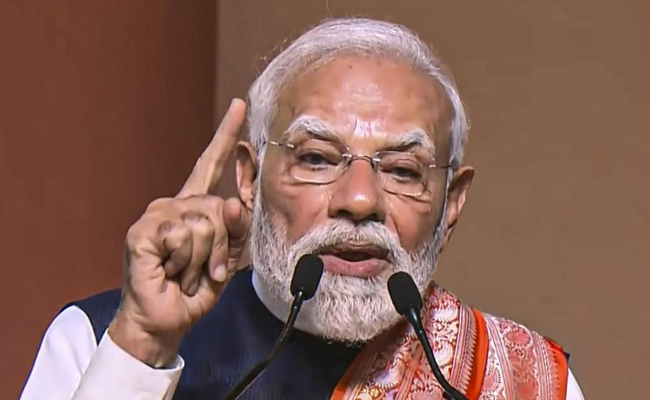
Siliguri (PTI): Prime Minister Narendra Modi on Sunday alleged the "tukde-tukde" gang had threatened to snap the strategic Siliguri Corridor to cut off the Northeast from the rest of the country, and the TMC gave them support from "the streets to Parliament" to serve its "appeasement politics".
Addressing an election rally at the Kawakhali ground in the northern West Bengal city of Siliguri, he described the TMC as an "anti-tribal, anti-women and anti-youth party".
Its appeasement politics have caused untold misery to the state, Modi alleged.
"The country has a 'tukde-tukde' gang, and it threatened to cut off the Siliguri Corridor. They wanted to separate the Northeast from the country.
"The TMC, which indulges in appeasement politics, supports such people from the streets to Parliament. That is the real face of TMC," he alleged, addressing his eighth rally in the state since assembly elections were declared.
The Siliguri Corridor, also known as the 'Chicken's Neck', is a narrow stretch of land in the northern part of Bengal, not more than 20-22 km wide, acting as the only land link between mainland India and its eight northeastern states.
It is a critical and highly vulnerable geopolitical bottleneck bordered by Bangladesh, Nepal, Bhutan, and is barely 130 km from the China border.
Terming it "the nation's corridor of defence as well as prosperity", Modi said the Centre was working round the clock to strengthen and develop the region on a massive scale, citing the under-construction Sevoke-Rangpo railway line, connecting Sikkim with Siliguri.
"The project will strengthen trade and tourism in the region, directly benefiting the youth of Darjeeling," he said.
Urging people to vote for a 'double-engine' government, Modi said Bengal will witness development at double the speed once the BJP assumes power in the state.
Harping on the TMC's "appeasement politics", the PM alleged that while the Mamata Banerjee government has earmarked Rs 6,000 crore in the state budget for the development of Madrassas, the fund allotted for the entire north Bengal region is "nowhere sufficient".
"The people of Bengal are now seeking answers from the TMC for every moment it spent in power over the last 15 years," Modi said, asserting that when the BJP comes to power, it will make the Mamata Banerjee-led party "pay for its misdeeds".
He alleged that the TMC has destroyed the state during its 15-year tenure and halted the implementation of Central schemes like the one for providing piped drinking water to remote tribal areas.
As a result, less than 25 per cent of the work could be completed so far, the prime minister claimed.
Terming the Mamata Banerjee government 'nirmam' (cruel), an obvious antonym to the chief minister's name, the PM said the people of the state have had enough of the TMC's "reign of fear", accusing its dispensation of bringing sufferings to the fledgling tea gardens of north Bengal.
Modi called the TMC an "anti-north Bengal and anti-tea garden party", and alleged that unbridled illegal entries caused by its "appeasement policies" are causing major demographic changes in the region, disrupting social balance and fostering unwanted changes in language and culture.
"Infiltrators are eating into local jobs. It will be too late if the menace is not stopped right away. That's why mantra is 'Kamal khilao, ghuspetia bhagao' (vote for lotus and drive infiltrators away)," he said, referring to the BJP's election symbol.
The PM highlighted the Centre's infrastructure and connectivity development initiatives for north Bengal, while alleging that the TMC government is putting up hurdles before those projects.
"A crucial stretch of the Porbandar to Silchar East-West corridor passing through Bengal is yet to be completed," he said,
Modi also underlined the BJP's promises of a special development package for north Bengal, which comprises modern engineering and medical colleges, a cancer treatment hospital and a fashion design institute.
While stating that Bengal has already given the Congress, the Left and the TMC chances to rule the state, Modi urged the people to give the BJP an opportunity to "revive its development trajectory".
"Give Modi a chance to ensure the security of the daughters, to save Bengal from infiltrators and to provide jobs to youth within the state.
"Give Modi a chance to resurrect investment, establish the rule of law, to ensure free healthcare and homes for the poor, to elevate the state from a rule of fear to a climate of trust and rescue Bengal's culture from the TMC's appeasement politics," the PM said.
Modi said the energy he had been witnessing among the people of Bengal has convinced him that the TMC's defeat is certain in the upcoming elections.
"My short travel from the Badgodra airport to the hotel on Saturday ended up becoming a 15-km roadshow as thousands of people, including children and senior citizens, lined up. It blew my mind and humbled me," he said.
"As a return gift to the blessings you have showered on me, I promise to dedicate my life to you and will keep fighting for you till my last breath," he said.
The PM was campaigning for BJP candidates in Jalpaiguri, Darjeeling and Kalimpong districts, where polling will be held in the first phase on April 23. The second phase of polling is on April 29, and the votes will be counted on May 4.